
Introduction
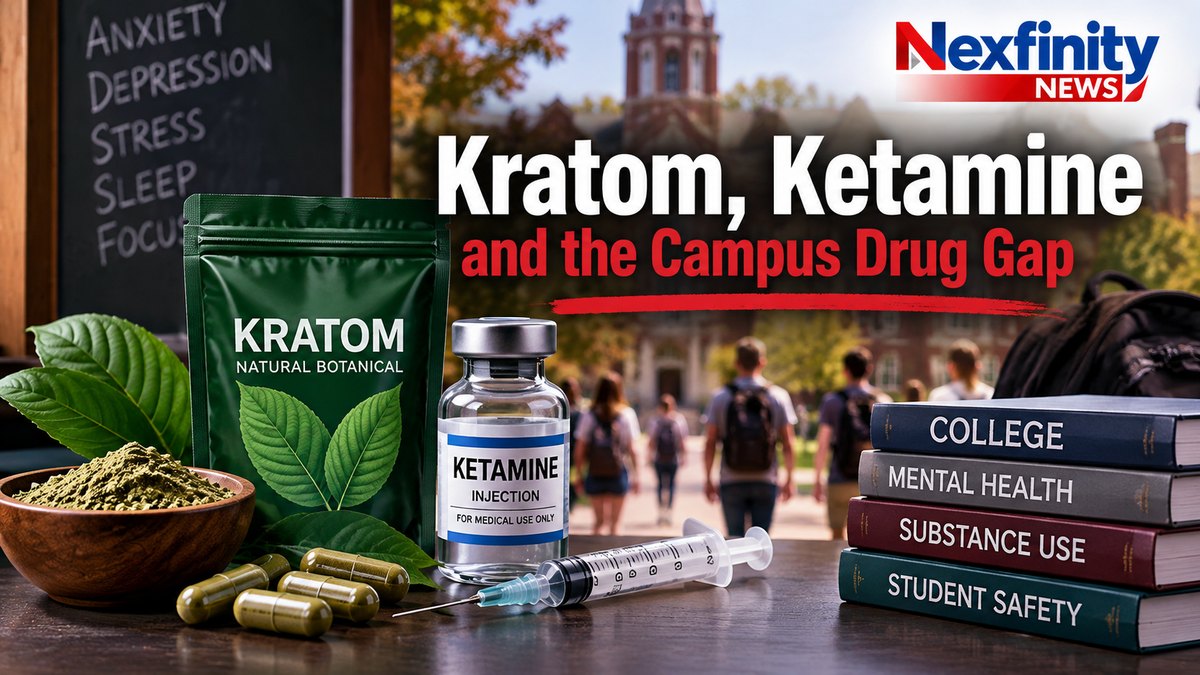
Two college stories have dominated campus news this fall, and both have been described as drug stories. They involve two different drugs.
At the University of Mississippi, two students died on Sept. 21, 2026, in separate incidents. Kratom-derived pills were found at both scenes. Court records disclosed at an Oct. 9 federal hearing say toxicology found the same three kratom-related compounds in both students. Two of those compounds had been federal Schedule I drugs since Aug. 26.
At Cornell University, a former student has sued the school and seven former classmates. She alleges she was pressured into taking ketamine and then sexually assaulted at a fraternity house in October 2024. The accused dispute her account. New York’s attorney general is now the special prosecutor.
The two drugs are often confused. They should not be. Kratom and its concentrated derivative, 7-OH, have been sold openly in gas stations and smoke shops. Ketamine is a controlled anesthetic that has never been legal to sell at retail. That difference is the center of this story: one of these products reached students through a storefront, and regulators took years to act on it.
Background: What Happened
Ole Miss: two deaths, a banned product
Aidan Hamilton, 18, a freshman from Englewood, Colo., and Robert Strang, 20, a junior from Atlanta, died on Sept. 21 in separate incidents, one on campus and one off. Investigators found packaged kratom-derived pills at both scenes.
Federal prosecutors have charged two employees of a local vape shop with possession with intent to distribute controlled substances. They are not charged with causing either death, and a complaint contains only allegations. The Justice Department said both deaths appeared consistent with drug overdoses and noted that kratom derivatives such as MGPI, MGM-15 and MGM-16 have been called “gas station heroin.”
Official causes of death have not been released. Court records discussed at an Oct. 9 hearing, reported by Action News 5, say toxicology found the same three kratom-related compounds in both students: mitragynine, MGM-15 and MGPI. The case is ongoing.
In simple terms: two students died with the same kratom-derived compounds in their systems, two of which had been federally banned weeks earlier. How those compounds contributed to the deaths has not been officially determined.
Cornell: ketamine in a contested account
A former student sued Cornell and seven former classmates on Sept. 16, 2026. She alleges she was pressured into taking ketamine, along with alcohol and marijuana, and then sexually assaulted at a fraternity house in October 2024, the AP reported. The accused dispute her account, and the university’s own disciplinary process reached mixed findings.
The Tompkins County district attorney originally closed the case without charges. On Oct. 1, Gov. Kathy Hochul issued an executive order naming Attorney General Letitia James special prosecutor. No one has been criminally charged.
Public reporting has not established where the ketamine came from. Nothing in the record links it to a retail store.
The Natural Leaf, the Smoke-Shop Pill, and the Anesthetic
There is no “natural” ketamine. Ketamine is a synthetic anesthetic used in hospitals and veterinary practice. The natural-versus-packaged split that shoppers encounter belongs to kratom.
Botanical kratom comes from the leaves of Mitragyna speciosa, a tree native to Southeast Asia. It is sold as leaf, powder and capsules. Its main active alkaloid, mitragynine, acts on the brain’s opioid receptors. At low doses it acts as a stimulant; at higher doses, a sedative.
7-OH (7-hydroxymitragynine) occurs in the leaf only in trace amounts. Manufacturers make it by chemically converting mitragynine, then press it into tablets, gummies and shots. It emerged on the U.S. market in late 2023. The FDA said in 2025 that 7-OH is several times as potent as morphine.
In simple terms: leaf kratom is a plant product; 7-OH is a lab-concentrated opioid-like compound sold under the kratom name.
Even the kratom industry draws that line. The American Kratom Association supported DEA action against 7-OH, arguing that chemically manipulated products are not kratom.
| Botanical kratom | 7-OH products | Ketamine | |
| Origin | Plant leaf | Semi-synthetic, made from kratom alkaloids | Fully synthetic |
| Typical form | Leaf, powder, capsules | Tablets, gummies, shots | Hospital injectable; illicit powder |
| How it acts | Opioid receptors; stimulant to sedative | Opioid receptors; far more potent | Dissociative anesthetic |
| Federal status (Oct. 2026) | Not federally controlled | Proposed Schedule I, still pending | Schedule III |
| Legal retail sale | Yes, where state law allows | Banned in some states; related analogs now Schedule I | Never |
| Campus case | — | Ole Miss | Cornell |
Ketamine’s risks are different. It produces detachment, dizziness and, at high doses, unconsciousness. NYU researcher Joseph Palamar has noted that most illicit ketamine today is not pharmaceutical grade and is sold as powder, raising the risk it contains other drugs such as fentanyl.
Policy: What Is Legal Right Now
As of Oct. 12, 2026, three 7-OH-related compounds are federal Schedule I drugs, but 7-OH itself is not yet.
On July 1, 2026, the DEA announced two notices of intent to temporarily place 7-OH and three related substances in Schedule I. Both were published in the Federal Register on July 6. The proposed threshold for 7-OH is 0.05% for the plant, or 0.05% or 1 milligram for extracts, pills and edibles.
The two notices then split:
- Mitragynine pseudoindoxyl, MGM-15 and MGM-16 were placed in Schedule I by a temporary order effective Aug. 26, 2026, running through Aug. 26, 2028.
- 7-OH above the threshold (docket DEA-1570) remained a pending notice. The DEA reopened public comment, with comments due Sept. 10, 2026, per the same analysis and Michigan Medicine.
In simple terms: a pill containing only 7-OH may still be federally legal today in states that have not banned it. A pill listing one of the three analogs is now a Schedule I product.
Botanical kratom below the threshold is not covered by either action. Congress has a bill to make the split permanent: the END 7-OH Act, H.R. 8000, introduced by Rep. Gus Bilirakis (R-Fla.) on March 19, 2026, remains in committee.
State and local rules fill the gap unevenly. Eleven states have banned kratom, the AP reports, and about half regulate or restrict it. Mississippi’s House Bill 1077, signed in April 2025, set a 21-and-over purchase age and outlawed more potent forms effective July 1, 2025. More than 30 Mississippi cities and counties go further, and Oxford has its own ban.
That means the pills allegedly sold in Oxford were already restricted under state law and banned under city law. Two of their listed ingredients, MGM-15 and mitragynine pseudoindoxyl, had been federal Schedule I drugs for 26 days when the students died. The law existed. The shelf still had it.
Is This an Epidemic on College Campuses?
The available data do not support calling either drug a campus epidemic. They do show both rising, and they show that no one is measuring 7-OH use among college students specifically.
| Indicator | Figure | Source |
| Kratom lifetime use, all ages | 1.6% (2021) to 1.9% (2024) | McCabe et al., Journal of Addiction Medicine, NSDUH data |
| Kratom use, adults 21–34 | ~3.4% ever; ~1% past year | Same study |
| Kratom past-30-day use, college students | 0.4% (310 of 81,513), 2019–20 | Healthy Minds Study, J. of American College Health |
| Kratom poisoning calls | Up more than 1,200%, 2015–2025 | CDC MMWR, Farah et al., March 26, 2026 |
| Ketamine past-year use, NYC nightclub attendees | 7.4% (2017) to 14.3% (2024) | Palamar et al., Lancet Regional Health – Americas |
| Illicit ketamine law enforcement seizures | Up 349%, 2017–2022 | Palamar et al., JAMA Psychiatry |
Kratom. About 1 in 100 adults aged 21 to 34 used it in the past year. Among people who had used it, more than half met criteria for a substance use disorder. The researchers stress the survey cannot show which came first. A CDC analysis of poison center data, led by University of Virginia researchers, counted 233 kratom-related deaths from 2015 to 2025, 184 of which involved other substances. Those records do not say whether a product was leaf kratom or 7-OH, so the data cannot separate the two.
Ketamine. Palamar’s team found nonmedical ketamine use rising among adults while adolescent use declines. Poisonings rose through 2023, but ketamine-related death rates did not significantly change. The sharpest growth is in nightlife settings, not general campus populations.
The gap. The only national college kratom figure predates 7-OH, which reached shelves in late 2023. There is no published national estimate of 7-OH use among students. In simple terms: the most dangerous product in this story is the one nobody is counting.
A fair reading: kratom and ketamine are low-prevalence drugs with rising trend lines. The concern is not how many students use them, but how unpredictable a concentrated retail product can be for the few who do.
What Nobody Knows: Market Size and the Research Gap
No one can say with confidence how big the kratom market is, how much 7-OH is sold, or what regular use does to the body. The numbers that circulate come mostly from paid market-research reports and from the industry’s own trade group.
How big is the market?
| Estimate | Figure | Source | Source type |
| Global kratom market, 2025 | $2.56 billion | Maximize Market Research | Commercial market-research estimate; methodology not public |
| Global kratom market, 2025 | $3.87 billion | Precedence Research | Commercial market-research estimate; methodology not public |
| Global kratom extract market, 2026 | $245 million to $269 million | Coherent Market Insights; Research and Markets | Commercial market-research estimates; methodology not public |
| U.S. kratom users | About 20 million | American Kratom Association testimony, Jan. 2025 | Industry trade group estimate |
| U.S. kratom market | More than $1 billion a year; 11 million to 15 million users | American Kratom Association, as reported in September 2021 | Industry trade group estimate, based on Indonesian import volumes; no newer dollar figure published |
| U.S. 7-OH market | No published estimate | — | — |
| Indonesian kratom exports to the U.S., 2025 | About $350 million a year; 96% of U.S. kratom supply | Indonesian Investment Minister, March 2025 | Exporting-country government figure; wholesale value, not U.S. retail sales |
Only the Indonesian export figure comes from a government, and it measures wholesale exports, not U.S. sales. Commercial reports are sold by market-research firms and do not publish their methods; the trade-group figures come from an organization that advocates for the kratom industry.
The two leading global estimates differ by more than $1.3 billion for the same year. The industry’s user count is also far above the federal survey: about 1.9% of Americans have ever used kratom under NSDUH data, which researchers put at more than 5 million people. In simple terms: the market is a billion-dollar-scale business, but its exact size depends on who is selling the estimate.
7-OH is not broken out anywhere. One person in recovery told a CBS investigative unit his habit cost roughly $200 a day, but no one has measured total sales.
Why so few studies?
Several structural reasons explain the thin research base.
- It is new. 7-OH products have been on shelves for about three years. Long-term health studies take longer than that to design, fund and publish.
- No one had to prove safety first. Kratom is not an FDA-approved drug, so no maker ran the clinical trials a drug company must. The kratom trade group itself says 7-OH products never cleared the FDA’s new dietary ingredient review.
- Surveys only recently started asking. The federal government’s main drug-use survey did not ask about kratom until 2019, when SAMHSA added two kratom questions to the National Survey on Drug Use and Health to establish a first national baseline. The University of Michigan team called its 2026 analysis the first national study tying kratom to mental health and addiction.
- Products are inconsistent. Unregulated products vary in strength from package to package, which makes it hard to compare users or link outcomes to a dose.
- Deaths are hard to attribute. Most standard drug screens do not test for kratom, and most kratom-linked deaths also involve other substances.
- Scheduling chills research. After the DEA’s 2016 attempt to schedule kratom, a leading researcher paused his lab and a private funder backed out of a human study. Schedule I research requires both DEA registration and FDA approval.
That last point creates a policy tension worth naming. Scheduling 7-OH may be the fastest way to get it off shelves, but it will also make it harder to study. Some kratom researchers have argued for Schedule II instead for that reason.
Ketamine is the opposite case: well studied as a medicine, poorly tracked as a party drug. National surveys group it with hallucinogens, and researchers note that reported use may mix medical and nonmedical use.
The Supply Chain: Who Makes It, Where It Comes From
7-OH is a domestic product made from an imported plant. Illicit ketamine is an imported or diverted drug whose current sources are poorly documented.
7-OH: imported leaf, U.S. conversion
The raw material is kratom leaf, and nearly all of it comes from Indonesia. Indonesia’s investment minister said in March 2025 that 96% of the kratom entering the United States comes from Indonesia, worth roughly $350 million a year in exports. Since 2025, Indonesian rules have allowed kratom to be exported only as processed powder, not whole leaf. Companies in the United States then chemically convert the leaf’s main alkaloid, mitragynine, into concentrated 7-OH and press it into tablets, gummies and shots.
In simple terms: the plant comes from Southeast Asia, but the potent product is made here.
The companies on the public record are there because of government action, not industry disclosure.
| Company | Location (per FDA letter) | Action | Date |
| Shaman Botanicals LLC (CBD American Shaman) | Kansas City, Mo. | FDA warning letter; Missouri AG lawsuit; settlement suspending Missouri kratom sales | Letter June 25, 2025; lawsuit announced March 31, 2026; settlement June 4, 2026 |
| Relax Relief Rejuvenate Trading LLC (RRR Trading / EDP Kratom) | Kansas City, Mo. | FDA warning letter; Missouri AG lawsuit and settlement suspending Missouri 7-OH sales; DOJ product seizure | Letter June 25, 2025; settlement June 10, 2026 |
| My Smoke Wholesale | Houston, Texas | FDA warning letter | June 25, 2025 |
| Thang Botanicals Inc. (7OHMZ) | Ojai, Calif. | FDA warning letter | June 25, 2025 |
| Royal Diamond Imports Inc. (Roxytabs.com) | Dallas, Texas | FDA warning letter | June 25, 2025 |
| Hydroxie LLC | Escondido, Calif. | FDA warning letter | June 25, 2025 |
| 7Tabz Retail LLC | Tampa, Fla. | FDA warning letter | June 25, 2025 |
All seven FDA letters are dated June 25, 2025; the agency announced them publicly on July 15, 2025.
Missouri’s attorney general describes Shaman Botanicals as the manufacturer of RRR’s 7-OH products, and its owner has said Shaman was the first company to make 7-OH products. The FDA’s letter to Shaman cites a tablet labeled “7OH + Pseudoindoxyl.” Pseudoindoxyl is one of the three compounds the DEA placed in Schedule I in August 2026.
A warning letter is not a finding of wrongdoing, and Missouri’s attorney general says neither settlement is an admission of liability. No company named here has been linked to the Ole Miss deaths.
The Ole Miss court record identifies a branded pill product, but not who manufactured or distributed it. The path from maker to wholesaler to a store counter is the least documented part of this market.
Ketamine: legal imports, illicit diversion and labs
Legal ketamine has been sold in the U.S. since the 1970s as an injectable anesthetic. The DEA notes it is imported into the United States. Federal reports have listed commercial producers in Belgium, China, Colombia, Germany, Mexico and the United States.
The illicit supply comes from three routes, according to federal and UN sources:
- Diversion and theft from legitimate sources, especially veterinary clinics, which the DEA has long described as the main U.S. source.
- Smuggling from Mexico, where pharmaceutical ketamine has been diverted and moved north; federal prosecutors indicted 20 people in one such case in 2002.
- Clandestine labs and diversion in Asia. UN drug analysts have pointed to labs in China and diverted Indian pharmaceutical output as major global sources. A 2010 DEA case on Long Island involved a ring buying kilos of powdered ketamine from a source in China.
The market has shifted from vials to powder. Palamar’s research found most illicit ketamine today is not pharmaceutical grade, which points to lab production rather than clinic theft. The DEA’s most recent fact sheet estimates about 762,000 Americans (0.3%) used ketamine in 2022.
Most federal reporting on illicit ketamine’s origins is 10 to 20 years old. The current picture of where U.S. street ketamine is made has not been published.
Analysis: Was Government Asleep at the Wheel?
On 7-OH, regulators were slow but not idle. Nearly three years passed between the product’s arrival and the first federal ban touching it, and the core compound is still not scheduled.
| Date | Action |
| 2016 | Federal regulators attempt to ban kratom; effort abandoned |
| Late 2023 | Concentrated and semi-synthetic 7-OH products reach U.S. shelves |
| April 2025 | Mississippi sets 21+ age limit, bans potent forms (effective July 1, 2025) |
| 2025 | FDA issues warning letters to 7-OH makers; product seizures follow |
| March 19, 2026 | END 7-OH Act introduced in the House; still in committee |
| July 1–6, 2026 | DEA files and publishes notices to schedule 7-OH and three analogs |
| Aug. 26, 2026 | Three analogs enter Schedule I; 7-OH notice stays pending |
| Sept. 21, 2026 | Two Ole Miss students die; kratom products found at both scenes |
| Oct. 1, 2026 | Federal charges announced against two vape shop employees |
The case that government lagged. 7-OH was sold for roughly 32 months before any federal scheduling. During that time it was marketed under the name of a plant product, sold in gas stations and vape shops, and largely unaddressed outside of state legislatures. The compound at the center of the federal action remains legal at the federal level today.
The case that it did not. Temporary scheduling is the government’s fastest tool, and the DEA used it. The statute requires an HHS consultation and a 30-day notice before an order can take effect, and temporary orders cannot be challenged in court. Mississippi acted in 2025, and Oxford banned kratom outright. Permanent scheduling through formal rulemaking routinely takes longer.
The enforcement gap. The Ole Miss case suggests the bigger failure may be on the counter, not in the statute book. State, city and federal restrictions were already in place, yet prosecutors allege the product was still being sold in a college town. Retail enforcement largely depends on local narcotics units acting after a problem surfaces.
Ketamine is a different problem. It has been a controlled substance for decades. The concern researchers raise is diversion: Palamar’s team has linked loosened pandemic-era prescribing and pop-up ketamine clinics to growing black-market supply. No retail loophole is involved.
Impact: Does a Store Shelf Signal Safety?
No national survey has directly measured whether retail availability makes consumers believe kratom or 7-OH is safe. The evidence that it might is indirect, but it points one way.
- Marketing. Kratom is sold as a remedy for pain and anxiety, next to energy drinks and vapes. Medical professionals say its effects resemble heroin and oxycodone.
- The label problem. DEA laboratory testing found commercial products often contain more 7-OH than occurs naturally in the leaf. A buyer reading “kratom” on a package has no reliable way to know which product they hold.
- Risk perception. Psychiatrists have long tied lower perceived risk to higher use. Smita Das, chair of the American Psychiatric Association’s Council on Addiction Psychiatry, made that point about youth drug use in a ketamine study discussion.
- Real users. Some adults report benefits. A retired police officer told Missouri lawmakers that 7-OH gave him a quality of life after he could not take standard pain relievers.
Sellers may understand the risk better than buyers. In the Ole Miss case, prosecutors allege a store clerk warned an undercover buyer that the pills were dangerous and sold them anyway.
In simple terms: a product sold beside gum and energy drinks looks ordinary. The DEA describes 7-OH’s effects as highly unpredictable. Those two facts sit on the same shelf.
Ketamine carries no such retail signal. Its public image comes from a different place: FDA-approved esketamine for depression and growing clinical use. Palamar has cautioned that a drug working in a clinic does not describe how most people use it.
Conclusion
The Ole Miss and Cornell cases are being discussed together, but they raise different questions. Cornell is a question about a criminal investigation, a university’s process and a controlled drug obtained outside any store. Ole Miss is a question about what a college town’s vape shop was allowed, or able, to sell.
The retail question is the one policymakers can act on. Federal, state and local law had already moved against concentrated kratom products by September. What remains unsettled is 7-OH itself, the threshold that separates it from the leaf, and who checks the counter.
Court records indicate both Ole Miss students had the same kratom-derived compounds in their systems, two of them federally banned weeks earlier. Official causes of death have not been released, and the criminal case is at an early stage. What the case already shows is the distance between a ban on paper and a product on the shelf.
Key Takeaways
- The Ole Miss deaths involve kratom-derived pills, not ketamine. Court records say both students had mitragynine, MGM-15 and MGPI in their systems; official causes of death have not been released.
- “Natural” kratom leaf and concentrated 7-OH are different products. 7-OH is a lab-made, far more potent opioid-like compound.
- Three 7-OH-related analogs, including two found in both students, became Schedule I on Aug. 26, 2026. 7-OH itself remains a pending federal action.
- Ketamine is a Schedule III anesthetic and is not sold at retail. Its illicit supply comes largely from diversion and black-market powder.
- Survey data show both drugs rising but used by about 1% or less of young adults. There is no national data on 7-OH use by college students.
If You or Someone You Know Needs Help
- SAMHSA National Helpline: 1-800-662-4357 (free, confidential, 24/7)
- 988 Suicide & Crisis Lifeline: call or text 988
- RAINN National Sexual Assault Hotline: 1-800-656-4673
- Poison Help Line: 1-800-222-1222
- Naloxone (Narcan) is available without a prescription and can reverse a 7-OH overdose because 7-OH acts on opioid receptors, according to public health guidance. It may not fully reverse an overdose if other drugs or alcohol are involved. Call 911 in any suspected overdose and give naloxone if available.
Related Coverage
- Trump Order Clears Path for U.S. Ibogaine Trials
- The FDA’s Drug-Ad Rule Would Cost Television Billions. The Coverage Hasn’t Mentioned It.
- Am I Crazy, Or Is This Backwards?
Sources
Government and primary documents
- DEA: Intent to temporarily schedule 7-OH and related substances (July 1, 2026)
- U.S. Attorney, N.D. Mississippi: Criminal complaint announcement (Oct. 1, 2026)
- CDC MMWR: Increases in Kratom-Related Reports to Poison Centers, 2015–2025 (March 26, 2026)
- FDA: Warning letters to firms marketing 7-OH products (July 15, 2025)
- FDA warning letters, June 25, 2025: Shaman Botanicals, Relax Relief Rejuvenate Trading, My Smoke Wholesale, Thang Botanicals, Royal Diamond Imports, Hydroxie, 7Tabz Retail
- Missouri Attorney General: American Shaman settlement (June 4, 2026)
- Missouri Attorney General: RRR settlement (June 10, 2026)
- SAMHSA: 2019 NSDUH kratom questions, Federal Register (Oct. 5, 2018)
- Kansas Department of Health and Environment: 7-OH advisory
- DEA Diversion Control: Ketamine drug fact sheet
- DEA: Ketamine fact sheet (current edition)
- National Drug Intelligence Center: Ketamine intelligence bulletin
- DEA New York: Suffolk County ketamine ring arrests (2010)
- American Kratom Association testimony to the North Dakota Legislature (Jan. 13, 2025)
Research
- McCabe et al., Journal of Addiction Medicine: national kratom use study (University of Michigan)
- Parent et al., Journal of American College Health: kratom use among U.S. college students
- Palamar et al., Lancet Regional Health – Americas: ketamine trends
- Palamar et al., JAMA Psychiatry: ketamine seizures (HealthDay summary)
- Psychiatric News: ketamine use and youth depression
Legal and policy analysis
- Vicente LLP: Three kratom-related substances placed in Schedule I; 7-OH pending
- Drug Policy Facts: DEA 7-OH thresholds (summarizing CRS LSB11457)
- Legis1: The END 7-OH Act and DEA action
- Michigan Medicine: 7-OH and kratom availability and addiction care
News reporting
- Gray News/WCAX: Ole Miss students identified
- Action News 5: Toxicology findings disclosed in federal court (Oct. 9, 2026)
- Associated Press via AJC: Cornell investigation documents
- UPI: Hochul names Letitia James special prosecutor
- Associated Press via WFTV: state kratom bans
- Mississippi Today: Mississippi’s 21-and-over kratom law
- Missouri Independent: Missouri AG investigation of 7-OH makers
- SC Daily Gazette: Kratom and 7-OH under state and federal scrutiny
- Columbia Missourian: Missouri 7-OH bill hearing
- CBS12/Spotlight on America: 7-OH still sold over the counter
- HMP Global: Kratom research needs
- Vice: Kratom scheduling and research
- Vice: Ketamine labs in China
- Antara News: Indonesia kratom export rules
- Investortrust: Indonesia’s share of U.S. kratom imports
- South China Morning Post: AKA market estimate (September 2021)
- Newswise: National kratom use estimate
- Fortune/EZ Newswire: American Kratom Association statement
- Fortune/EZ Newswire: SABER statement
- Nutritional Outlook: DEA action and AKA position
Market estimates (commercial)