
At a Glance
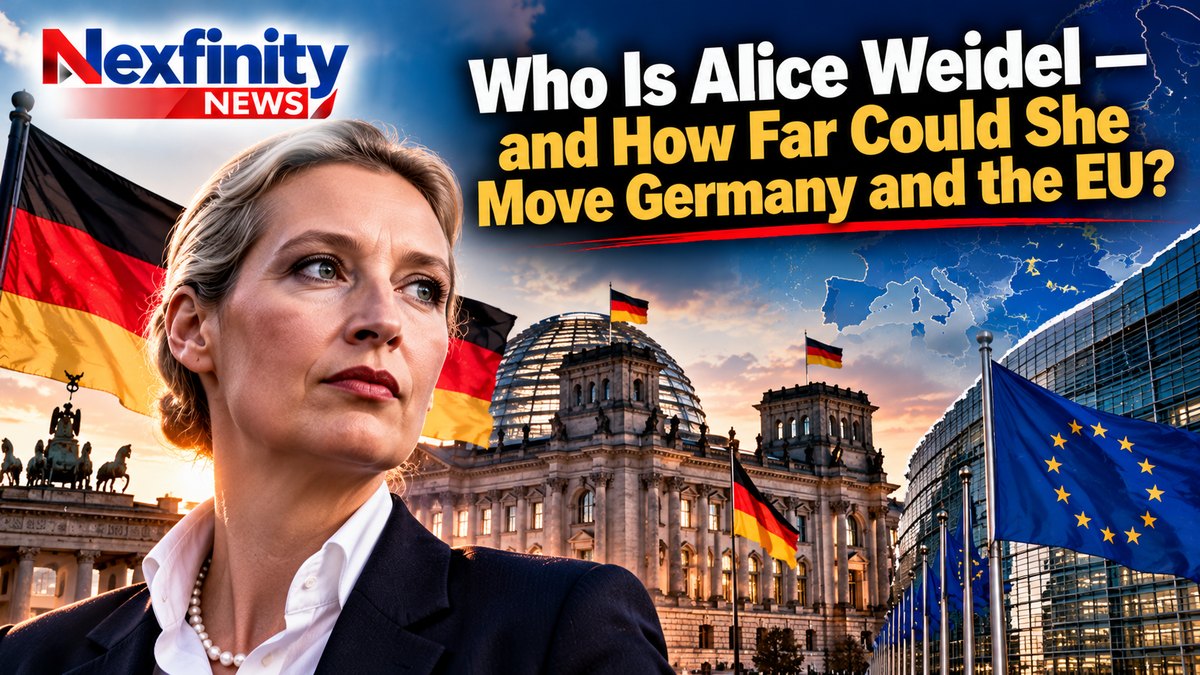
Alice Weidel (born 1979) is co-leader of the Alternative for Germany (AfD) and was its first candidate for chancellor, in 2025. As of Oct. 18, 2026, the AfD leads Germany’s national polls at about 28%, after winning the most votes in the Saxony-Anhalt and Mecklenburg-Western Pomerania state elections in September 2026. It governs no state, because every other major party refuses to form a coalition with it. Weidel’s program would sharply restrict migration, end German aid to Ukraine, resume Russian energy imports, and shrink the EU into a looser association of nations, with leaving the EU kept as a fallback.
Intro
For most of the postwar era, the far right sat outside the center of German politics. In October 2026, the party furthest to the right in the Bundestag leads every major national poll.
That party is the Alternative for Germany (AfD), and its most visible face is Alice Weidel, a 47-year-old former Goldman Sachs analyst who co-chairs the party and led it to second place in the February 2025 federal election.
As of Oct. 18, the PolitPro polling average puts the AfD at 27.7%, roughly eight points ahead of Chancellor Friedrich Merz’s CDU/CSU at 19.5%. The most recent INSA survey, dated Oct. 16, shows an 11-point gap (29% to 18%).
This article explains who Weidel is, what her party proposes for Germany and the European Union, and the legal and political limits that still stand between the AfD and national power.
Background: Who Is Alice Weidel?
Weidel was born Feb. 6, 1979, in Gütersloh, North Rhine-Westphalia. She studied economics at the University of Bayreuth, then worked as an analyst at Goldman Sachs Asset Management in Frankfurt from 2005 to 2006.
She later worked for the Bank of China and lived in China for about six years, where she learned Mandarin. In 2011 she completed a doctorate at Bayreuth on China’s pension system. She also worked for Allianz Global Investors before becoming an independent consultant.
Weidel joined the AfD in 2013, the year it was founded as a protest party against eurozone bailouts. She entered the Bundestag in 2017, became co-chair of the national party in 2022 alongside Tino Chrupalla, and in December 2024 became the party’s first-ever candidate for chancellor.
Her personal profile is unusual for a national-conservative leader. She lives in a registered partnership with Swiss film producer Sarah Bossard; the couple has two sons and keeps a home in Einsiedeln, Switzerland. Her party opposed same-sex marriage. Analysts quoted by NBC News say her economics-first profile gives her credibility with the party’s business-minded wing and with some voters outside it.
From 20% to First Place
In the Feb. 23, 2025 federal election, the AfD won 20.8%, roughly doubling its 2021 share and finishing second behind the CDU/CSU at 28.6%. Merz then formed a coalition with the Social Democrats (SPD), which had fallen to 16.4%.
That coalition has struggled. An INSA survey in May 2026 found 71% of respondents dissatisfied with Merz, and only 16% viewed the government as successful in its first year. The Economist reported the government had cut its 2026 growth forecast to 0.5%.
2026 then produced the AfD’s strongest state-level results to date:
- Saxony-Anhalt (Sept. 6): The AfD won 43.8% of the list vote and 39 of 83 seats three short of a majority. Turnout reached 77.8%, the highest in the state since reunification. On Oct. 6, AfD lawmaker Tobias Rausch became president of the state parliament.
- Mecklenburg-Western Pomerania (Sept. 20): The AfD placed first with 38.2% in preliminary results, ahead of the SPD’s 35.5%. Merz’s CDU fell to 4.9% and dropped out of the state parliament.
- Berlin (Sept. 20): The Left party won; the AfD finished third with 16.3%.
After the Saxony-Anhalt vote, Weidel told public broadcaster ZDF the CDU would never win another election.
Policy Explanation: What Weidel and the AfD Want
Migration. Migration remains the party’s central issue. Weidel has called for “remigration” and large-scale repatriations, which Merz has likened to ethnic cleansing, according to UnHerd’s account of her recent Economist interview. In the same interview she said Germany’s aging population makes her favor recruiting skilled foreign workers.
Russia and Ukraine. Weidel has called for ending German aid to Ukraine, which she says has already lost the war, and for a “diesel deal” to resume Russian fuel and gas supplies, according to Ukrainian outlet Censor.NET.
The European Union. The AfD’s 2023 European program described the EU as a failed project and called for replacing it with a looser “federation of European nations” a common market with shared external-border protection, while repeating the party’s rejection of the euro.
Weidel’s own position on leaving the EU has shifted. In 2023 she said a “Dexit” was not party policy. In a 2024 Financial Times interview she said a referendum on leaving would be appropriate if reform attempts failed, later describing exit as a “Plan B.”
In simple terms: the AfD wants a much smaller EU closer to a trading bloc with border cooperation than a political union and treats leaving as a fallback rather than a first step.
On extremism. On Oct. 17, Weidel rejected the extremist label outright: “We are not an extremist party.”
The Firewall and the Courts
Two barriers have kept the AfD out of government despite its vote share.
The “Brandmauer” (firewall). Every other major party has pledged not to govern with the AfD. In simple terms, the AfD can win the most votes and still be locked out if the other parties combine against it. In Saxony-Anhalt, the Sahra Wagenknecht Alliance (BSW) has talked with the AfD on individual issues but, as of the latest reporting, does not support Ulrich Siegmund as state premier. No new state government has been formed.
The intelligence service and the courts. In May 2025, Germany’s domestic intelligence agency (BfV) classified the national AfD as a “confirmed right-wing extremist” organization. On Feb. 26, 2026, the Cologne Administrative Court provisionally barred that classification (13 L 1109/25) pending the main case. The court found a strong suspicion of extremist positions but said the evidence did not yet show they dominate the whole party. The “suspected case” status remains. Several state branches, including Saxony-Anhalt’s, are still classified as confirmed extremist by state authorities.
The ban debate. A cross-party group of Bundestag members has pursued a constitutional ban. In June 2026 the civil-rights group GFF released a report of more than 1,500 pages arguing the party is unconstitutional. On Oct. 16, outgoing Bundesrat President Andreas Bovenschulte (SPD) called for a federal-state working group to examine a ban, citing the failed NPD ban and the Cologne ruling as reasons for caution. The CSU has said a ban attempt would be legally unpromising and politically counterproductive. Only the Federal Constitutional Court can ban a party.
Examples: Where AfD Influence Is Already Visible
- State parliaments. Holding the Saxony-Anhalt parliamentary presidency gives the AfD control of the chamber’s agenda and procedure a first for a hard-right party since 1945.
- The Bundesrat. Germany’s upper house represents state governments. Chatham House notes that an AfD-led Saxony-Anhalt would control four Bundesrat votes and could use them against federal legislation touching state finances or administration.
- The European Parliament. In July 2024 the AfD founded the Europe of Sovereign Nations group with 25 MEPs from eight countries, 14 of them AfD. Mainstream groups keep it outside the parliament’s leadership posts.
Impact: What Would Change?
For Germany. The next federal election is not due until 2029. Merz has ruled out both a snap election and a minority government. For Weidel to become chancellor, the AfD would need either an outright Bundestag majority or a coalition partner and no party currently offers one. Near-term AfD influence therefore runs through state governments, the Bundesrat, and pressure on the CDU’s own positions on migration and energy.
Economic institutions have raised concerns. The German Economic Institute warned that the AfD’s immigration policy would be “ruinous” for Saxony-Anhalt, whose health sector depends heavily on foreign-born workers.
For the EU. Germany is the EU’s largest economy and a pivotal vote in the Council of the EU. A German government shaped by AfD positions would likely move the bloc on four fronts: Ukraine support and Russia sanctions, the euro, climate rules under the Green Deal, and migration. Even without entering government, a sustained AfD lead constrains how far Merz can go on EU integration and Ukraine funding.
The AfD is also somewhat isolated within Europe’s right. UnHerd reports that Nigel Farage and Marine Le Pen have kept their distance from the party.
Analysis
Three factors will decide how much Weidel actually changes Germany.
1. Geography. The AfD is strongest in the former East. Analysts quoted by Al Jazeera note it does not dominate in western Germany, where most voters live. Saxony-Anhalt has about 2.1 million residents. National polls in the high 20s suggest growth in the West, but a national majority is a different threshold.
2. The courts. If the BfV wins the main Cologne case, the ban debate likely returns with more force. If the AfD wins, opponents lose one of their strongest legal arguments. Either outcome shapes whether the firewall holds.
3. The governing coalition. The AfD’s rise has tracked the Merz coalition’s slide. A recovery in growth or a credible migration result would test whether AfD support is protest or realignment.
The central point: Weidel has already changed German politics without holding federal office. Whether she changes German government depends less on her next speech than on whether the firewall survives the next round of state elections.
Conclusion
Alice Weidel has taken a party founded to oppose euro bailouts and made it the most popular party in Germany. She has done so with a platform built on migration restriction, closer economic ties to Russia, and a sharply reduced EU.
The obstacles are real: a firewall that so far holds, a court case that could cut either way, and a federal election three years away. But the question in Berlin has shifted from whether the AfD can be contained to how long containment can last.
Key Takeaways
- Alice Weidel, 47, co-chairs the AfD and was its first chancellor candidate. She is a trained economist and former Goldman Sachs analyst.
- The AfD leads national polls at roughly 27–29% (PolitPro average 27.7% as of Oct. 18, 2026), well ahead of the CDU/CSU.
- In September 2026 the AfD won Saxony-Anhalt (43.8%) and Mecklenburg-Western Pomerania (38.2%), but holds no state government because of the cross-party firewall.
- A court has provisionally blocked the federal “confirmed extremist” label; a ban is being debated but not filed.
- Weidel’s EU agenda: a looser “federation of nations,” rejection of the euro, ending Ukraine aid, and “Dexit” as a fallback.
- The next federal election is due in 2029.
Frequently Asked Questions
Is Alice Weidel the leader of the AfD? She is one of two co-chairs, with Tino Chrupalla, and co-leads the AfD group in the Bundestag.
Can the AfD govern Germany? Not without a Bundestag majority or a coalition partner. All other major parties currently refuse to govern with it.
Does the AfD want Germany to leave the EU? Its stated goal is to replace the EU with a looser association of nations. Weidel has called a referendum on leaving a fallback if reform fails.
Is the AfD officially classified as extremist? The national party remains a “suspected case.” A court has provisionally blocked the stronger “confirmed extremist” designation pending a ruling. Several state branches are classified as confirmed extremist.
Sources
- PolitPro Germany election trend (Oct. 18, 2026)
- Wikipedia Opinion polling for the next German federal election
- Wikipedia Alice Weidel
- NBC News Alice Weidel profile
- Al Jazeera AfD picks first chancellor candidate (Dec. 2024)
- Anadolu Merz rules out snap elections (May 2026)
- Wikipedia Landtag of Saxony-Anhalt
- NPR via St. Louis Public Radio Saxony-Anhalt breakthrough
- Al Jazeera AfD wins Saxony-Anhalt
- Chatham House Saxony-Anhalt turning point
- Pharmazeutische Zeitung/dpa Mecklenburg-Vorpommern result
- Al Jazeera Berlin and Mecklenburg-Vorpommern
- Stuttgarter Zeitung Saxony-Anhalt government formation
- UnHerd Weidel interview with The Economist
- Censor.NET Weidel on Ukraine and Russian diesel
- JFeed Weidel denies extremism (Oct. 17, 2026)
- Volksstimme/dpa AfD calls EU a failed project (2023)
- Phoenix Weidel rejects Dexit (2023)
- Leinetal24 Weidel backs Dexit referendum (FT interview)
- evangelisch.de/epd BfV classification (May 2025)
- beck-aktuell VG Köln ruling, 13 L 1109/25
- abgeordnetenwatch Ralf Stegner on ban motion and GFF report
- abgeordnetenwatch Stephan Mayer (CSU) on ban motion
- Volksstimme/dpa Bovenschulte calls for ban working group (Oct. 16, 2026)
- Bernama/dpa Europe of Sovereign Nations founded
- PinkNews Weidel personal background