
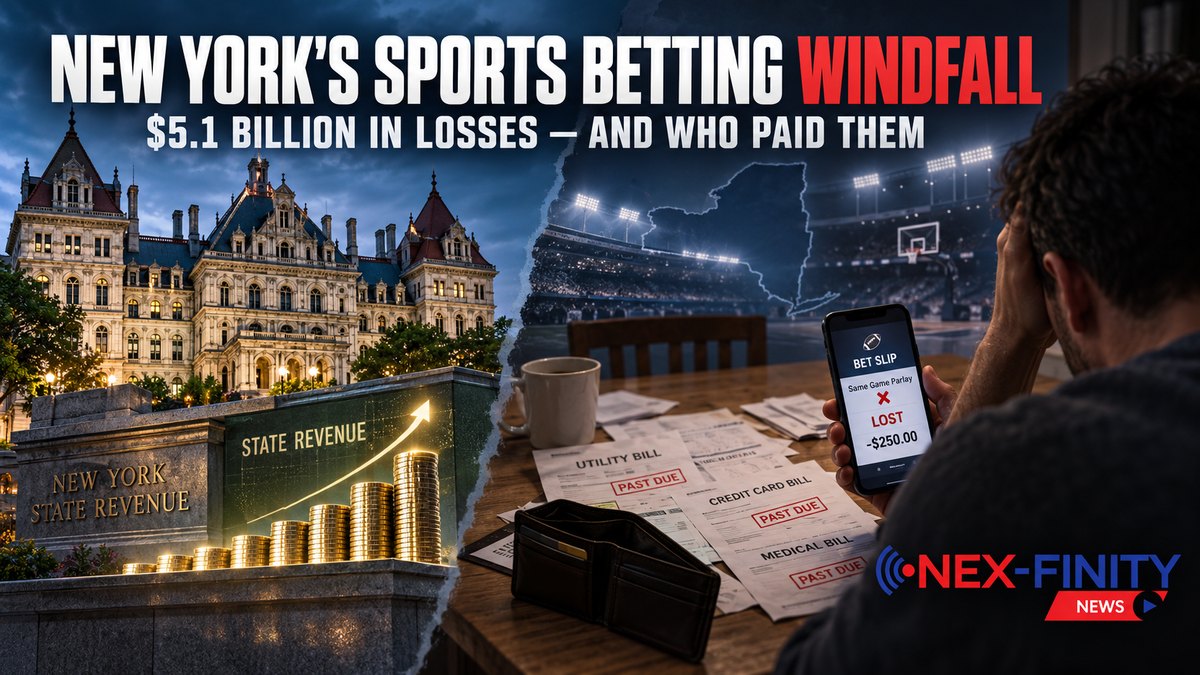
New York’s mobile sports betting tax is usually reported as a win for the state and its schools. Two numbers rarely appear alongside it: what bettors lost to produce that revenue, and whether schools actually receive more money because of it.
The first can be calculated directly from the tax rate. For the widely cited $2.6 billion in tax revenue, bettors lost about $5.1 billion. The second is answered by how New York builds its budget, and the answer is largely no.
Background
New York launched mobile sports wagering in January 2022. Between then and December 2024, the tax delivered close to $2.6 billion credited to education, according to Gaming Commission data reported by New York Focus, on nearly $58 billion in wagers.
The totals have grown since. A report State Comptroller Thomas P. DiNapoli released Sept. 16 found that from launch through the end of state fiscal year 2026 on March 31, New Yorkers wagered more than $91.2 billion, producing $8.3 billion in gross gaming revenue.
Mobile betting is now the state’s second-largest gaming revenue source, trailing only the lottery. Without it, revenue from all other forms of gaming fell 0.8 percent in fiscal 2026.
How the Tax Works
New York taxes mobile sportsbooks at 51 percent, one of the highest rates in the country. The tax applies not to the amount wagered but to gross gaming revenue, or GGR: total wagers minus winnings paid out.
In simple terms: GGR is what bettors, as a group, lost. The state takes 51 cents of every dollar of it.
That makes the conversion straightforward. Divide tax revenue by 0.51, and the result is the taxable amount bettors lost.
The Math
The $2.6 billion figure (Jan. 2022–Dec. 2024): $2.6 billion ÷ 0.51 = roughly $5.1 billion in net bettor losses. Against about $58 billion wagered, sportsbooks kept close to 9 cents of every dollar bet.
The current figure (Jan. 2022–Mar. 2026): $8.3 billion in GGR × 0.51 = roughly $4.2 billion in state tax. Against $91.2 billion wagered, sportsbooks again held about 9 cents per dollar, and the state received about 4.6 cents of it.
The most recent full year: In fiscal 2026, mobile sports betting produced $1.3 billion in state tax revenue. That implies roughly $2.5 billion in bettor losses in a single year.
Two Caveats That Cut in Opposite Directions
GGR slightly overstates cash losses. New York counts promotional credits given to players as taxable revenue and does not let operators deduct the value of bonus bets. A free $50 bonus bet that a player loses is recorded as $50 in revenue, even though no cash changed hands. Part of the $5.1 billion is therefore lost bonus credit, not lost cash. The state does not publish a breakdown that would allow a precise adjustment.
GGR understates what losing bettors lost. GGR is a net figure: total losses minus the profits of winning bettors. Every dollar a winner took home offset a dollar lost by someone else.
In simple terms: $5.1 billion is what the whole pool of bettors lost after the winners are subtracted. The people who lost money lost more than that combined.
Where the $5.1 Billion Goes
The $5.1 billion splits roughly in half. About $2.6 billion went to the state. The remaining $2.5 billion went to the sportsbooks, before their costs for marketing, promotions, technology and staff.
On current figures, $8.3 billion in losses splits into about $4.2 billion for the state and $4.1 billion for operators. Several of the licensed operators are publicly traded companies headquartered outside New York.
The state’s half stays in the state budget. It is labeled for education, but as explained below, it largely replaces other state dollars rather than adding to school funding.
Where the $5.1 Billion Comes From
It would be reasonable to assume betting money comes out of local spending, such as a night out or a purchase at a neighborhood store. The strongest research says otherwise.
Economists Scott Baker, Justin Balthrop, Mark Johnson, Jason Kotter and Kevin Pisciotta tracked household bank and card transactions as states legalized online betting. They found that betting did not replace other gambling or ordinary spending. It came out of savings, as money that would have gone into investments went into wagers instead. In the version published this year in the Journal of Financial Economics, covering 184,000 households, net deposits into brokerage accounts fell 20 percent after legalization.
The harm was not evenly spread. The effects were concentrated in households already short on cash, where the researchers found rising credit card balances, shrinking available credit and more frequent overdrafts.
A separate team from UCLA and USC examined credit reports for roughly 7 million Americans. Its most recent version found online sports betting associated with an average credit-score decline of about 12 points, far larger than the effect of in-person betting alone. An earlier version of the same study estimated that personal bankruptcy filings became 25 to 30 percent more likely in states that allowed online betting.
In simple terms: The money New Yorkers lose on betting apps comes mostly from what they would otherwise have saved or invested. The cost falls on household balance sheets, especially thin ones.
Neither study isolated New York. These are national estimates that describe the direction of the effect, not a New York dollar figure.
Does the Money Actually Add to School Funding?
New York markets gambling revenue as school money. In 2024, the Gaming Commission’s chairman told New Yorkers that when lottery players lose, their kids win.
The budget process works differently. School aid is set by formula, and gambling revenue is one of the sources that pays for that total, not an addition to it.
“The legislature and the governor decide on the school aid number first,” Brian Cechnicki, executive director of the Association of School Business Officials and a former state education finance director, told New York Focus. The state budget office says lottery money reaches districts through the same statutory formula as other state school aid.
State officials have acknowledged this for years. In 2012, State Sen. Joseph Addabbo said the most common misunderstanding is that lottery money supplements state school aid, when it is actually part of the overall funding package. Robert Lowry of the New York State Council of School Superintendents said this month that most of the money simply helps cover the cost of state aid as a whole.
In simple terms: If sports betting brought in nothing, New York would not cut school aid by $1.3 billion. It would pay for the same aid from the general fund. The betting tax replaces other state dollars rather than adding new ones.
The pattern predates sports betting. A 2013 City Limits analysis of State Education Department data found lottery revenue grew about 146 percent from 1995 while state school spending grew about 118 percent, and the lottery’s share of education revenue nearly tripled, from 5 percent in 1999 to about 14.5 percent in 2013.
National research points the same way. A 2007 study in the Review of Regional Studies found that earmarking lottery money for K-12 education had little or no effect on actual state K-12 funding. A UNC Charlotte study of North Carolina’s education lottery found no link between lottery growth and higher per-pupil spending.
The evidence is not unanimous. A Stanford working paper by Neva Novarro estimated that an earmarked lottery dollar raises education spending by about 36 cents more than an unearmarked one. Even on that finding, most of each earmarked dollar does not reach schools as new money.
Sports betting revenue is best understood as general budget relief. That has real value to the state. But describing it as money “for education” implies schools receive something they otherwise would not, and the budget process shows they generally do not.
Who Is Betting
New York’s betting population is young. Among accounts that reported an age, 77 percent belonged to people aged 21 to 44, and the largest single group, 40 percent, was 25 to 34, according to the Gaming Commission and the Office of Addiction Services and Supports (OASAS). The average account wagered $3,500 in 2025, down from $4,329 in 2024, and the average bet was $42.
At a hold near 9 percent, a $3,500 average implies a typical loss of roughly $300 per account. That is our arithmetic, and an average conceals a wide spread. Accounts are also not people; one bettor may hold accounts at several sportsbooks.
The state does not know much more than that. The law requires an annual report analyzing which groups problem gambling hits hardest, but regulators found in their 2022 and 2023 reports that several operators had not kept data consistently enough to tell. Rules requiring better data collection took effect Feb. 28, 2026.
In simple terms: New York has collected more than $4 billion in sports betting tax but cannot yet say which New Yorkers are most harmed by it.
The legal age is a partial safeguard. Licensed sportsbooks require bettors to be 21. Prediction markets generally admit users at 18 and face fewer advertising restrictions.
Gambling Disorder and Suicide Risk
Gambling disorder is a recognized psychiatric diagnosis, and it is treatable. It also carries serious risk. A 2026 commentary in the Journal of Gambling Studies noted that suicidal thoughts and attempts are common among people with the disorder and that suicide is a leading cause of death in this group, yet national physician guidelines include no standard recommendation to screen these patients for suicide risk.
Research identifies young people as the highest-risk group. A review indexed in PubMed Central summarized work by Heather Wardle and colleagues showing that 16- to 24-year-olds whose gambling problems worsen over time face a higher risk of suicide attempts.
Whether legalization itself changes suicide rates is less settled. A study presented at the 2026 International Conference on Gambling and Risk Taking examined state data from 2015 to 2023 and found no detectable overall effect. It did find legalization associated with about 2 additional suicides per 100,000 per year among males 15 to 34, and a decline of about 2.4 per 100,000 among males 35 to 54. The paper has not yet been peer-reviewed, and the finding for younger men should be treated as preliminary.
In simple terms: For an individual with gambling disorder, the suicide risk is well documented. Whether legal betting has raised suicide rates across the population is still being studied, and early evidence points to young men as the group to watch.
In New York, demand for help is rising. The state’s HOPEline received 2,545 calls in 2025, up 8.5 percent from 2020, and mobile sports wagering has been the leading reason for calls since 2022.
Treatment funding is small relative to the revenue. The state doubled funding for problem-gambling services from $6 million to $12 million, a step DiNapoli welcomed while calling it “a drop in the bucket.” Against $1.3 billion in tax collected in fiscal 2026, $12 million is under 1 percent.
When Bettors Win, the State Loses
During the first two weeks of June 2026, more than $1 billion was wagered in New York, yet operators recorded a net loss of $14.4 million as payouts on the underdog Knicks’ championship run exceeded the amount bet. For June as a whole, betting rose by more than $604 million from a year earlier while gross gaming revenue fell by nearly $90 million.
The comptroller’s point is that large winning wagers at long odds can cut GGR sharply, and the tax collected on it falls with it.
Analysis
The state’s position is structurally unusual. New York does not profit from betting activity in general. It profits specifically from bettors losing, which aligns the state’s fiscal interest with the sportsbooks’ hold rate. A high-hold month is a strong tax month. A month when bettors win is a weak one.
The education label obscures that relationship. Because school aid is set by formula, the betting tax functions as general revenue. The real tradeoff is not betting losses versus school funding. It is betting losses, drawn largely from household savings, in exchange for general budget relief.
A newer pressure sits outside the tax system. New York regulators ordered Kalshi in October 2025 to stop offering what they called unlicensed sports wagering, and the governor and attorney general sued the company on July 31. Losses on prediction markets produce no state revenue and fall outside the state’s treatment funding and data-collection rules.
DiNapoli said the rise in problem gambling, “particularly among young people, is a major concern.”
Conclusion
The headline figure answers one question: how much the state collected. The formula behind it answers two more: how much New Yorkers lost, and whether the “for education” label means what it implies.
For the $2.6 billion collected through 2024, bettors lost about $5.1 billion on net. Through March 2026, the totals stand at roughly $8.3 billion lost and $4.2 billion collected. That revenue is credited to schools but largely replaces dollars the state would have spent anyway, while the losses fall disproportionately on younger adults and financially stretched households.
Key Takeaways
- New York taxes mobile sportsbooks at 51 percent of what bettors collectively lose.
- $2.6 billion in tax (Jan. 2022–Dec. 2024) equals roughly $5.1 billion in net bettor losses, split about evenly between the state and operators.
- Through March 2026: $91.2 billion wagered, $8.3 billion lost, about $4.2 billion in state tax.
- The tax is credited to education, but school aid is set by formula first; betting revenue largely replaces general-fund dollars rather than adding to school budgets.
- National research finds betting losses come mainly from household savings, with the sharpest effects on financially stretched households.
- 77 percent of New York betting accounts with age data belong to people 21 to 44; the state’s demographic data on problem gamblers remains incomplete.
- Gambling disorder carries a documented suicide risk; population-level effects of legalization are still under study, with early signals among young men.
- Problem-gambling treatment funding is $12 million, under 1 percent of annual sports betting tax revenue.
| Get helpIf you or someone you know is struggling with gambling, the New York HOPEline is available 24/7 at 1-877-8-HOPENY (1-877-846-7369) or by texting HOPENY (467369).If you are having thoughts of suicide, call or text 988 to reach the Suicide & Crisis Lifeline. |
Sources
- Office of the NYS Comptroller, mobile sports wagering report (Sept. 16, 2026), via Mid-Hudson News
- Office of the NYS Comptroller, press release text, via CNY Online
- Finger Lakes Daily News, comptroller report coverage (June/Knicks figures)
- Fingerlakes1.com, Gaming Commission/OASAS account and age data
- Fingerlakes1.com, prediction markets and Kalshi litigation
- New York Focus, “In Brief: Sports Betting in New York” (Jan. 16, 2025)
- Accounting Today, “N.Y. Sportsbooks Limit Promos, Ask for Tax Breaks as Losses Rise”
- Covers, New York sports betting tax testimony (Jan. 2023)
- Baker, Balthrop, Johnson, Kotter & Pisciotta, “Gambling Away Stability,” NBER Working Paper 33108
- Same authors, Journal of Financial Economics, vol. 183 (2026)
- BYU News, summary of the published study (July 2026)
- Hollenbeck, Larsen & Proserpio, “The Financial Consequences of Legalized Sports Gambling,” SSRN
- UCLA Anderson Review, summary of the earlier version
- Spectrum News, “How much state gambling revenue goes to New York schools” (Mar. 2024)
- NYS Division of the Budget, Gaming Commission appropriations, FY2024 Executive Budget
- NY Senate, Sen. Joseph Addabbo press release on lottery school aid (2012)
- State of Politics / Spectrum News, NY lottery and education aid (Sept. 16, 2026)
- City Limits, “Math Test: How Much Do Schools Get From the Lottery?” (Oct. 2013)
- Review of Regional Studies, vol. 37, no. 2 (2007)
- Novarro, “Does Earmarking Matter?” Stanford SIEPR working paper (2002)
- WFAE, UNC Charlotte study of the NC Education Lottery (2021)
- NYS Gaming Commission, Responsible Play Partnership announcement (Oct. 2024)
- NYS Gaming Commission & OASAS, Impact of Mobile Sports Wagering on Problem Gamblers (2024 report)
- Hardoy, “Gambling Disorder and Suicide Risk,” Journal of Gambling Studies (2026)
- “Sports gambling in the Americas: the rise of invisible risks,” PubMed Central review
- ICGRT 2026, “Sports Betting Legalisation and Suicide Mortality” (UNLV conference abstract)