
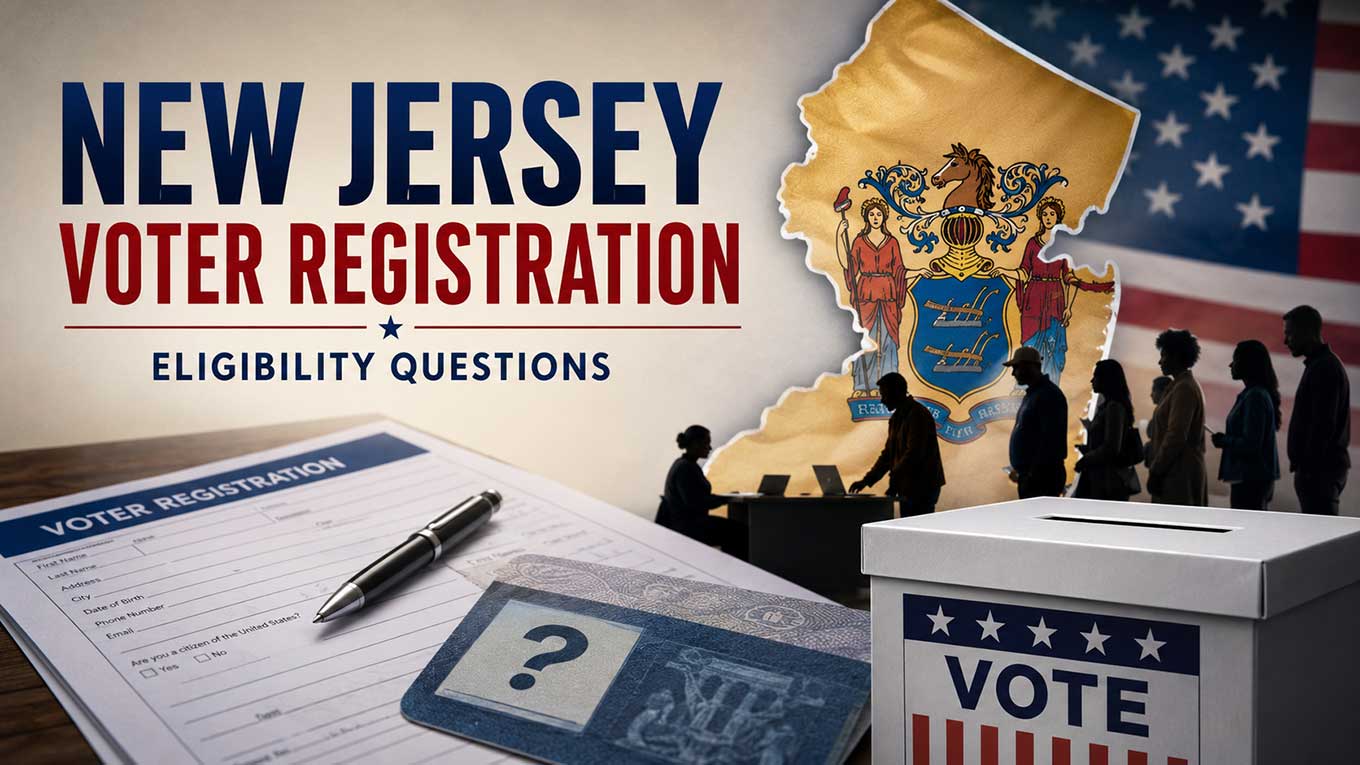
New Jersey handed the national election fight a gift this week, and it took the federal government barely a day to unwrap it. On July 21, Governor Mikie Sherrill announced that roughly 6,600 noncitizens had been mistakenly registered to vote through the state’s Motor Vehicle Commission, and that fewer than 400 had cast ballots before the error was caught. Within hours, the Justice Department was using the disclosure to press a demand it had been making for months: hand over New Jersey’s voter rolls.
The mistake itself was mundane, not sinister. The people involved had answered “no” when an MVC keypad asked whether they were U.S. citizens, and a software system built by the state’s vendor registered them anyway. The glitch ran from June 2023 to June 2024, was corrected, and surfaced publicly only when Sherrill — who took office in January 2026 — disclosed it more than a year later. She ordered the registrations removed, opened an investigation through her chief counsel, installed a new Motor Vehicle Commission administrator, and moved to drop the vendor. There was, she said, “no evidence that the error changed the result of any election”; the affected voters were mostly unaffiliated and scattered across the state.
Washington wanted the rolls — and pounced
That was the opening the Justice Department had been waiting for. The same day, Assistant Attorney General Harmeet Dhillon opened a federal probe into the failure and cited it as “an additional basis” to demand New Jersey’s complete voter file — not merely the records of the 6,600, but the statewide roll the department has been seeking since winter. For the roughly 400 who voted, DOJ went further still, requesting their voting dates and locations and even their mail-in ballot certifications and signatures. “Ensuring that U.S. citizens’ votes are not illegally diluted by noncitizens’ votes is of paramount importance,” Dhillon wrote.
This is the fight that actually matters, and the New Jersey error dropped straight into the middle of it. For more than a year the Justice Department has been demanding that states surrender their full voter files — including partial Social Security numbers and driver’s-license numbers — so the federal government can, in its telling, verify the rolls and identify noncitizens. Most Republican-led states complied. A wall of Democratic-led states, New Jersey among them, refused. DOJ sued the state in February for its “full, unredacted voter file,” and the American Civil Liberties Union of New Jersey called the demand “an unconstitutional and unlawful overreach,” warning it “could be used to justify challenges and purges to disenfranchise voters.” As its executive director, Amol Sinha, put it: “Elections, and thus voter information, are administered by states.” According to Democracy Docket, the department has since lost 16 consecutive district-court rulings on demands like it.
The debate, made flesh
As NexfinityNews argued last week in Elections, Politics and Data Hypocrisy, that standoff is the country’s election-trust problem in miniature: one side insists that only full transparency — handing over the rolls — can prove the count is clean, while the other insists that surrendering millions of voters’ sensitive data is itself the threat. New Jersey now gives each camp its talking point. To the Justice Department, the error is proof the rolls are dirty and Washington should get to inspect them. To the state, it is proof of something else entirely.
Would the federal data even have caught it?
Because here is what the New Jersey case actually demonstrates: the state found this error itself, using its own records, without sending a single Social Security number to Washington. What flagged these 6,600 registrations was not a federal cross-match — it was the “no” those applicants had already entered on a state keypad. New Jersey’s own citizenship data was enough to identify every one of these self-reported registrations once officials looked, and the fix was state auditing and vendor accountability, not a federal database.
Which is why the DOJ’s response invites the question the department has never answered: how would federal possession of the personal data of millions of eligible New Jersey voters have prevented this error, or caught it any faster than the state did? A Social Security number does not establish citizenship — the government issues work-authorized numbers to lawful noncitizens — so the very field DOJ most wants would not, by itself, have distinguished these registrants from any citizen on the roll. The tools that genuinely catch this kind of discrepancy already exist and require no bulk handover: the state’s own citizenship records, the Social Security Administration’s HAVV verification, and the multistate ERIC compact, which flags exactly these mismatches without exposing a single raw identifier. New Jersey’s mistake is an argument for using those tools well. It is not, on its face, an argument for shipping the entire roll — plus 400 voters’ ballot signatures — to the Justice Department.
The number nobody can actually see
There is a deeper hole in the New Jersey story that almost no one has named — including, so far, the coverage itself. The 6,600 figure counts only the noncitizens who answered “no” to the citizenship question and were registered anyway. The state could identify them precisely because they had told the truth; the audit worked backward from that “no.” It reveals nothing about noncitizens who answered “yes” — whether out of confusion at a keypad, a language barrier, or intent. Those registrations look identical to a citizen’s, and the state’s own records contain no field that would expose them. In short, 6,600 is a floor, not a total, and New Jersey’s self-audit is structurally incapable of seeing past it.
That is the one genuinely strong argument for outside verification in this entire dispute, and it complicates the tidy conclusion that the state fixed everything on its own. Catching the honest “no” required only New Jersey’s data. Catching a mistaken or dishonest “yes” requires matching the rolls against an external citizenship source — which is exactly what the federal government says its roll demand is for. On this narrow point, the case for some form of cross-check is real.
And someone did run that match: the Department of Homeland Security. In a July 16 letter to New Jersey’s secretary of state, DHS said comparing the state’s voter data against federal immigration records flagged 19,497 registrations as likely noncitizens and as many as 35,152 “potential” ones — part of a broader DHS claim of roughly 256,000 across four states. The department called the findings preliminary and their causes “undetermined,” and gave New Jersey until the end of July to respond.
But the ceiling is as unreliable as the floor is incomplete. The SAVE system DHS used to generate those numbers is documented — by ProPublica and ABC News — to produce heavy false positives, because it leans on Social Security data that often predates a person’s naturalization. Foreign-born citizens who obtained a Social Security number years before becoming citizens are precisely the people it tends to misflag. The measured error rates are not small: in Boone County, Missouri, more than half of the voters SAVE flagged turned out to be citizens; in Denton County, Texas, roughly one in seven; across surveyed Texas counties, more than five percent. “This is not ready for prime time,” one Missouri election official said of the tool. “I’m not going to risk the constitutional rights of my voters for bad data.”
So the truthful answer to the obvious question — how many noncitizens are actually on New Jersey’s rolls? — is that nobody credibly knows. The real figure sits somewhere above the 6,600 who flagged themselves and well below the 35,152 produced by a tool that brands naturalized citizens as aliens. Both the reassuring version (“just 6,600, no big deal”) and the alarming one (“35,000 noncitizen voters!”) are overclaims resting on the same missing data. That uncertainty — a genuine blind spot measured with a faulty instrument — is the real state of play, and it is why the roll fight is so combustible: each side can wave a number, and neither number can be trusted.
Transparency cuts both ways
None of this lets the state off the hook. The error ran for a year and then sat undisclosed for another, and Sherrill’s insistence that “when we find a problem, we don’t hide it, deny it, or invent conspiracies — we investigate it, we fix it, and we tell the public” reads awkwardly against a two-year gap between the problem and the telling. That silence is its own corrosion of trust, and it is precisely what gives the federal demand its rhetorical force: if the rolls are clean, why not prove it?
But the mirror image is just as real, and it is the heart of the roll fight. DOJ is not asking only for the 6,600 bad records; it wants the full, unredacted file — and the ballot certifications and signatures of the 400 — data that a different set of voters sees as the raw material for challenges and purges rather than a remedy. The department has not explained how holding the sensitive information of every eligible voter in the state would have stopped a vendor’s keypad software from ignoring a “no.” Both fears here are sincere, and each is inflamed by the other’s secrecy: the state’s delayed disclosure feeds suspicion of the rolls, and the federal appetite for the whole file feeds suspicion of the motive. That is the loop the earlier piece described, and New Jersey has now run it in fast-forward.
The number that matters most is the smallest one
Through all of it, the smallest figure stays the most important. Fewer than 400 improper ballots, in a state where statewide races are decided by tens or hundreds of thousands of votes, is a serious administrative failure and not an election-altering one — and documented cases of noncitizens actually voting remain rare, with one widely cited tally counting 77 nationwide between 1999 and 2023. Holding those two truths together — the error is real, and the fraud narrative is overstated — is what almost no one in this fight is willing to do.
So the SAVE Act will get its floor speeches, the Justice Department will keep suing for the rolls, and New Jersey will keep saying no. But the question underneath the noise is narrower, and more answerable, than the shouting suggests: does verifying a voter roll actually require the federal government to hold everyone’s data? New Jersey just showed that it doesn’t — the state caught its own mistake with information it already had. Whether anyone in Washington wants to hear that is a different matter, and, as we wrote last week, the unwillingness to hear it is exactly why the trust keeps draining away.
Related from NexfinityNews
- Elections, Politics and Data Hypocrisy (last week’s analysis)
- The Data Broker Loophole: How Governments Buy Around Privacy Laws
- California Vote-Counting Delays and Ballot Harvesting — What They Mean for the 2026 Midterms
- ActBlue Fraud Controls Under Scrutiny: Investigation & Donation Rules
External Links & Sources
- Office of Gov. Mikie Sherrill — Statement on the noncitizen voter registration error (July 21, 2026)
- Democracy Docket — Trump DOJ cites New Jersey registration error to renew demand for private voter data
- ACLU of New Jersey — Response to DOJ lawsuit demanding New Jersey’s voter rolls (Feb. 27, 2026)
- Brennan Center for Justice — Tracker of Justice Department Requests for Voter Information
- NBC News — 6,600 noncitizens registered to vote in N.J. because of a ‘software error’
- Forbes — Hundreds of noncitizens voted in New Jersey after DMV mistakenly registered them
- Shore News Network — DHS says up to 35,152 potential noncitizens found on New Jersey voter rolls
- ProPublica — The SAVE citizenship tool is riddled with mistakes and confusion
- ABC News — System DHS is urging states to use to check voter rolls returns faulty results
- SSA / AAMVA — Help America Vote Verification (HAVV)