
How the war on wealth is bankrupting New York and California — and the politicians who lit the fire still can’t stop playing with matches
Let’s start with the most tone-deaf political moment of 2026 so far — and the competition for that title has been fierce.
On March 11th, New York Governor Kathy Hochul stood before a room full of journalists and political insiders at Politico’s New York Agenda: Albany Summit and said, out loud, with cameras rolling: “The fact is that I need people who are high net worth to support the generous social programs that we want to have in our state.” She went on to praise what she called “some patriotic millionaires who stepped up” and capped the performance by suggesting that wealthy New Yorkers who wanted to help should go to Palm Beach and “see who you can bring back home, because our tax base has been eroded.”
Read that again.
The Governor of New York — the same woman who told Republicans in 2022 to “just jump on a bus and head down to Florida where you belong… Get out of town. Because you don’t represent our values” — is now essentially dispatching her remaining wealthy constituents to South Florida to recruit the ones she already drove away.
This isn’t just irony. This is a masterclass in what happens when populist politics collides with fiscal reality at highway speed.
The Empire State’s Self-Inflicted Wound
New York’s tax base didn’t erode by accident. It eroded by design — the slow, grinding design of policies that treated high earners as inexhaustible ATMs rather than mobile citizens with choices. And as Hochul herself inadvertently admitted at that summit, remote work “changed everything.” As she put it: “There were people who could only work in an office in Manhattan and work in New York State, and they were captives to our state. They were going to stay.”
Captives. That’s the word she used. That’s how her administration viewed the taxpayers funding the whole operation. The moment the cage door opened, they walked.
A surge of affluent New Yorkers moved to Florida in 2025 as Mayor Zohran Mamdani’s far-left agenda — including massive income tax hikes, free day care, and city-run grocery stores — went from campaign fantasy to political reality. And now, even as Hochul pumps the brakes on new taxes while eyeing a 2028 presidential run, Mamdani is still pushing hard. Among his proposals: dropping the estate tax exemption from $7.1 million to just $750,000 and raising the rate to 50%. New York City has 123 billionaires with an average age of 67. You don’t need a PhD in economics to see where that math leads.
Law professor Jonathan Turley put it cleanly: “There is another novel approach: change your policies to make people want to come back.” Nassau County Executive Bruce Blakeman was even more direct, noting that when you “raise taxes, drive up the cost of living, make it harder to do business, and try to destroy families’ savings, people leave. Apparently Hochul’s new economic development strategy is to ask them politely to come back.”
He’s not wrong. And the painful punchline is that Hochul seems to understand the problem perfectly when she’s not trying to get re-elected. She’s privately signaled she philosophically opposes the new tax hikes being pushed through Albany. She’s acknowledged New York is “in competition with other states who have less of a tax burden on their corporations and their individuals.” She knows the answer. She just can’t say it out loud because her base doesn’t want to hear it.
That tension — between what works and what plays well at a rally — is exactly what’s destroying these states.
California: When You Target 200 People With $2 Trillion, They Move
Three thousand miles west, California is in the middle of conducting perhaps the most reckless fiscal experiment a major state government has attempted in modern history. And they’re doing it in real time, with a live audience, while the subjects of the experiment relocate to Miami.
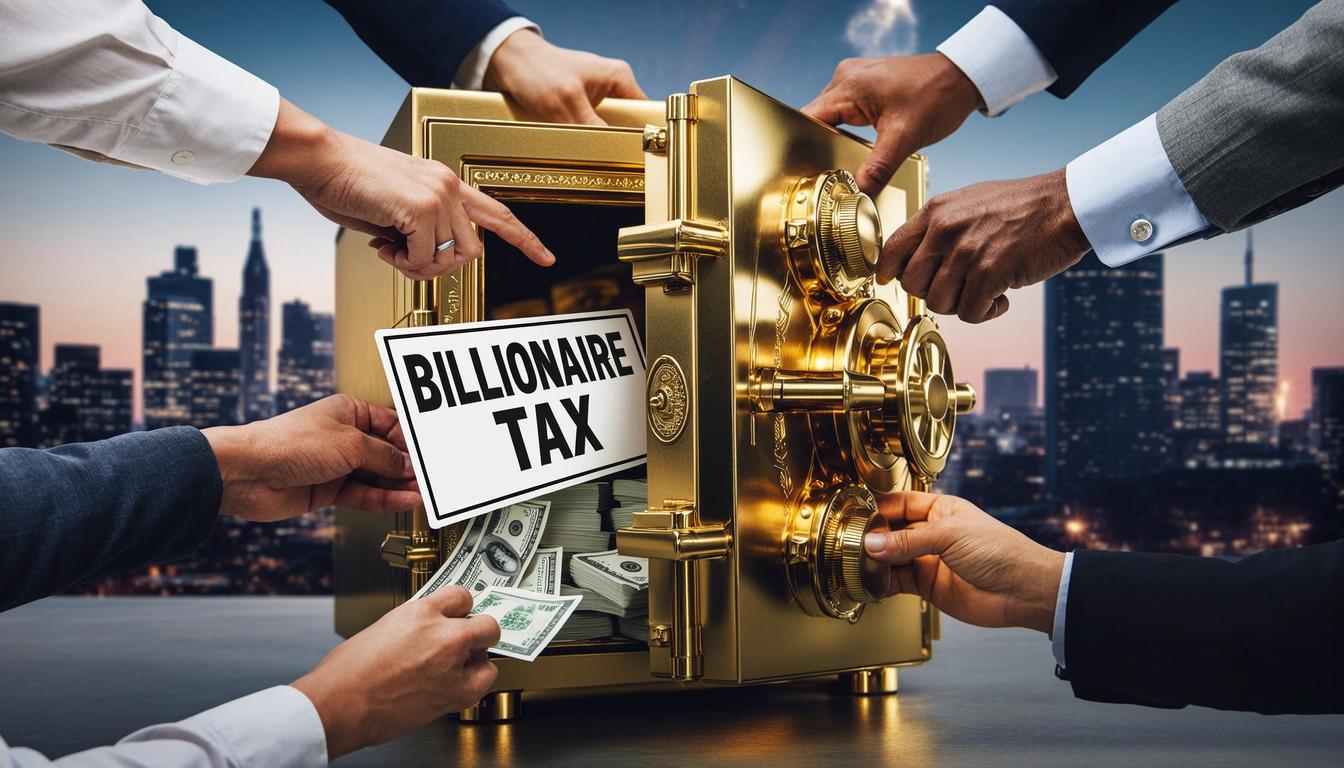
The 2026 Billionaire Tax Act — Initiative No. 25-0024 — is a ballot measure backed by the SEIU labor union that would impose a one-time 5% excise tax on the total net worth of any California resident with assets exceeding $1 billion. Proponents estimate around 200 California residents could be subject to the tax, with those taxpayers collectively holding approximately $2 trillion in net worth.
Think about that structure for a moment. The entire fiscal ambition of this initiative rests on approximately 200 people. Not 200,000. Not 20,000. Two hundred individuals, out of a state population of 40 million, carrying the weight of what supporters are calling an “emergency” revenue solution.
Here’s the reality of California’s tax structure that rarely makes the nightly news: of the state’s 40 million residents, fewer than half pay state income taxes at all — only around 17 million. The tax burden is concentrated in a thin slice at the top. And within that slice, those roughly 200 billionaires represent a staggering share of total revenue. When your entire social safety net is structurally dependent on a group that fits comfortably in a mid-size conference room, you don’t have a tax system. You have a hostage situation — and the hostages just figured out there are no locks on the doors.
The departures began almost immediately after the initiative was filed. Before the January 1, 2026 residency cutoff, Google co-founders Larry Page and Sergey Brin and venture capitalist Peter Thiel left California for Miami. Car loan magnate Don Hankey left for Las Vegas. Former Uber CEO Travis Kalanick announced he’d left for Texas. Meta CEO Mark Zuckerberg and Oracle CEO Larry Ellison also departed.
The result? A Hoover Institution study found that just six publicly confirmed billionaire departures removed $536 billion — nearly 30 percent of aggregate billionaire wealth — from the proposed tax base. When you factor in the loss of ongoing income tax revenue from those departures, the one-time levy would leave California worse off by an estimated $25 billion overall.
They chased 200 people hoping to collect $100 billion — and by the time the legislation could even reach a ballot, they’d already lost more than they stood to gain.
A February 2026 poll found 60% of likely voters backing the wealth tax, even as a majority of those same respondents said the move would spark a business exodus and cost local jobs. They support it anyway. That’s not fiscal policy. That’s a vibe.
The Deeper Problem Nobody Wants to Talk About
Here’s what the Hochul-in-Palm-Beach moment and the California billionaire stampede are really telling us: these states have built social program architectures that are fundamentally incompatible with the revenue bases they’ve created. And rather than restructure the architecture, they keep demanding more from the people still writing checks.
The California initiative’s own text is almost philosophically honest about the dependency it’s trying to paper over. It acknowledges that there are more than 19 million taxpayers in California who are not billionaires — nurses, teachers, firefighters, tech workers — all paying tax on a larger portion of their income than the billionaires do. The pitch is fairness. The reality is desperation.
Hedge fund manager Bill Ackman put the wealth tax concept in stark terms: “I am opposed to wealth taxes because they effectively represent an expropriation of private property and have many unintended and negative consequences that have occurred in every country that has launched such a tax.” He’s right — and the European experience backs him up. France, Germany, Sweden, and others all experimented with wealth taxes and eventually abandoned them after watching capital evaporate across borders.
The mechanism is simple. Wealth is mobile. Especially modern wealth, which increasingly lives in digital assets, investment portfolios, and intellectual property rather than factories and farmland you can’t pick up and move. When you make a jurisdiction hostile enough, the wealth leaves — and it takes the income tax, the capital gains tax, the estate tax, the philanthropic contributions, and the economic activity with it. You don’t just lose the wealth tax you were counting on. You lose everything that came with the presence of that wealth.
So Why Do They Keep Doing It?
This is the question that should genuinely frustrate every voter, regardless of where they sit politically. If the evidence is this clear — if Hochul herself is standing in front of cameras admitting the tax base is collapsing, if economists can demonstrate with actual math that the California billionaire tax would leave the state $25 billion in the hole — why do progressive politicians keep reaching for the same lever?
Three reasons, and none of them are good.
First, the timeline doesn’t match the electoral calendar. The damage from chasing out high earners is slow, diffuse, and multi-year. The political reward from proposing a billionaire tax is instant. You get the headlines, the applause at rallies, the donations from the base, and the viral moments — all before the fiscal consequences hit. By the time the budget gaps materialize, you’ve already won the election and someone else is holding the bag.
Second, the math is invisible to most voters. When 40 million Californians hear that 200 billionaires control $2 trillion, the emotional response is visceral and entirely understandable. The counterargument — that those 200 people are generating a disproportionate share of the state’s tax revenue and their departure will cost everyone more than their wealth tax would raise — requires a level of fiscal literacy that a 30-second campaign ad simply cannot convey. Populism is a compression algorithm. It takes complex systems and collapses them into “them vs. us.” That compression destroys nuance, and nuance is exactly what fiscal policy requires.
Third, and most cynically, there’s no accountability. Hochul told New Yorkers to get out of town in 2022, presided over a billionaire exodus, watched the budget strains compound — and she’s still governor, still running for re-election, still framing herself as the responsible adult in the room compared to Mamdani. The voters who cheered her 2022 remarks are unlikely to connect them to the 2026 budget crisis. The political press will move on to the next outrage cycle. No one gets fired for being wrong about tax policy.
The Invitation That Should Come With Policy, Not Pleading
Governor Hochul’s plea to “go down to Palm Beach” and recruit former New Yorkers home is actually the right instinct, expressed in entirely the wrong way. New York should want those people back. And they could come back — not because a governor asked nicely, but because the state made itself worth returning to.
That means tax competitiveness. It means regulatory predictability. It means not letting a socialist mayor propose a death tax that would hit families who built a $1 million small business alongside families who built a $1 billion empire. It means treating wealth creators as partners in the public project rather than adversaries to be outlasted.
California still has the weather, the culture, the talent pool, and the innovation ecosystem. New York still has Wall Street, the global media infrastructure, and the gravitational pull of the most consequential city on earth. These are not hopeless cases. But they are hemorrhaging — not because the wealthy are greedy, but because the policy environment has made staying an act of charity rather than an act of economic sense.
Hochul accidentally said the quiet part loud when she praised the millionaires who “cut her checks” as patriotic. Civic participation used to be the baseline expectation for anyone living in the community. When you’ve made taxation so punitive that simply staying qualifies as an act of patriotism, you’ve already lost the argument.
The choice these states face isn’t between taxing the rich and letting them off the hook. It’s between a system where broad prosperity generates broad tax revenue, and a system where an increasingly narrow group of people fund an increasingly expensive set of programs while everyone else wonders why the math never adds up.
One of those systems is stable. The other one keeps sending the governor to Palm Beach.