
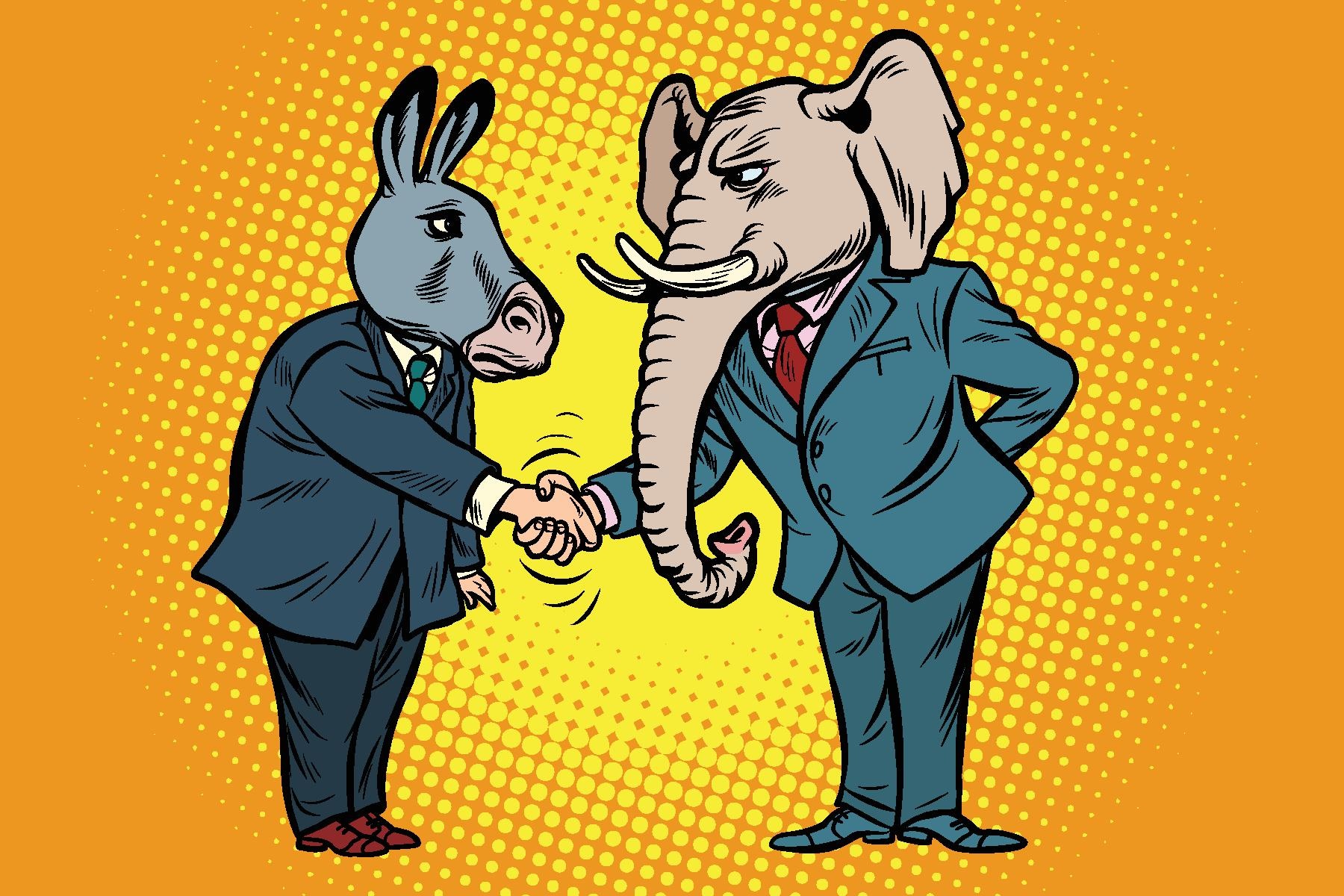
After years of gridlock, finger-pointing, and partisan warfare — Congress has found its common ground. Unfortunately, it’s a vote to make sure you never find out who among them is a predator.
You have to hand it to them. You really do.
For years, we’ve been told Washington is broken. Hopelessly divided. Two parties so far apart they can’t agree on the color of the sky, let alone the business of governing the most powerful nation on earth. Red vs. Blue. Left vs. Right. The endless culture war theater that plays out on cable news every night while nothing actually gets done.
And then — quietly, efficiently, and with remarkable bipartisan unity — 357 members of the United States House of Representatives found their common cause.
Keeping their own sexual misconduct records buried.
That’s the legislation that finally brought Washington together.
What It Takes to Get Congress to Agree on Anything
Rep. Nancy Mace forced a floor vote on her resolution directing the House Ethics Committee to make public all reports on allegations of congressional lawmakers and aides engaging in sexual misconduct or harassment. A transparency measure. A basic “let the public see what their tax dollars paid for” resolution.
The measure failed 357 to 65, with lawmakers from both major parties opposing the proposal. 77 WABC
To put that in perspective: Congress can’t agree on a budget. Can’t agree on the border. Can’t agree on healthcare, infrastructure, foreign policy, or what to have for lunch in the Capitol cafeteria. But when it came to making sure you don’t find out which of their colleagues has been settling sexual harassment claims on your dime?
Unanimous. Lightning fast. Remarkably organized.
Funny how that works.
The Day #MeToo Died on the House Floor
Remember #MeToo? Remember 2017? Remember when the entire country — politicians included — stood up in unison and declared that the era of powerful men hiding behind institutional silence was finally, definitively over?
Remember the speeches? The press conferences? The carefully worded statements of solidarity? Remember how every member of Congress tripped over themselves to get to a microphone and declare their unwavering commitment to survivors, to accountability, to never again?
That movement — that seismic cultural reckoning that toppled executives, ended careers, and forced a national conversation about power and abuse — met its institutional death on March 4, 2026, in a 357 to 65 vote on the floor of the United States House of Representatives.
No eulogy. No ceremony. Just a procedural motion and a quiet burial.
The #MeToo era, as it turns out, was always welcome in Hollywood, in corporate boardrooms, in the media, in sports — everywhere except the one place where it perhaps mattered most. Congress exempted itself then. And with this vote, Congress has made clear it intends to keep it that way.
If you needed a timestamp for when the movement officially lost its teeth in the halls of power, you now have one. March 4, 2026. Roll Call 83. The ayes have it.
A $17 Million Bipartisan Achievement
Let’s talk about the money, because this is ultimately a story about your money.
According to House records cited by Rep. Thomas Massie, members of Congress have spent roughly $17 million in taxpayer money to settle sexual harassment claims over the years — quietly, behind closed doors, with no names attached. Black Westchester
Seventeen million dollars. Quietly. With your paycheck.
Not a Republican slush fund. Not a Democratic one. A bipartisan slush fund — which, come to think of it, might be the most genuinely unifying thing this institution has ever produced.
The resolution Mace filed would have required all reports to be made public within 60 days, with the personally identifiable information of victims and alleged victims redacted. The Hill Victims protected. Predators exposed. Seems reasonable.
Apparently, 357 members disagreed.
The “Protecting Victims” Two-Step
Now, to be fair — and we are always fair here at NexfinityNews — members didn’t exactly vote to say they were burying the records. That’s not how Washington works. They’re far too sophisticated for that.
Members rarely vote directly against transparency. Instead, they rely on procedural maneuvers. By voting to send the resolution back to committee rather than voting directly on releasing the records, lawmakers avoided a simple yes-or-no vote that could later be used in campaign ads. Technically, members can now say they did not vote against transparency. Black Westchester
Elegant, isn’t it? Three hundred and fifty-seven members voted to “refer it to committee” — the Washington equivalent of saying “I’ll think about it” while walking briskly toward the exit.
The House Ethics Committee itself came out against the resolution, saying it “could chill victim cooperation and witness participation in ongoing and future investigations.” The Hill
The Ethics Committee. Protecting victims. By keeping the records of misconduct against those victims locked in a filing cabinet.
You can’t write this stuff.
Even the “Accountability” Caucus Showed Up to Vote It Down
Here’s the part that should make your coffee go cold.
Among the members voting to block the release were 78 female members of Congress — a number that has drawn attention because many have built their political messaging around workplace accountability and protecting employees from harassment. Black Westchester
Seventy-eight. Not a typo.
The same members who’ve given floor speeches about toxic workplaces, who’ve held press conferences about empowering women, who’ve campaigned on “believing survivors” — showed up and voted to keep the House’s own survivor files locked away from the public.
This is exactly how movements die. Not with a dramatic reversal. Not with a villain twirling a mustache. They die with a procedural vote on a Wednesday afternoon, surrounded by people who once marched in solidarity and now can’t get to the “refer to committee” button fast enough.
The #MeToo generation that stormed into Congress promising to change the culture didn’t change the culture. The culture changed them.
Accountability for thee, but not for me, apparently.
And Then There’s the Epstein Problem
Following the vote, Mace pointedly noted that the loudest voices demanding release of the government’s Jeffrey Epstein files had just voted to keep congressional harassment records sealed. Newsweek
Let that land for a moment.
The same Congress that has spent months rattling cages about elite predators, secret files, and institutional cover-ups — staged a near-unanimous vote to cover up their own institution’s misconduct files.
“Release the Epstein files!” they thundered.
“Refer H.Res. 1100 to committee,” they whispered — and then voted 357 to 65 to make it disappear.
The self-awareness level in that chamber is, to put it charitably, a work in progress.
The Trigger Nobody Wants to Talk About
None of this happened in a vacuum. The resolution came in direct response to allegations that Rep. Tony Gonzales (R-TX) had an affair with one of his staffers — who set herself on fire last September and died as a result of her injuries. ABC News 4
A woman is dead. An ethics investigation is open. And Congress’s response — with breathtaking bipartisan efficiency — was to vote to make sure the full record of what happened never reaches the public.
During the height of #MeToo, that story alone would have triggered congressional hearings, prime-time coverage, and a stampede of members demanding accountability. Instead, it triggered a 357 to 65 vote to bury the file.
That’s not progress. That’s regression dressed up in procedural language.
After the vote, Mace said: “Both parties colluded to protect predators. They voted to keep sexual harassment records buried, and they did it together. Every member who voted against this resolution voted to protect the cover-up instead of the victims.” The Mountaineer
That’s not a partisan attack. That’s arithmetic.
The One Thing Washington Does Well
So here we are. Years of dysfunction. Years of nothing getting done. Years of being told the system is broken beyond repair.
And yet — when it truly mattered, when the chips were down, when the question was simple and the stakes were personal — Washington delivered. Swiftly. Decisively. Together.
Three hundred and fifty-seven members of Congress walked into that chamber and found the one issue that transcends party lines, gender, ideology, and every other division that supposedly makes this country ungovernable.
Their own secrets.
The #MeToo movement asked a simple question of every powerful institution in America: Will you protect your people, or protect your image?
For a brief, electric moment, it felt like the answer might finally be different. Like the walls were actually coming down. Like power could no longer simply outlast accountability.
March 4, 2026 answered that question for Congress — clearly, decisively, and with a veto-proof majority.
Mace left them with a warning: “This is the establishment in action, always protecting itself, never the victims. Ask yourself why. Remember their names when they ask for your vote.” The Mountaineer
| These are the members of Congress who voted against disclosing sexual ha…Bethany Blankley | The Center Square contributor(The Center Square) – Nearly all members of Congress, 357 Republicans and Democrats, don’t want taxpayers to kno… |
We’d add only this: the roll call is public record. Every name is on it. Every member who voted to bury those files will be back in your district asking for your vote soon enough.
Ask them about it. See how unified they are then.
And the next time a member of Congress stands at a podium and invokes the spirit of #MeToo — remember this vote. Remember the number. Remember what they chose when choosing was easy and the only thing at stake was their own exposure.
Three hundred and fifty-seven.
That’s the number that ended an era.
But the Fight Isn’t Over — And Here’s What You Can Do Right Now
Congress voted to bury this. They counted on you moving on. They’re banking on the news cycle doing what it always does — churning forward, leaving yesterday’s outrage in yesterday’s feed.
Don’t let them win that bet.
There are Americans who refuse to accept that transparency is optional when it comes to the people we elect and the taxpayer dollars we hand them. Organizations like TrueService.com exist precisely for moments like this — to hold elected officials accountable to the people they serve, to amplify the voices that Washington tries to procedurally silence, and to make sure that votes like this one have consequences.
The work of real civic accountability doesn’t happen in committee rooms. It happens when citizens refuse to be managed, refuse to be distracted, and refuse to forget.