
Results reflect network projections as of about 1 a.m. ET, Wednesday, Nov. 4, 2026. Vote counting continues, and final margins in many races are not yet known.
Intro
Democrats won control of both chambers of Congress on Tuesday. CBS News projected Democratic majorities in the House and Senate, with Senate flips in Texas, Kansas, Ohio, Iowa, North Carolina, South Carolina and Maine, where longtime Sen. Susan Collins was defeated.
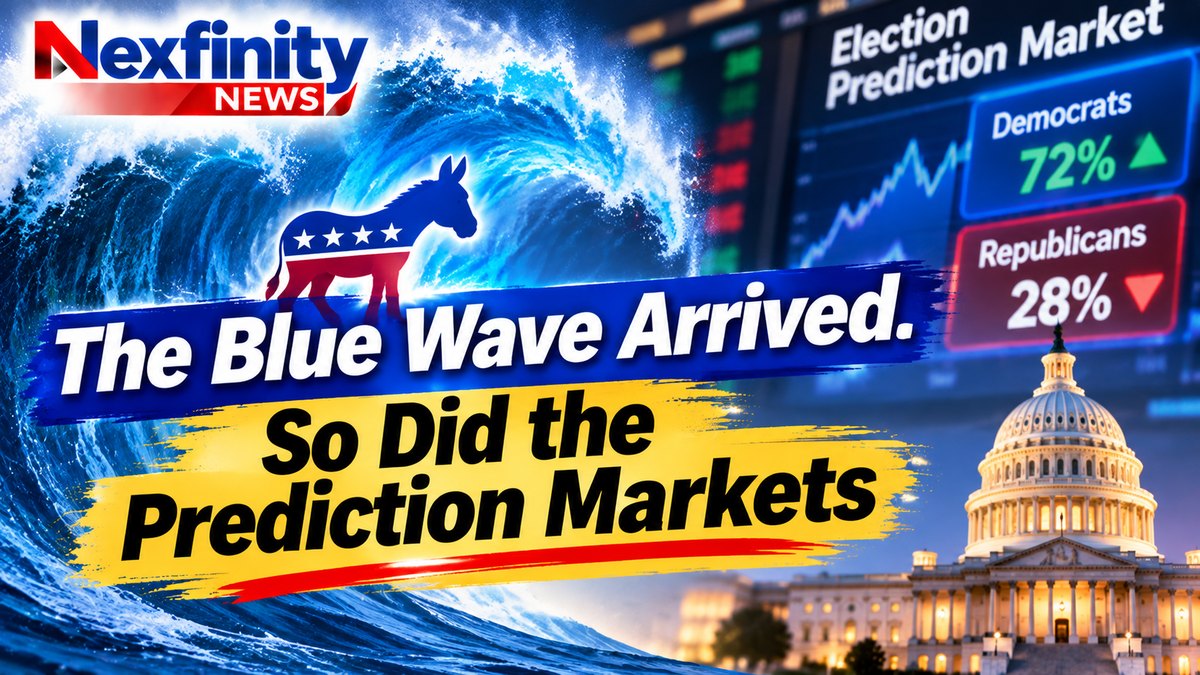
The outcome matched what prediction markets had priced for weeks. On Election Day, Kalshi put a Democratic sweep of both chambers at 75% and Polymarket at 75.5%, according to Cointelegraph.
That has prompted a fast-forming narrative: the markets beat the polls. The record is more complicated. On the core question of who would control Congress, the leading poll-based models pointed the same direction as the markets and were more confident, not less.
The bigger story may be something else. This was the first midterm in which prediction markets operated at scale, inside newsrooms, on licensed Associated Press data, with more than a billion dollars on the line. That is a structural change in how Americans consume election forecasts, whatever the accuracy scorecard eventually shows.
Background: What Happened Tuesday Night
The House was called first. MS NOW projected Democratic control just before 10 p.m. ET, followed by CNN, NBC News and CBS News, Variety reported. CNN projected the Senate at 11:35 p.m. ET, with Democrats reaching at least 51 seats.
Republicans had held the Senate 53–47, meaning Democrats needed a net gain of four seats, Fortune noted on Election Day. Iowa, Kansas, Maine, Ohio and Texas sat in the toss-up column of the major forecasts.
NBC News described it as the first time since 2006 that the minority party flipped both chambers on a single night, and said Democrats could hold their largest House majority in nearly two decades.
Some individual results stood out. Texas and Kansas elected their first Democratic senators in decades, James Talarico and Adam Hamilton. Democrats flipped three of Iowa’s four House seats, and Jamie Ager won North Carolina’s 11th District, a seat no Democrat had held since 2010, per CBS News.
How Prediction Markets Work
A prediction market lets people buy contracts that pay $1 if an event happens and nothing if it doesn’t. The trading price becomes an implied probability.
In simple terms: if a contract on “Democrats win the Senate” trades at 75 cents, the market is collectively saying there is roughly a 75% chance it happens and a 25% chance it doesn’t.
The three U.S.-facing platforms that matter are Kalshi, a CFTC-regulated exchange; Polymarket; and PredictIt. Their argument is simple: people with money at stake have a reason to be right, and prices update instantly as news breaks. Polls, by contrast, are snapshots taken days or weeks earlier.
Kalshi’s head of politics growth, Benjamin Freeman, made the case directly to CNN before the vote, saying markets are always live while polls look backward, as compiled by Shattered.
What the Markets Said Going In
The final pre-election prices were consistent across platforms:
- House: Kalshi 93%, Polymarket 94.5% for Democrats, per Newscord’s comparison of 11 outlets.
- Senate: Kalshi 75%, Polymarket 75.5%.
- Swing Senate races: Less than 24 hours before polls opened, both platforms favored Democrats in all seven top battleground Senate contests, Mediaite reported, including Talarico at 76% in Texas and Sherrod Brown at 71% in Ohio.
The markets also moved over time. Kalshi’s House market opened May 27 at 76% for Democrats and climbed above 90% by Election Day, according to Oddschecker. Its Senate contract was at 67.8% as recently as Oct. 30.
Iowa was the clearest late swing and it shows which way the information flowed. The final Times/Siena poll, released Sunday, had Turek up one point. That same day, Kalshi still had Republican Ashley Hinson at 57%. By Monday, both platforms had flipped to Turek at 52%, per Mediaite. Turek won.
Did the Markets Beat the Polls?
On the headline question, no not on the evidence available tonight.
Yahoo Finance tracked both instruments side by side, averaging Kalshi, Polymarket and PredictIt against two poll-based models Nate Silver’s and Harvard’s ElectIt. On the Monday before the election:
| Chamber | Prediction markets | Poll-based models | Gap |
| Senate (Democratic control) | 73.1% | 80.3% | Polls 7.2 pts more confident |
| House (Democratic control) | 94.1% | 96.7% | Polls 2.6 pts more confident |
Yahoo found the Senate gap averaged about 7.4 points since Sept. 1. In other words, the markets spent the fall less convinced of a Democratic Senate than the polling models were. When Democrats won it, the polls had the more confident call.
In simple terms: both forecasts said the same thing. The polling models said it louder.
That does not mean the polls were precise, and single surveys can be cherry-picked to argue either side. In Texas, late polls ranged from a seven-point Talarico lead to a one-point Paxton lead from Quantus Insights, the only late poll showing Paxton ahead, per Newsweek.
A fairer test is one high-quality pollster across every battleground. The final New York Times/Siena College polls, released Sunday, Nov. 1, are the standard benchmark. Here is how they lined up with the markets the day before the election:
| Senate race | Final NYT/Siena poll (likely voters) | Market odds, Nov. 2 (Kalshi/Polymarket) |
| Michigan | El-Sayed +11 (53–42) | El-Sayed 78% |
| Texas | Talarico +7 (50–43) | Talarico 76% |
| Maine | Jackson +6 (51–45) | Jackson 73% |
| Ohio | Brown +5 (49–44) | Brown 71% |
| Kansas | Hamilton +5 | Not reported |
| Alaska | Peltola +2 (48–46) | Peltola 72% |
| Iowa | Turek +1 (48–47) | Turek 52% |
Market odds: Mediaite; Michigan: Boston Globe.
Siena had Democrats ahead in all seven races the same seven the markets favored. In every one, the poll and the market picked the same leader. Only Michigan and Texas were outside the margin of error, The Hill noted; the other five were statistical ties.
Whether Siena understated the wave depends on certified margins. Early returns reported by Newsweek put Talarico near 55%, about five points above Siena’s 50%. If that holds, it is a polling miss on margin not on the winner.
That is the circular problem at the center of this debate. Prediction markets do not generate independent data about voters. Much of what moves their prices is polling.
The Markets’ Recent Misses
Any scorecard has to include the recent failures.
- Brazil, Oct. 25, 2026: Nine days before the midterms, markets had Flávio Bolsonaro at roughly 80% the day before Brazil’s runoff. President Luiz Inácio Lula da Silva won, per Cointelegraph. Vanderbilt political scientist Joshua Clinton suggested traders may have over-corrected for the tendency of polls to understate right-wing candidates, the Honolulu Star-Advertiser reported, via Reuters.
- 2024 U.S. popular vote: On election morning, Kalshi and Polymarket gave Donald Trump a 20% to 30% chance of winning the popular vote. He won it, per Yahoo Finance.
The academic record is mixed. A 2025 Vanderbilt study of nearly 2,500 political markets from the final weeks of the 2024 race found PredictIt picked the right outcome 93% of the time, Kalshi 78% and Polymarket 67%, Yahoo Finance reported. Kalshi called the methodology flawed and pointed to calibration as the right test.
In simple terms: accuracy asks whether the favorite won. Calibration asks whether things priced at 75% happen about 75% of the time. A well-calibrated market should lose one in four of its 75% calls. Judging it on a single night tells you very little either way.
Why This Still Looks Like a New Era
The accuracy argument is unsettled. The shift in scale and influence is not.
Money. Nearly $1.9 billion in election contracts had traded on Kalshi and Polymarket by the Monday before the vote, a record for a midterm cycle, according to a Washington Post analysis cited by Cointelegraph. The Anti-Corruption Data Collective counted more than 28,000 midterm markets, with nearly $67 million wagered on the Texas Senate race alone by Oct. 29, per the Star-Advertiser.
Institutional integration. Kalshi licensed AP vote-count data and race calls starting with the 2026 midterms, Axios reported in March. CNN and CNBC hold exclusive deals with Kalshi; Dow Jones and Yahoo Finance have deals with Polymarket. Market odds now sit on screen beside poll averages on major networks.
Election-night “projections.” Kalshi published its own live race projections Tuesday night, in the same format news decision desks use. That is a new kind of participant in the race-calling ecosystem one with a commercial interest in the outcome being traded.
Kalshi CEO Tarek Mansour called this “truly the first prediction-market election” in an interview with Politico, as compiled by Shattered.
Impact: The Scrutiny Comes Next
Growth has brought regulatory attention, and Tuesday’s results change who will be asking the questions.
Sens. Elizabeth Warren (D-Mass.) and John Curtis (R-Utah) jointly wrote to Kalshi and Polymarket raising concerns about election markets and possible manipulation, per Yahoo Finance. Warren could chair the Senate Banking Committee in a Democratic majority.
The ACDC’s research found political markets can be moved with relatively small bets, and several candidates have bet on their own races, per the Star-Advertiser. Kalshi says it blocks politicians and campaign workers from political wagers; both platforms say they have tightened controls.
The Coalition for Prediction Markets, led by former Rep. Sean Patrick Maloney, argues the markets offer an unbiased forecasting tool while acknowledging they are not perfect.
Analysis
Tuesday was a good night for prediction markets, but not the knockout their marketing will claim.
They were right on the direction, consistent across platforms and quick to reprice. But in Iowa, the market’s late flip followed the final Times/Siena poll rather than leading it.
But the claim that markets were more accurate than the polls does not hold on the main event. The poll-based models were more confident on both chambers, and both chambers went the way the models said.
The more durable conclusion is about position, not precision. Markets have moved from a niche curiosity to a fixture of election coverage, wired into AP data and network broadcasts. That influence will now be tested by a Congress with oversight power and members who have already raised questions about manipulation.
The real accuracy test will come when the final margins are certified and researchers can score thousands of 2026 contracts including the races that weren’t close and the ones that were.
Conclusion
The blue wave was forecast by the markets and by the polls. What changed in 2026 is who gets heard. For the first time in a midterm, the odds board sat next to the poll average on Americans’ screens, backed by the same vote data the networks use.
Whether that is a better way to see an election, or simply a louder one, is a question one night cannot answer.
Key Takeaways
- Democrats won both the House and Senate, flipping Senate seats in Texas, Kansas, Ohio, Iowa, North Carolina, South Carolina and Maine.
- Kalshi and Polymarket priced a Democratic sweep at about 75% and favored Democrats in all seven top swing Senate races.
- Poll-based models (Silver, Harvard ElectIt) were more confident than the markets in Democratic control of both chambers.
- Whether polls understated the size of the wave depends on final margins, which are still being counted.
- Markets missed Brazil’s runoff nine days earlier and the 2024 U.S. popular vote.
- The clearest change is scale: about $1.9 billion traded, 28,000+ markets, AP data licensing and network partnerships.
- With Democrats in control, Senate scrutiny of election markets is likely to intensify.
- The final NYT/Siena polls led in the same seven swing Senate races the markets favored, and moved first in Iowa.
Sources
- CBS News Live election results for the 2026 midterms
- Variety Democrats Win House and Senate
- NBC News Democrats capture full control of Congress
- Fortune The polling misses hanging over the 2026 midterm forecasts
- Yahoo Finance Prediction markets vs. polls: Election forecasting industry faces midterm test
- Yahoo Finance Are prediction markets really the future of forecasting?
- Cointelegraph Kalshi and Polymarket midterm odds favor Democratic sweep
- Mediaite Prediction markets favor Democrats in all 7 top swing Senate races
- Honolulu Star-Advertiser / Reuters Prediction markets face midterms test as election bets soar
- Oddschecker 2026 Midterm Election Tracker
- Newscord Kalshi and Polymarket price Democrats favored, 11 outlets compared
- Axios Kalshi licenses election data from the AP
- Kalshi Election night live projections
- Shattered Polymarket, Kalshi midterm test
- Siena Research Institute NYTimes/Siena Poll of Likely Voters: AK, IA, KS, ME, MI, OH, TX
- The Hill Democrats edge out Republicans in 7 heated Senate races
- Newsweek Talarico vs. Paxton: What early Texas results show
- Boston Globe Prediction market odds on the eve of the midterms