
Bailey Pennington borrowed $12,000 to go to cosmetology school. Pennington now pays about $150 a month on that loan and told The Christian Science Monitor that standing out in the field “doesn’t always work for everyone.” Under a federal rule that takes full effect next July, students in programs like that one could soon lose access to the kind of federal loan Pennington used.
The question in this article’s headline is often put as a ban: should the government stop colleges from offering, or students from choosing, majors whose graduates can’t repay what they borrow? That is not what Washington has done. No one will be barred from studying art, religion or early childhood education. What the government has done is narrower, and it is already law. If a specific program at a specific college leaves its graduates earning no more than people who never went to college, the federal government will stop lending students money to attend it.
This article explains how the new test works, who it hits, and whether it is the right way to protect students and taxpayers.
Background: From Gainful Employment to “Do No Harm”
For more than a decade, federal rules tying student aid to graduates’ outcomes applied mainly to for-profit colleges and certificate programs, under a regulation known as gainful employment. The 2025 budget reconciliation law, which Republicans called the One Big Beautiful Bill Act and which the Education Department now calls the Working Families Tax Cuts Act, extended the idea to nearly every degree program in the country.
The Education Department issued the final regulations on June 29 and published them in the Federal Register on July 1. Officially called the Student Tuition and Transparency System (STATS) and Earnings Accountability rule, it replaces the old gainful employment debt-to-earnings test with a single earnings test and applies that test to certificate programs as well as degrees.
The rule is moving into effect now. Colleges must report program-level data for the 2026 cycle by Oct. 1. As of Sept. 25, about 1,550 institutions were still missing required data from earlier cycles, down from more than 1,900 flagged in August, and the department said it will consider fines or other action against schools that don’t report. The list of delinquent schools includes Columbia and Barnard.
In simple terms: Washington is not banning majors. It is deciding which programs can be paid for with federal loans, based on whether their graduates out-earn people with only a high school diploma.
How the Test Works
The test is a comparison of earnings. For an undergraduate program, the government takes the median earnings of its graduates in the fourth tax year after they finish. It compares that figure with the median earnings of working adults ages 25 to 34 in the college’s state who have only a high school diploma. If most of a program’s students come from out of state, the national figure is used instead. Graduate programs are measured against workers who hold a bachelor’s degree.
A program that fails in two out of three consecutive years loses eligibility for federal Direct Loans for at least two years. Students in the program can still receive Pell Grants. If failing programs account for at least half of a college’s federal aid recipients or aid dollars, the whole institution can lose Pell Grants as well.
Programs with fewer than 30 graduates in a year are combined with related programs until they reach 30. A college that fails once must warn current and prospective students in writing, and new students must acknowledge the warning before enrolling. Colleges can appeal only on the grounds of a calculation error, not by submitting their own earnings data.
The timeline is long. The first results, using 2025 earnings of students who finished in 2021, are expected in early 2027. The earliest loss of loans would come in July 2028. Twenty fields that depend on tips, including cosmetology, culinary arts and massage therapy, get at least one more year because tip income has historically been underreported on tax returns.
In simple terms: If a program’s graduates, four years out, earn no more than a typical high school graduate in their state, and that happens two years out of three, students can no longer borrow federal money to enroll in it.
Who Fails
Most programs pass easily. An October 2025 analysis by American University’s Postsecondary Education and Economics Research Center (PEER) found that the programs at risk enroll fewer than four in 100 students. Preston Cooper of the American Enterprise Institute estimated that about 5% of programs would fail, enrolling 644,000 students who borrowed $2.7 billion in federal loans in 2024–25. Nearly 2,000 of the country’s roughly 5,000 colleges have at least one failing program, by his count.
Failure is concentrated in a few places. Almost all bachelor’s degree programs pass. The highest failure rates are among short certificate programs and associate degrees, especially in cosmetology, medical assisting, culinary services, and design and applied arts. At four-year colleges, about 8% of studio and fine arts programs are at risk, the largest share of any bachelor’s major. At the graduate level, master’s programs in mental health and social services, as well as religious studies, are among those most exposed.
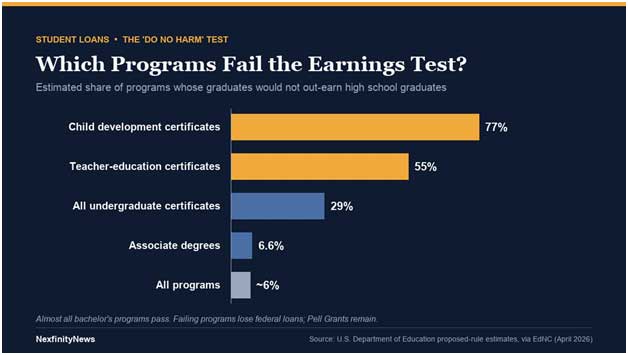
Estimated share of programs that would fail the earnings test, from the Education Department’s proposed-rule analysis. Source: U.S. Department of Education via EdNC. Graphic: NexfinityNews.
Some of the fields most likely to fail are ones the country says it needs more of. In the department’s own estimates, reported by EdNC, 77% of certificate programs related to child development and 55% of teacher-education certificates would fail. North Carolina has an estimated 75 programs at risk, 57 of them at community colleges.
The Case for Cutting Off Loans
Supporters say the test is fair because the bar is low. Andrew Gillen of the libertarian Cato Institute called it “a very, very low bar.” Earning more than a high school graduate is the minimum anyone would expect from a credential that costs time and money.
Supporters also say the policy protects students as much as it protects taxpayers. A student who borrows for a program that doesn’t raise their earnings ends up worse off than if they had never enrolled. That student has the same earning power as before, plus debt. Cooper argued that losing loan access “may induce some of those students to choose higher-value programs of study.” And because the test measures a specific program at a specific school, a weak cosmetology program can lose loans while a strong one down the road keeps them. That puts pressure on colleges, not on fields.
What the record shows: The rule doesn’t stop anyone from studying anything. Students can still pay with Pell Grants, savings, state aid, scholarships or private loans, and colleges can keep offering the program. What ends is federal lending for programs that, on average, don’t pay off.
The Case Against
Critics say the test measures the wrong thing. Earnings are a proxy for repayment, but they don’t account for public service loan forgiveness, income-driven repayment, or the social value of low-paid work. “Who’s to say what’s worth it for taxpayers and what’s not?” Joanna Woronkowicz of the Strategic National Arts Alumni Project asked the Monitor. Jon Fansmith of the American Council on Education, the main lobby for colleges, warned of “the basic collapse of the labor pipeline for these low-pay, high-need professions.”
The National Education Association, the largest teachers union, argued in its formal comments that the rule ignores regional, gender and racial wage gaps. A program that trains mostly women for child care jobs is being compared with a statewide median for all high school graduates. Four years after completion is also early for careers in the arts, ministry or counseling, where income often rises later.
There is also a gap in what the test covers. It measures only students who finish. The students most likely to default on their loans are those who don’t. TICAS research found that borrowers who completed a credential within six years were less than half as likely to default within 12 years as those who dropped out, 11% versus 23%. A program with a high dropout rate and well-paid graduates can pass the test even if many of its borrowers can’t repay.
What the record shows: The earnings test catches programs whose graduates earn too little. It doesn’t catch programs that leave many students with debt and no credential, which is where most defaults happen.
Analysis: Cutting Off Loans Isn’t the Same as Banning a Major
The question of whether the government should ban unprofitable majors has a fairly clear answer, and both sides of the current debate mostly share it: no. A government list of approved majors would decide for students what is worth studying, and it would treat a strong music program and a weak one the same.
The narrower question, whether federal loans should keep flowing to programs whose graduates earn no more than if they had skipped college, is harder to argue against. Federal student loans are made with almost no underwriting. The government doesn’t check a borrower’s major, a program’s track record or the likely salary at the end. Every other lender looks at whether a loan is likely to be repaid. The new test is a minimal version of that check, and on current estimates it affects about one in 20 programs.
The critics’ strongest points are about design, not principle. Measuring earnings four years out may be too early for some fields. Comparing graduates with a statewide median ignores the fact that some essential jobs pay poorly because of how they are funded, not because the training is weak. Limiting appeals to calculation errors leaves colleges no way to show that their graduates are better off in other ways. And the test does nothing about dropouts, where repayment problems are concentrated. Each of these could be fixed without dropping the test.
One tradeoff is real and should not be glossed over. If federal loans disappear for early childhood and teacher-aide programs, some of them will close, and states that rely on those programs to staff classrooms will have to pay those workers more, subsidize the programs, or go without. The rule makes that cost visible. It doesn’t decide who pays it.
The Bigger Picture: New Loan Limits
The earnings test is one part of a broader tightening of federal student lending. Since July 1, 2026, new graduate students can no longer take out Grad PLUS loans. They are limited to $20,500 a year in most programs and $50,000 a year in professional programs such as law and medicine, with a $257,500 lifetime cap across federal loans.
Which programs count as “professional” is already in court. Maryland Attorney General Anthony Brown led a coalition of 24 attorneys general and two governors in suing the department in May. They argue it wrongly left degrees such as nursing, physician assistant and physical therapy out of the higher cap. The case is in its early stages in federal court in Maryland.
Conclusion
The federal government isn’t going to ban majors, and almost nobody in the current debate is asking it to. It has decided that federal loans should go only to programs whose graduates, after four years, out-earn people who never went to college. By the department’s own estimates, most programs and most students clear that bar easily. The ones that don’t are concentrated in short certificates, some associate degrees, and a few low-paid but necessary fields.
The first real test comes in 2027, when the department publishes program-by-program results. That’s when students, colleges and states will learn which programs are at risk, and whether the rule leads colleges to improve those programs, cut their prices or close them.
Key Takeaways
- No major is being banned. Starting in July 2028, college programs whose graduates earn no more than a typical high school graduate in two out of three years will lose access to federal Direct Loans.
- Undergraduate programs are measured against workers ages 25 to 34 with a high school diploma, and graduate programs against workers with a bachelor’s degree, four years after completion.
- About 5% of programs are expected to fail. Most of them are certificates and associate degrees. Almost all bachelor’s programs pass.
- Students in failing programs keep Pell Grant eligibility, and colleges can keep offering the programs.
- Critics say the test penalizes essential low-wage fields, ignores wage gaps, and misses dropouts, who default at about twice the rate of completers.
What Students and Families Should Know
- Nothing changes for current loans: the earliest any program can lose federal loan eligibility is July 2028.
- First results: program-by-program earnings results are expected in 2027.
- Watch for warnings: a program that fails once must notify current and prospective students in writing.
- Pell Grants stay: students in a failing program can still receive Pell Grants.
- Graduate students: Grad PLUS loans ended for new borrowers on July 1, 2026. Check your program’s annual limit ($20,500 or $50,000).
- Ask before you enroll: request a program’s completion rate and graduates’ earnings, not just the college’s overall figures.
Sources
- U.S. Department of Education, Student Tuition and Transparency System and Earnings Accountability final rule, Federal Register (July 1, 2026)
- Duane Morris LLP, “Department of Education Finalizes Earnings Accountability Framework for Title IV Programs” (July 2026); law firm client alert
- Inside Higher Ed, “How Soon Could Colleges Lose Loan Access?” (July 20, 2026)
- The Christian Science Monitor, “Graduate earnings could determine future of some programs” (Sept. 23, 2026)
- EdNC, “Department of Education opens public comments for proposed ‘do no harm’ earnings test” (April 22, 2026); nonprofit news site
- Preston Cooper, “Low-Earning Degrees Will Soon Lose Access to Federal Loans—Is Yours on the List?” (Jan. 15, 2026); American Enterprise Institute, conservative think tank
- American University PEER Center, “How Do College Programs Measure Up Against the One Big Beautiful Bill Act’s New Accountability Standard?” (Oct. 2025); university research center
- CBS News, “Colleges with low-earning grads could lose access to student loans. Here’s why.”
- Association for Institutional Research, “Education Department Refreshes FVT/GE Reporting Data; About 1,550 Institutions Still Short” (Sept. 25, 2026)
- Federal Student Aid, “Guidance on FVT/GE Data Reporting, STATS Early Implementation, and Next Steps for Publication” (updated Sept. 25, 2026)
- Columbia Spectator, “Department of Education labels Columbia and Barnard ‘delinquent’ over missing data” (Sept. 20, 2026); student newspaper
- The Institute for College Access & Success, “Students at Greatest Risk of Loan Default” (April 2018); college affordability advocacy group
- National Education Association, comments on ED-2026-OPE-0100 (2026); teachers union
- NASFAA, “Big Changes to Federal Student Loans: What Graduate Students Need to Know”
- Office of the Maryland Attorney General, lawsuit over professional-degree loan limits (May 2026); Democratic state attorney general
- Oregon Department of Justice, federal litigation tracker: Maryland v. U.S. Department of Education (D. Md.)