

Ask a small business owner what an ad costs and they’ll quote you a number: the monthly spend, maybe a cost-per-click or a cost-per-lead if their vendor bothered to calculate it. That number is on the invoice. It’s clean, it’s budgeted, and it’s almost completely beside the point.
The real cost of running paid ads shows up somewhere the invoice never looks — in the phone that won’t stop ringing, in the employee who drops what they’re doing to answer a call that turns out to be a robot, in the owner who learns to let the phone go to voicemail and, in doing so, misses the one call that was a real customer. It’s a tax on your attention, and nobody quotes it up front.
We got a rare, clean look at that tax. A business owner running a single Yelp ad had done the smart thing: instead of pointing the ad at his everyday line, he set up a dedicated phone number just for the campaign, forwarding to his business, precisely so he could track how the ad was performing. One week later he pulled the raw call log from that tracking number — every call in and out, timestamped to the second and stamped by the phone carrier itself. The export listed 238 call records. What they show is a small-business marketing problem hiding in plain sight.
What the ad actually delivered
First, the honest accounting, because the raw file overstates the drama by exactly double. The 238 records are call legs, not calls. Every incoming call to the ad’s New York City number was logged once when it arrived and again when it forwarded to the owner’s real line. Strip the duplication and you get the true figure: 119 inbound calls, from 45 distinct phone numbers, over a single week.
That’s still a lot of ringing for one ad. The question is who was on the other end. The carrier data answers it in a way that’s hard to argue with.
Most of the “calls” were never conversations. Of the 119 inbound calls, 105 — roughly 88 percent — lasted five seconds or less. The median call length was zero seconds. These aren’t customers who hung up disappointed; they’re auto-dialers connecting and dropping, the mechanical exhaust of a robocalling operation. Only three calls in the entire week ran longer than a minute — and as we’ll see, even those weren’t customers.
More than half were provably fake. Every call that crosses the U.S. phone network now carries a digital signature under a framework called STIR/SHAKEN, designed to prove a caller is really calling from the number they claim. 67 of the 119 calls — 56 percent — failed that check outright, flagged by the carrier as invalid identity. In plain terms: the number on the caller ID was spoofed. It wasn’t real.
And they came from everywhere except where the ad ran. The dedicated ad number was a New York City line, forwarding to the owner’s Long Island number. Yet the single most common origin state for the callers wasn’t New York — it was Texas, with more unique numbers than any other state. All told, the calls traced back to ten states plus Washington, D.C. — California, Illinois, Florida, Ohio and on down the map, from San Antonio to Sanford to Pell City, Alabama. That is not what a local customer base looks like. It’s what a national spam operation looks like.
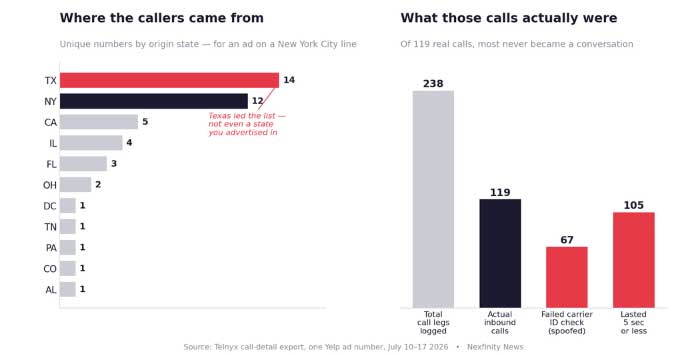
For an ad on a New York City line, Texas led the callers — and of 119 real calls, most never became a conversation.
Source: Telnyx call-detail export, July 10–17, 2026.
Can you identify the numbers? Yes — and that’s the trap
The owner’s instinct was the right one: pull the numbers, find the culprits, block them. The data makes the pattern easy to identify. It makes the culprits almost impossible.
The pattern is unmistakable. This wasn’t 45 different people who each happened to dial once. Forty of the 45 numbers called more than once, and a small core did the real damage. One San Antonio number rang the line nine times in a week. A second number hit it eight times, a third six times, several more four and five times each. A handful of auto-dialers, hammering the same ad line day after day, accounts for nearly all of the traffic. Block the top ten numbers and you’d kill most of the noise.
Except you wouldn’t, and here’s the trap that makes phone spam so corrosive for small businesses. More than half of those numbers were spoofed — that’s what the failed identity checks mean. The “San Antonio” number on your caller ID may have nothing to do with San Antonio, or with the person it actually belongs to. Reverse-lookup the numbers and block them, and you’re not blocking the spammer; you’re blocking whatever random, innocent phone line they borrowed the identity of this week. Next week they’ll wear a different one. This is precisely why we’ve chosen not to publish the individual numbers from this log: naming them would finger victims, not offenders.
And the three longest calls — 61, 82, and 167 seconds? They’re the most human part of this whole log, and they weren’t customers or spammers slipping up. They were the owner. Worn down by a line that wouldn’t stop ringing, he started staying on with whoever he could reach, trying to keep them talking long enough to learn who was behind it. What he found tied the whole week together: the callers who actually spoke to him all opened with the very same line — “How are your Yelp ads performing?” Different numbers, different cities, different spoofed caller IDs, one identical script.
That single sentence is the tell. This wasn’t random robocall roulette that happened to land on a small business. It was a coordinated lead-generation operation that knew exactly what this number was — a brand-new Yelp advertiser — because the number had done its job and gone live on a Yelp ad. The industry that harvests freshly advertised numbers had found it within hours. Ad-“optimization” services, SEO “audits,” web-design pitches, merchant cash advances: the moment your number goes up on a paid ad, it becomes a signal to a whole industry that you (a) have money to spend on marketing and (b) are reachable by phone. The ad you paid to attract customers doubles as a beacon for everyone who wants to sell you something.
And the irony writes itself. The owner created this number for one reason — to measure how his Yelp ad was performing. What the number delivered was a week of strangers asking him that exact question, “How are your Yelp ads performing?”, as the opening line of a sales pitch. The tool built to answer the question became the reason he couldn’t get a moment’s peace to ask it.
The dilemma no cost-per-lead can capture
Put yourself in the owner’s chair. You turned on one ad. In return you got a phone that rang 119 times in a week, where seven out of eight rings were a machine, more than half were lying about who was calling, and the “real people” who did get through were mostly trying to sell you marketing services. Your actual customers are in there somewhere — but now they’re competing for your attention with a wall of noise you’re paying to generate.
This is the small-business marketing dilemma in its purest form. The advertising platform reports your campaign as a success: look at all these calls, look at the engagement. Your cost-per-lead looks reasonable on the dashboard. But the dashboard can’t see that most of those “leads” were robots, and it certainly can’t see the second cost — the one that doesn’t fit in a spreadsheet cell:
- Your time, and your team’s. Every interruption has a switching cost. Answer a spam call mid-task and you don’t just lose the 30 seconds on the phone; you lose the several minutes it takes to get back into what you were doing. Multiply that across 119 calls and you’ve lost a meaningful chunk of a workweek to conversations that produced nothing. This owner spent the three longest calls of his week not closing a sale, but staying on the line trying to identify who was harassing him — time no cost-per-lead figure will ever bill you for.
- The customers you miss. The cruelest part. Buried in the spam were real callers. But an owner trained by a week of junk to distrust their own phone starts screening, delaying, letting it ring out — and the cost of a missed real customer dwarfs anything on the ad invoice.
- The erosion of the tool itself. The phone number is one of the most valuable assets a local business owns. Paid ads, by broadcasting it, quietly degrade it — turning a direct line to customers into a magnet for dialers and pitchmen.
None of that appears on the bill. All of it is the cost of the ad.
What owners can actually do
The situation isn’t hopeless, but the fix isn’t “block the bad numbers” — the spoofing makes that a game of whack-a-mole. The more durable moves are structural:
Use a dedicated tracking number for every ad, and never your main line. This owner already did the single most important thing right: the ad pointed at a separate number that forwarded in. That’s what made this analysis possible, and it’s what lets you kill or re-point a number the moment it gets poisoned — without touching the line your real customers and vendors know.
Turn on carrier-level spam filtering and STIR/SHAKEN screening. The same identity check that flagged 56 percent of these calls as fake can be used to screen them before they ever ring you. Most modern VoIP providers and business phone systems can reject or divert calls that fail attestation. That one setting would have silenced the majority of this week’s traffic automatically.
Add a light layer of friction for the machines. A simple “press 1 to reach us” whisper prompt, or a few seconds of automated greeting, stops the vast majority of auto-dialers cold — they hang up rather than respond — while a real customer barely notices. It converts a wide-open line into one that filters itself.
Measure the right number. Push your ad platform or agency past cost-per-lead to cost-per-qualified-conversation. A campaign that generates 119 calls and two real customers is not a success just because the calls were cheap. If your vendor can’t or won’t distinguish the two, that tells you something about the vendor.
Budget the hidden tax on purpose. When you decide whether an ad is worth it, price in the disruption, not just the spend. Sometimes the honest answer is that a channel delivering mostly noise isn’t worth the attention it costs, no matter how attractive the cost-per-lead looks on the dashboard.
The bottom line
One ad. One week. 238 records, 119 real calls, 45 numbers, and — as best anyone can tell from a log this noisy — a small handful of genuine prospects. The carrier’s own data shows most of it was robots and spoofers — and the calls that reached a human were all the same coordinated pitch, “How are your Yelp ads performing?”, over and over, from an industry that treats every new advertiser as a fresh sales lead.
The cost-per-lead on that campaign will read just fine. It always does. The number that matters — the hours lost, the customers missed, the phone the owner learned not to trust — never makes it onto the invoice. For small businesses weighing whether to run paid ads, that’s the figure worth reckoning with. The dilemma isn’t whether you can afford the ad. It’s whether you can afford everything the ad brings with it.
Related from Nexfinity News