

Long Island’s teacher pensions are fully funded. The retiree health insurance that school districts promise those same teachers is not funded at all, and state law says districts may not save for it.
The gap is now on district balance sheets in the hundreds of millions of dollars. In Syosset, the promised retiree health benefits are valued at $401.8 million, more than the district’s entire annual budget.
Those promises land on a region with fewer students and some of the highest property taxes in the country. This article looks at how the liability grew, why no money was set aside, and who had the power to change that.
Background: Two Promises, Funded Two Ways
Teachers on Long Island earn two kinds of retirement benefits. The first is a pension, paid through the New York State Teachers’ Retirement System (NYSTRS), which covers public school teachers outside New York City.
That system is in strong shape. NYSTRS reports a funded ratio of 100.2% on an actuarial basis and 103.3% at market value as of June 30, 2025. Districts pay into it every year, and the money is invested.
The second promise is health insurance in retirement. Accountants call it OPEB, short for “other post-employment benefits.” Each district provides it on its own, and none of them has money set aside to pay for it.
In simple terms: the pension has a savings account behind it. Retiree health care has only a promise, paid out of each year’s budget.
Fewer students
The region that carries these costs is shrinking. Long Island enrollment fell 12%, from 465,000 to 409,000, between 2007 and 2022. The Empire Center found 83 of 125 districts had fewer students than five years earlier.
The decline is steepest in Suffolk. State data reported by WSHU show Suffolk lost 26,610 students over a decade, a 10.5% drop, while Nassau fell 3.3%.
High taxes
School taxes make up about 70% of local property bills on Long Island. Per-pupil spending on Long Island averages $39,653, the highest of any region in the state.
Related: New Year, New Tax Rules: What Takes Effect in 2027 — and What’s Going Away
Policy Explanation: Why the Money Was Never Saved
Three rules shape the liability: how it is paid, how it is reported, and how hard it is to change.
Pay-as-you-go by law. New York gives school districts no legal vehicle to save for retiree health care. District audits state it plainly: each district “is only permitted to fund OPEB on a ‘pay as you go’ basis, and is not permitted to accumulate funds for the OPEB liability,” in the words of North Merrick’s financial statements. Districts may keep reserves for pension bills, but there is no matching reserve for retiree health.
Reported, but not funded. Since fiscal years beginning after June 30, 2017, accounting rule GASB Statement 75 has required districts to show the full value of these promises on their balance sheets. The rule made the liability visible. It did not create a way to pay it down.
Hard to cut. A 1994 state law limits how far districts can reduce retiree coverage. According to the Empire Center, it essentially requires retirees to receive at least the same level of benefits as active employees. Districts can still change retiree plans alongside changes for current staff.
Set at the bargaining table. The size of the benefit is negotiated. As the New York City Comptroller puts it for the city’s own plan, the OPEB liability is contractual and set in collective bargaining. On Long Island, the same is true district by district: each board of education and its unions set the share of premiums the district pays for retirees.
Examples: What the Audits Show
Every district’s audited financial statements report a “total OPEB liability.” A sample from Nassau and Suffolk:
| District | County | Total OPEB liability | Measured as of | Context |
|---|---|---|---|---|
| Eastern Suffolk BOCES | Suffolk | $742.5 million | June 30, 2025 | Regional services agency serving Suffolk districts |
| Syosset CSD | Nassau | $401.8 million | June 30, 2025 | 2026-27 budget: $306.9 million |
| Bay Shore UFSD | Suffolk | $221.6 million | June 30, 2024 | Proposed 2026-27 budget: just over $211 million |
| Baldwin UFSD | Nassau | $134.9 million | 2024 statements | Down from $175.4 million after a new actuarial valuation |
| North Merrick UFSD | Nassau | $47.1 million | 2025 statements | Elementary-only district |
| Valley Stream UFSD 13 | Nassau | $42.6 million | June 30, 2025 | Elementary-only district |
In Syosset and Bay Shore, the retiree health liability is larger than a full year of district spending. Bay Shore’s enrollment fell from 5,856 to 5,589 between 2019-20 and 2023-24, according to its bond disclosure. Syosset’s grew.
A closer look at Syosset
Syosset’s audit shows how the burden builds. The plan covers 1,244 retirees and beneficiaries but only 887 active employees. The liability equals 388% of the payroll of covered workers.
The district paid $16.2 million in retiree health benefits in fiscal 2025. That money came out of the operating budget, the same budget that pays for classrooms.
Syosset is also one of the few Nassau districts that is growing, up about 9% over ten years to 7,238 students. That matters: the liability follows retirees, not enrollment. A district can add students and still carry more people on its retiree plan than on its active payroll.
Impact: A Fixed Bill on a Shrinking Base
Retiree health costs do not fall when enrollment does. The benefits were earned by staff who have already retired or will retire soon. Fewer students means the same bill is spread across fewer classrooms.
Research on New York districts shows the share is rising. A study by Robert Bifulco, Minchin Lewis and Iuliia Shybalkina found retiree health spending grew from 3.4% to 4.3% of district revenue between 2010 and 2021. On current trends, they project it will exceed 9% by 2040.
In simple terms: every dollar that goes to a retiree’s premium is a dollar that cannot go to a teacher, a bus or a reading program.
The tax cap squeeze
The state’s property tax cap limits how much districts can raise levies each year. Retiree health bills compete with everything else inside that limit.
Bayport-Blue Point shows what happens when the math runs out. Its allowable levy limit for 2026-27 was negative 0.761%. The district proposed a 2.75% increase, needed a 60% supermajority, and voters rejected it.
Most Long Island budgets still pass easily. In Nassau, all 58 district budgets for 2025-26 were approved, many by 60% to 80% margins.
Related: What Is a Living Wage? Nobody Agrees on What It Should Buy
Projection: The Next 20 Years
On its own actuary’s assumptions, Syosset’s annual retiree health bill grows from $16.2 million in fiscal 2025 to about $52 million by 2045. Over 20 years the district would pay roughly $650 million, more than twice what the audit carries as today’s liability, which is discounted.
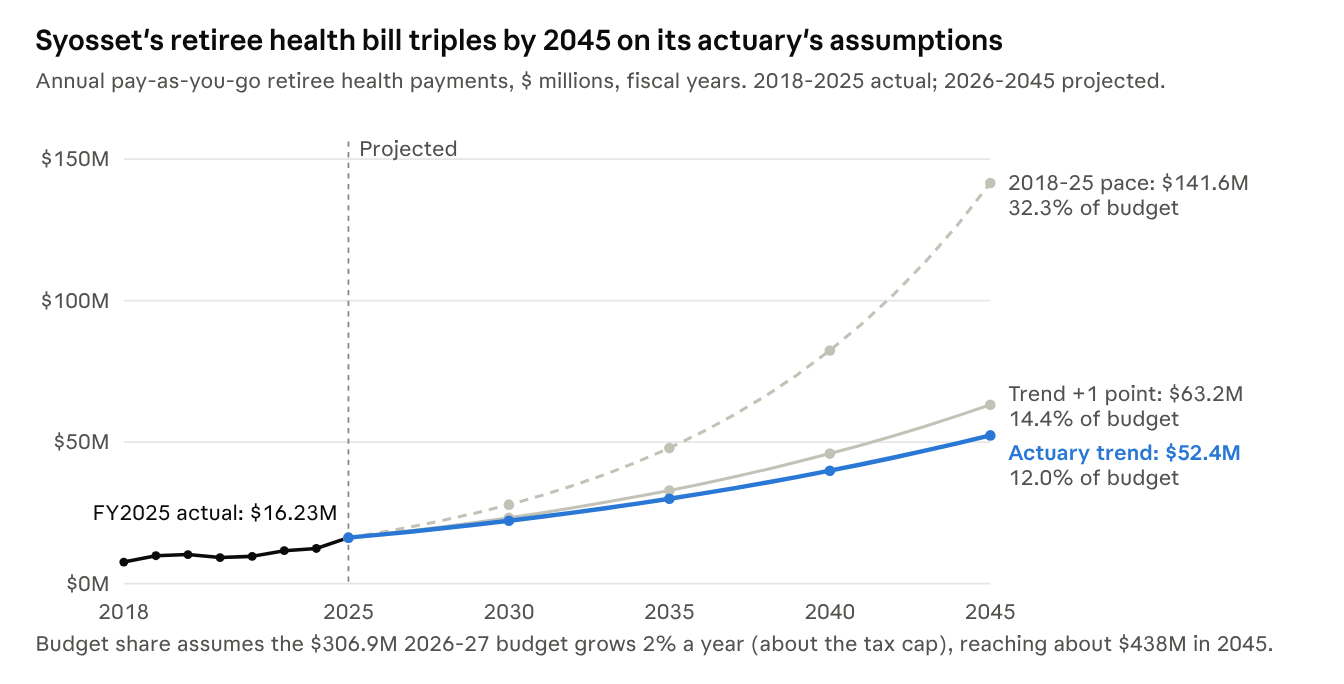
How we built it. NexfinityNews applied three growth paths to Syosset’s fiscal 2025 payments, taken from its audited statements:
| Scenario | Annual growth | FY2045 payment | 20-year total | Share of FY2045 budget |
|---|---|---|---|---|
| Actuary trend | 6.6%, easing toward 3.8% | $52.4 million | $647 million | 12.0% |
| Trend +1 point | 7.6%, easing toward 4.8% | $63.2 million | $727 million | 14.4% |
| 2018-25 pace | 11.4% a year | $141.6 million | $1.22 billion | 32.3% |
The first two use the health cost trend rates in the district’s own actuarial note, and the 1-point sensitivity the audit itself reports. The third extends what actually happened: payments rose from $7.6 million in 2018 to $16.2 million in 2025, including a 31% jump in the last year. It is a stress case, not a forecast.
In simple terms: today, retiree health takes about 5.5 cents of each Syosset budget dollar. On the actuary’s numbers it takes about 12 cents by 2045.
Limits. The projection holds the number of covered retirees flat. It assumes the budget grows 2% a year, roughly the tax cap. It does not model Medicare changes or new contract terms, either of which could move the numbers in either direction.
Across Long Island
No public dataset totals retiree health payments for all 125 Long Island districts. The best statewide guide is the Bifulco study, which projects that school retiree health costs exceed 9% of revenue by 2040 and then level off. Its sample is statewide, and the authors find the heaviest burdens in big-city districts, so Long Island may differ.
As a rough illustration only: Long Island districts spend on the order of $16 billion a year (about 414,000 students at about $39,700 each). At the study’s projected shares, retiree health would cost Long Island districts roughly $0.9 billion a year now and about $2 billion a year by the early 2040s.
Analysis: Who Is Responsible?
No single party created the liability. Each of four groups held a lever, and the record shows what each did with it.
1. The State Legislature
The Legislature controls whether districts may save at all, and it has repeatedly declined to act.
State Comptroller Thomas DiNapoli’s office has pushed for local OPEB trusts since at least 2008. A 2009 Senate bill would have let school districts and BOCES create them. In 2015, DiNapoli proposed an optional trust and estimated local governments outside New York City carried $68.3 billion in unfunded OPEB. None of these proposals became law.
The most recent attempt went backward for schools. Sen. Christopher Ryan’s S10630, introduced June 1, 2026, originally let boards of education set up OPEB reserve funds. A June 3 amendment removed school districts, leaving only counties, cities, towns and villages. The Assembly companion, A11522, was amended the same way: its current version covers only counties, cities, villages and towns. The Senate bill remains in the Rules Committee.
Lawmakers have also added to pension costs. Tier 6 changes in the 2026 state budget will cost NYSTRS an estimated 0.46% of pay, or $94.9 million a year, starting with 2027-28 salaries.
2. Boards of Education
Boards sign the contracts that set retiree health benefits. Every board that agreed to pay a large share of retiree premiums added to the liability, even if the cost would not show up for decades.
Boards can also point to the limits they face. They cannot legally save for the cost, and the 1994 law restricts how far they can cut retiree coverage on its own.
3. Teachers’ Unions
Unions negotiate the benefits on the other side of the table. Retiree health coverage is a long-standing bargaining goal, and unions have defended it in contract talks and in Albany.
NYSUT, the statewide teachers’ union, campaigned for the 2026 Tier 6 changes and has said it will keep pressing for lower TRS member contributions. A pending Senate bill, S9945, would go further. It would bar public employers from cutting health benefits for Medicare-eligible retirees, or the employer’s share of the cost, below December 2021 levels. It has at least 33 Senate co-sponsors and sits in committee.
Unions argue these benefits were earned in exchange for wages and are a contractual promise. Teachers also contribute to their own pensions, and NYSTRS is fully funded in part because of those contributions.
4. Voters
Voters approve district budgets every May, and they have approved the large majority of them. Turnout at school budget votes is historically low, even though school taxes are the largest piece of the property bill.
The other side of the argument
Some finance officials argue pay-as-you-go is reasonable. Prefunding would mean raising taxes now, under a tax cap, to build a fund for costs decades away. Many states and cities that allow OPEB trusts have saved little in them.
The reported numbers also swing with assumptions. Baldwin’s liability fell by $40.5 million in one year because of a new actuarial valuation, not because benefits changed.
Related: NY Prisons and ICE Detainers: The Early-Deportation Law Nobody Is Using
Conclusion
Long Island’s retiree health liability was built in the open, one contract at a time, and reported on every audit since 2018. The pension side shows that funding these promises is possible: NYSTRS is fully funded because districts and teachers pay in every year.
Retiree health care never had that option. Albany has heard proposals for school OPEB trusts since 2008 and has not passed one. This June it removed school districts from the latest bill.
For homeowners, the conclusion is direct: falling enrollment, by itself, will not bring school taxes down. Retiree health care is tied to people who have already retired, not to students in seats. On Syosset’s own actuarial assumptions, it grows roughly three times as fast as a budget held to the tax cap.
It is not the largest cost in a school budget. Salaries, active-employee benefits, pensions and special education make up most of the spending. But it is the one that keeps growing no matter how many students a district serves. Unless the benefits change, or Albany gives districts a way to pay for them over time, that cost will keep pushing levies toward the cap even as classrooms empty.
Key Takeaways
Bottom line: Falling enrollment alone will not lower Long Island school taxes. Retiree health costs follow retirees, not students, and they grow faster than the tax cap lets budgets grow.
- Long Island teacher pensions are fully funded through NYSTRS (100.2% actuarial, June 30, 2025). The underfunded liability is retiree health care.
- State law bars school districts from saving for retiree health benefits. They must pay as they go from each year’s budget.
- Sampled liabilities range from $42.6 million (Valley Stream 13) to $401.8 million (Syosset) and $742.5 million (Eastern Suffolk BOCES).
- Syosset’s plan covers more retirees and beneficiaries (1,244) than active employees (887).
- On its actuary’s assumptions, Syosset’s annual retiree health bill rises from $16.2 million to about $52 million by 2045.
- Long Island enrollment fell 12% from 2007 to 2022, while school taxes make up about 70% of property bills.
- The Legislature, boards of education, unions and voters each share responsibility. A June 2026 amendment cut school districts out of the latest OPEB reserve bill.
Methodology: District liabilities are taken from each district’s most recent audited financial statements or bond disclosures available as of Nov. 26, 2026. Projections are NexfinityNews calculations, not actuarial forecasts.
Hero image: AI-generated illustration, not a photograph. Chart: NexfinityNews projection from audited district data.