
The New York City Police Department ran about 26,000 facial recognition analyses in 2025, according to a report released Nov. 17, 2026 by the Department of Investigation’s Office of the Inspector General for the NYPD (OIG-NYPD).
The audit found the department “largely complies” with the city’s surveillance transparency law. It also documented gaps in supervision, record-keeping and disclosure, along with past violations of the NYPD’s own facial recognition policy.
DOI issued 17 recommendations. DOI Commissioner Nadia I. Shihata said police use of surveillance technology requires “public transparency, policies, and procedures to limit the risk of misuse.”
Background
The review was conducted under the Public Oversight of Surveillance Technology (POST) Act, Local Law 65 of 2020. The law requires the NYPD to publish an Impact and Use Policy (IUP) for each surveillance tool and directs DOI to audit compliance. This is the fourth POST Act report.
In 2025 the City Council added facial-recognition-specific requirements through Local Laws 54 to 56. Those include written rules on modifying images, supervisory approval procedures and an annual audit.
Those rules have a history. OIG-NYPD’s 2022 POST Act report recommended image-modification guidelines and periodic audits. The NYPD rejected both. The Council later wrote them into law.
The current review began after the Legal Aid Society asked the Inspector General in August 2025 to investigate alleged policy violations, including searches against unauthorized photo databases and reliance on outside agencies.
How the NYPD’s System Works
Under the NYPD’s current policy, investigators submit a “probe image” — a still from surveillance video or a photo of an unidentified person — tied to a case or complaint number. Software compares that image against a database of arrest photos and returns possible candidates.
In simple terms: the NYPD does not scan live crowds. It compares one face from an investigation against mugshots after the fact.
The audit identified three products in use:
- DataWorks Face Plus, accessed through a federal High Intensity Drug Trafficking Area (HIDTA) partnership, searching New York and New Jersey arrest photos.
- PhotoManager System (DataWorks Plus), searching all NYPD arrest photos, including juvenile photos.
- FaceExpert (Idemia), searching adult NYPD arrest photos, limited to the Facial Identification Section.
The NYPD’s published policy named the manufacturers but not the products, which the POST Act requires. The policy also described repositories containing parole photos. The NYPD told investigators none of the repositories actually contain them.
Key Findings
Volume. The Facial Identification Section ran about 26,000 analyses in 2025 — roughly 70 a day, by NexfinityNews’ calculation.
Federal requests. The NYPD logged 98 approvals to send facial recognition requests to outside repositories between October 2023 and October 2025. All went to U.S. Customs and Border Protection. About 36% involved cases concerning individuals described as “supportive of foreign terrorist organization.”
All 98 were approved by the Assistant Commissioner for Intelligence and Counterterrorism alone. The policy then in effect required joint sign-off by three officials, while the Patrol Guide listed them as alternatives. The NYPD kept no log of such requests before October 2023 and produced no record of denials.
Supervisory review. In the Intelligence Division, about one-third of 2024–2025 searches were marked “no” for supervisor review. About one-third of log entries listed the same investigator as both requester and recorder. The unit used email and paper logs instead of the case management system the Patrol Guide requires.
Juvenile photos. Searches of the juvenile arrest-photo database require separate approval. The NYPD reported seven between November 2025 and January 2026.
Image editing. Former investigators used enhancement tools on probe images before 2023. A training presentation, last shown in 2022, depicted substituting publicly available photos of celebrities for the probe image. The NYPD said the practice ended in 2022. The Inspector General found no policy issued since then that specifically bans it, and the Patrol Guide contains no image-enhancement guidance.
What the NYPD Says — and What the Audit Checked
The NYPD’s policy states it does not conduct real-time facial recognition. The Inspector General confirmed that through system reviews and interviews.
The policy also states a facial recognition result is a lead only and cannot by itself justify a stop, arrest or warrant. Report templates carry that language. The audit notes, however, that it did not test whether officers followed that rule in practice.
In simple terms: one claim was verified; the other is policy on paper that the audit did not test.
The Legal Aid allegations could not be confirmed because the underlying cases were dismissed and sealed in mid-2025. The Inspector General did find that practices in place through 2025 allowed the kind of duplicate analysis Legal Aid described.
Since November 2025, a single Intelligence Division unit, the Regional Intelligence Support Center, handles facial recognition work, and it moved to a dedicated case system in January 2026. The Patrol Guide has not been updated to reflect those changes.
Cameras Everywhere, Matching After the Fact
The 26,000 figure counts searches, not cameras. The NYPD’s CCTV policy states its cameras cannot run real-time facial recognition. Its digital camera policy adds that a still image from an NYPD camera may still be used as a probe image.
In simple terms: the cameras don’t recognize faces. But a frame pulled from almost any of them can become a facial recognition search.
The size of that camera pool is not officially published. In 2021, Amnesty International’s Decode Surveillance NYC project had volunteers map more than 25,500 public and private cameras at city intersections, and Amnesty estimated the NYPD could draw images from 15,280 cameras in Manhattan, Brooklyn and the Bronx. Both figures are crowdsourced and five years old.
Many of those feeds run into the NYPD’s Domain Awareness System, which pulls together cameras, license plate readers and other data. The city has been connecting cameras at public housing developments to that system.
The DOI audit’s 17 recommendations address the software, the reviewers and the records. None addresses which or how many camera feeds can supply probe images.
Live face scanning in New York is happening in the private sector. Madison Square Garden has screened entrants with facial recognition, and retailers including Wegmans have posted notices of face-scanning cameras. Council Member Shahana Hanif’s Int. 213, which would bar businesses open to the public from using biometric recognition on customers, has the backing of Mayor Zohran Mamdani’s administration and 28 co-sponsors, a majority of the 51-member Council. It has not yet come to a vote.
The MTA, which is adding AI analysis to subway cameras, has said that system will not use facial recognition.
The 17 Recommendations
Seven recommendations would bring the published policy in line with the POST Act — naming the three products and their photo sources, identifying which bureaus have access, and adopting the annual audit required by the 2025 amendments.
The remaining ten are operational. They include mandatory supervisory and blind peer review of every analysis, documented approval before editing probe images beyond standard settings, written records of approvals and denials for outside-agency requests, barring two units from processing the same request, training and periodic recertification for investigators, and regular review of vendors’ National Institute of Standards and Technology accuracy evaluations.
The NYPD told the Inspector General it will complete the mandated annual audit each year beginning in 2026.
Analysis
The report’s central finding is less about what the technology does than about whether anyone can reconstruct what was done with it.
The department’s 2022 rejection of image-editing rules and audits, followed by the Council codifying both, is the clearest test of the oversight model. The NYPD’s formal response to this round will show whether recommendations are adopted voluntarily or again require legislation.
The CBP findings raise a separate question. The audit documents the approvals and the sign-off problem but does not say what happened to the images after they were sent or how CBP’s repositories were used. Those questions sit outside the city’s audit authority.
For background on how camera networks feed police investigations, see NexfinityNews’ Flock Safety investigation and our analysis of the consent gap in surveillance law.
Conclusion
The NYPD’s facial recognition program passed the city’s transparency test in broad terms. The audit’s detail shows a program that grew faster than its documentation: unnamed products, logs that skipped supervisors, federal requests approved outside the written policy and editing practices never formally banned.
The next checkpoints are the NYPD’s formal response to the 17 recommendations, its first annual facial recognition audit in 2026, and the Council’s private-sector face-scanning bills.
Key Takeaways
- The NYPD ran about 26,000 facial recognition analyses in 2025.
- 98 outside-repository requests went to U.S. Customs and Border Protection from October 2023 to October 2025, approved in a way inconsistent with the policy then in effect.
- About one-third of 2024–2025 Intelligence Division searches were marked as having no supervisor review.
- Seven juvenile arrest-photo searches were run between November 2025 and January 2026.
- The published policy did not name the three software products in use, as the POST Act requires.
- NYPD cameras do not scan faces live, but stills from them can be used as search images; the audit set no limit on that.
- DOI issued 17 recommendations; the NYPD previously rejected similar ones that the City Council later made law.
- The audit confirmed the NYPD does not use real-time facial recognition but did not test whether the “lead only” rule is followed in practice.
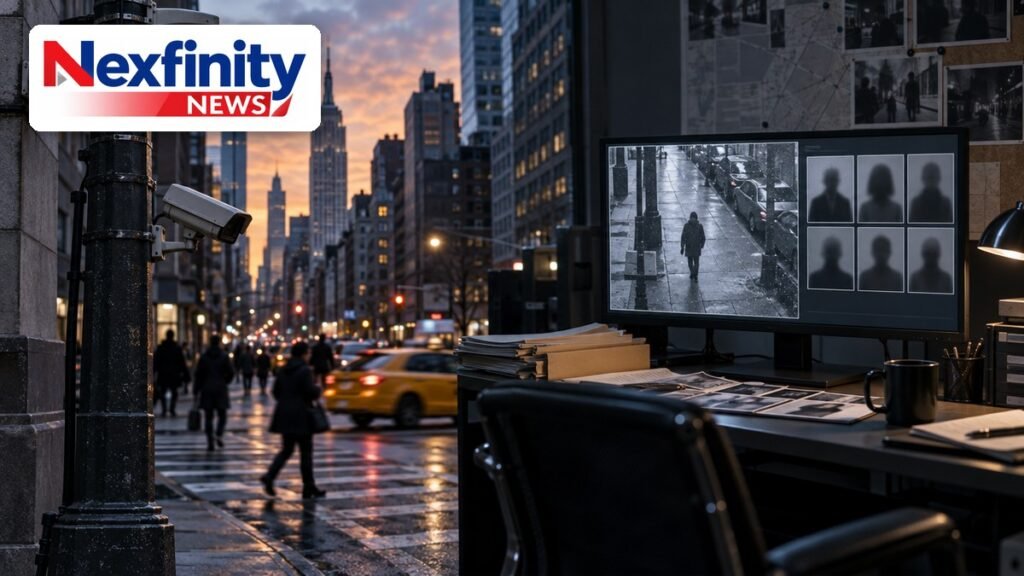
Hero image: AI-generated editorial illustration. The NYPD says, and the city audit confirmed, that it does not run real-time facial recognition on live crowds; searches are run on still images after the fact.