

On Tuesday night, Nov. 17, the National Security Agency told most of its employees to stay home. The agency’s classified internal network, the system America’s largest spy agency runs on, had gone offline. Four days later, President Trump said the FBI’s national crime database, which police check during traffic stops and arrests, had been “targeted in a hack.” By Tuesday of this week, an unclassified CIA system had been breached too.
That came on top of the rest of November. Every flight in the country was grounded. Customers were locked out of the largest banks. Hackers got into the Agriculture Department’s farm payment systems. And on Nov. 20, the president fired his top cyber adviser.
Washington insists this was not a coordinated campaign. Director of National Intelligence Jay Clayton told House lawmakers the outages “are not a coordinated or state-sponsored attack.” That may be true of the outages. But the FBI, USDA and CIA incidents were break-ins, not breakdowns, and nobody has publicly said who did them.
So, are we in a new age of warfare? Governments on both sides of the Atlantic are now acting as if we are. The harder questions are who is actually behind the disruptions, why “AI” keeps getting named, and what a country, a business or a family can do about it.
Twelve Days in November: Breakdowns and Break-Ins
The incidents fall into two groups. It matters which is which.
Breakdowns: officials say no attacker was involved
- Nov. 12–14, Microsoft 365: A global outage of Outlook, Teams and Copilot. Microsoft called it a technical issue “not related to cyber or AI.”
- Nov. 13, the FAA: A nationwide ground stop, the first since 9/11. It was traced to router work at a remote site in Arkansas that flooded the agency’s legacy network.
- Nov. 16, Chase and other banks: Chase blamed a software bug, not a cyberattack.
- Nov. 17, the NSA: The agency’s classified network went offline. The NSA called it “temporary degradation during scheduled routine maintenance.” Sources told CBS News it was linked to an urgent patch for PHP software vulnerabilities, which federal agencies had warned about in October. Clayton said the fix “caused some of these systems to not come back up.”
Break-ins: hacks confirmed, attackers not named
- USDA, week of Nov. 16: Systems for farm payments, mapping and contracting were shut down. Under Secretary Richard Fordyce called the incident a “cyberthreat,” not a software update, according to the agriculture publication DTN.
- FBI, disclosed Nov. 21: The National Crime Information Center, which holds criminal histories, fugitive warrants, stolen-property and missing-persons records, was hacked, Trump said and a law-enforcement source confirmed to ABC News. The FBI declined to comment. Who did it and what was taken are unclear.
- CIA, reported Nov. 24: An unclassified system that handles open-source intelligence was breached, a person familiar with the incident told the AP. No classified information was involved, and it was not clear who was responsible.
- Commercial shipping, reported Nov. 24: U.S. intelligence suggests as many as 50 commercial vessels were compromised through known flaws in Fortinet firewall devices, NPR reported, following a Wall Street Journal report. The government is investigating possible ties to Iran. The FBI and Coast Guard say they have no reports of operational disruptions or danger to crews.
In the middle of all this, Trump replaced National Cyber Director Sean Cairncross with Pentagon chief information officer Kirsten Davies, in an acting capacity. Secretary of State Marco Rubio said the outages had “nothing to do with a hostile actor or another country.”
In simple terms: some of what failed this month broke on its own, and some of it was broken into. Both kinds show the same thing. The systems Americans depend on, from airports and bank apps to the FBI’s own records, are more fragile than most people assumed.
Background: War Without a Declaration
Military planners have a name for this: hybrid or “gray zone” warfare. It means hurting an opponent below the threshold that would trigger a conventional military response. Typical tools include cyberattacks on utilities, ships dragging anchors across undersea cables, arson and explosives on rail lines, and disinformation that makes all of it harder to sort out.
None of these tools is new. In 2021, a ransomware gang shut down the Colonial Pipeline, which carries about 45% of the East Coast’s fuel, and set off days of panic buying. In 2022, explosions ruptured the Nord Stream gas pipelines under the Baltic Sea, and who did it is still disputed.
What has changed is the volume, the number of countries involved, and how this activity now overlaps with real wars. The United States and Israel began striking Iran on Feb. 28, 2026. Within days, U.S. officials were bracing for cyber retaliation. In April, federal agencies warned of an “urgent and ongoing” Iran-affiliated campaign exploiting industrial controllers in American infrastructure. On Nov. 10, President Trump said the war was “effectively over.” Hacking campaigns rarely end on the same day as the shooting.
In simple terms: hybrid war is war by disruption. The goal isn’t to take territory. It’s to make daily life unreliable, make governments look helpless, and leave the public unsure whom to blame.
The Targets: Five Systems Everyone Depends On
Water and power
The clearest case of foreign hands on American infrastructure came this summer. On the night of July 26, the water plant in Braham, Minnesota, a town of about 1,700 people, stopped working. Someone got into the controls remotely and switched them off, taking the treatment plant and the town’s well offline. That weekend the same thing happened at more than 30 community water systems across the state. Officials said the water stayed safe. U.S. intelligence agencies assessed that Iran was likely responsible but have not said so definitively.
The Minnesota attacks were part of a wider pattern. The Center for Strategic and International Studies, a Washington think tank, counted attacks on the U.S. water sector reaching at least 12 states and 100 municipalities and asked whether they were Iranian escalation or opportunism. Small utilities are easy targets. Many run industrial controllers that are reachable from the internet and have no full-time security staff.
China’s activity has been aimed at the same systems, though for a different purpose. In 2024, CISA, the FBI and the NSA said a Chinese state group known as Volt Typhoon had been pre-positioning inside U.S. critical infrastructure, including energy, water and transportation. The agencies said it had stayed hidden inside some networks for at least five years. The aim, they said, was not spying. It was to be ready to disrupt those systems during a crisis, such as a conflict over Taiwan.
Banking
On Nov. 16, customers at Chase, Bank of America, Wells Fargo, U.S. Bank and Zelle reported trouble reaching their accounts. Chase blamed a software bug, not a cyberattack, and has not published a detailed root cause. That was a failure, not an attack. But it showed how much of the payment system runs through a few providers, and how fast a single fault spreads. Britain’s new preparedness campaign uses almost this exact scenario as its example: a cyberattack on a payment provider that leaves grocery shelves full but customers unable to pay.
Transportation
On Nov. 13, the FAA halted every departure in the country for about four hours. The agency traced the failure to equipment tied to new router work at a remote site in El Dorado, Arkansas. The router flooded the FAA’s legacy telecom network with connection attempts, and the agency stopped installing new routers. Officials have ruled out an attack. In Europe the rail threat is not hypothetical. In November 2025, an explosion damaged a Polish rail line used to move aid to Ukraine, and Poland’s prime minister called it sabotage.
Food logistics and storage
Food reaches stores through a small number of distributors, cold-storage warehouses and ordering systems, and that makes it fragile. In June 2025, a cyberattack forced United Natural Foods, the main distributor for Whole Foods, to take its systems offline, and stores reported empty shelves. In July 2026, an attack on Japan’s Nichirei, a frozen-food and cold-chain logistics company, threatened supply to about 1,300 KFC restaurants. The Food and Ag-ISAC, the industry’s threat-sharing group, counted 265 ransomware attacks on food and agriculture in 2025.
Undersea cables and pipelines
Almost all intercontinental internet traffic, and the financial transactions that ride on it, travels through cables on the seabed. More than a dozen cables in the Baltic Sea have been damaged in the past few years, most of them after ships dragged their anchors. On New Year’s Eve, Finnish police seized a cargo ship sailing from Russia on suspicion of cutting a Helsinki-to-Estonia telecom cable. NATO responded with Baltic Sentry, a patrol-and-alarm mission for the sea.
In Asia, Taiwan in 2025 detained a Chinese-crewed cargo ship after a cable to the Penghu islands was cut. This month, the maritime analytics firm Windward reported that three vessels tied to a Chinese state-linked manager stopped near major cable corridors between mid-October and early November. Windward was careful to add that no cable fault was reported, and that ordinary seabed survey work is another possible explanation.
That caution is the point. Cables break 150 to 200 times a year worldwide, mostly because of fishing gear and anchors. Sweden concluded that at least one Baltic cable break was an accident. Deniability is built into the method.
Every Major Government Is Telling Citizens to Prepare
The clearest sign that officials take this seriously is what they’re telling their own people.
- European Union: In March 2025, the EU told its roughly 450 million residents to keep at least 72 hours of essential supplies, citing sabotage of critical infrastructure and cyberattacks among the risks.
- Sweden: In November 2024, it began mailing an updated In Case of Crisis or War brochure to every household, about 5 million copies.
- United Kingdom: On Oct. 22, Britain launched a three-year “Be Ready” campaign asking households to keep three days of supplies, with cyberattacks named alongside severe weather.
- Germany: Interior Minister Alexander Dobrindt has urged Germans to stock food and water. Germany’s civil protection office says China, Iran and North Korea, not just Russia, are targeting the country with hybrid tactics.
- United States: In May, CISA launched CI Fortify, telling utilities and other operators to plan for keeping essential services running while degraded or partly compromised. That includes practicing manual operation and being ready to cut connections to outside networks.
The American message has mostly gone to companies, not households. Washington has not run anything like Sweden’s mailer or Britain’s campaign.
Who Is Actually Behind It: AI or Foreign Adversaries?
The question comes up constantly, and it’s the right one to ask. When something breaks, two easy explanations circulate. Companies say it wasn’t cyber. Commentators say AI did it. Neither answer, on its own, tells the public who is responsible.
The record points to three groups of culprits. AI is a tool all three can use.
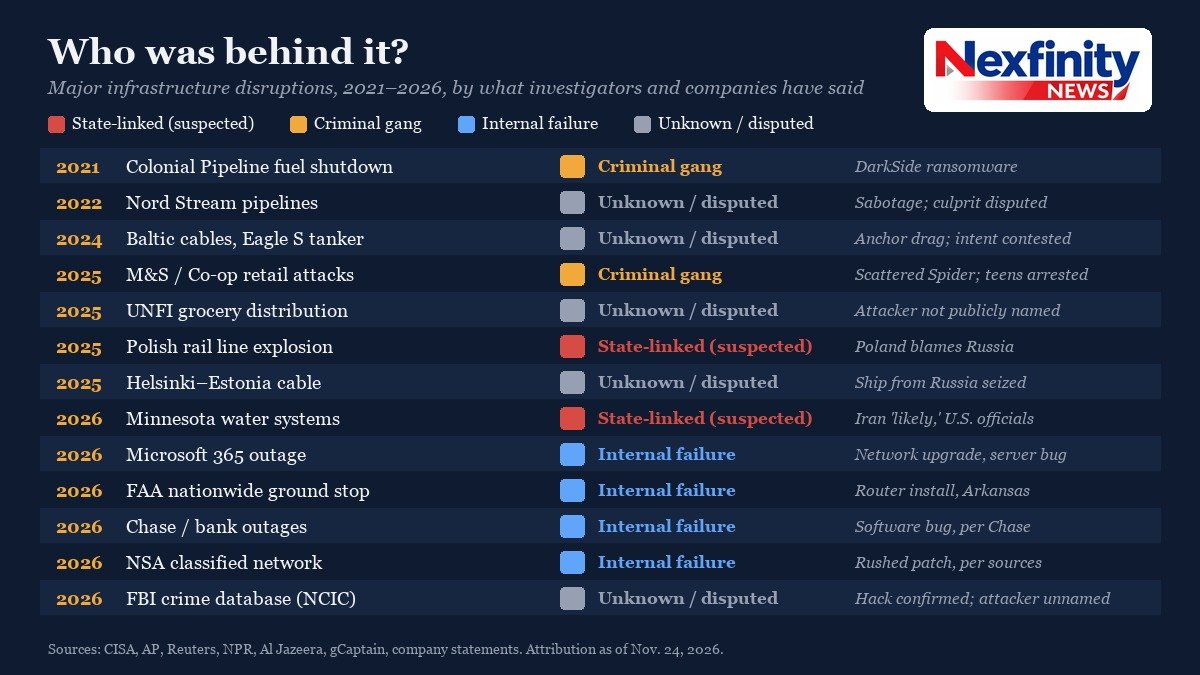
1. Foreign states. The deliberate attacks on infrastructure with strategic aims trace back mainly to governments. Investigators tie Volt Typhoon to China. The water-system campaign is suspected to be Iran’s. A study by the counterterrorism research groups ICCT and GLOBSEC counted 151 Russian-linked sabotage incidents in Europe between February 2022 and February 2026. Western officials say Moscow’s campaign aims to weaken support for Kyiv and map Europe’s weak points. Russia and China deny involvement.
2. Criminals. Some of the most damaging attacks on food and retail came from profit-driven gangs, not governments. In 2025, attacks on the British retailers Marks & Spencer and the Co-op led to arrests of suspects who were mostly teenagers, linked to a group called Scattered Spider. U.S. prosecutors say the group collected more than $115 million in ransoms. Many of the people involved were English-speaking young people in the U.S. and U.K.
3. Our own fragility. The biggest U.S. disruptions this month, at Microsoft, the FAA, Chase and the NSA, were all attributed to internal failures: a software bug, a router installation, a capacity problem and a rushed security patch. Even the government’s top intelligence official says patching one known flaw knocked a classified network offline. Hostile governments study failures like these closely, because each one shows where a single fault can stop a whole system.
And AI? AI makes all three groups faster. In November 2025, Anthropic, the company behind the Claude models, reported that a Chinese state-sponsored group had used its AI coding tool to carry out an estimated 80% to 90% of an espionage campaign against about 30 organizations, succeeding in a small number. Around Nov. 17, the FBI issued an alert about ARTEX, an AI-powered hacking framework being used by both criminals and state-aligned hackers. Microsoft tied one campaign using the tool to a China-aligned group it tracks as Storm-0940.
In simple terms: AI is the power tool, not the burglar. It doesn’t choose to go after a Minnesota water plant or a Baltic cable. People do, usually with a government’s backing or a ransom in mind. Calling it “an AI attack” can blur that responsibility, just as calling an outage “not cyber” without showing evidence can.
Analysis: Is This Really a New Age?
Partly. Sabotage, blockades and attacks on supply lines are as old as war. What’s new is how cheap, distant and deniable the attacks have become, and how much of daily life now depends on systems that were never built to withstand a determined opponent.
A traditional attack has a return address. A gray-zone attack is designed not to. That makes the gap in attribution a weapon of its own. A country that can’t prove who cut a cable or shut off a water plant has a hard time justifying a response. Meanwhile, every unexplained outage, including ones that turn out to be honest accidents, feeds public suspicion. That is a win for an adversary that wants Western societies to distrust their institutions.
It’s also why the official “not a cyberattack” statements have to come with evidence. Most outages really are accidents. But a public that hears the same reassurance after every failure, without a published root-cause report, will stop believing it, and then misinformation fills the gap.
The honest answer to the question in the headline is that we’re in a period of constant, low-level conflict aimed at the systems civilians depend on. It isn’t a new kind of war so much as an old kind fought at internet speed. The countries that come through it best won’t be the ones with the most firewalls. They’ll be the ones whose systems keep working, even badly, when something fails.
Where Do We Go From Here: How to Defend
For governments:
- Build for failure, not just prevention. CISA’s CI Fortify approach is the right model: assume intruders are already inside, and practice keeping water, power and transport running by hand.
- Protect the seabed. Fund more cable repair ships, patrols like Baltic Sentry, satellite backup routes, and laws that make it easier to hold a ship’s owners responsible for damage.
- Publish root causes. Require public post-incident reports for major outages at banks, airlines and utilities so the public can see why officials rule out an attack.
- Talk to households. The U.S. should run a plain-language preparedness campaign like Europe’s.
For businesses:
- Know your single points of failure, including vendors, managed IT providers and cloud regions. Many recent breaches came in through a supplier.
- Train help desks against impersonation. Scattered Spider’s main technique was calling IT staff and talking its way into password resets. Use phishing-resistant multifactor authentication.
- Keep offline backups and paper procedures, and rehearse a day without the network.
For households: The goal isn’t panic. It’s being able to ride out three days of disruption without needing anything to work.
Conclusion
In a single month, America saw its flights grounded, its banks frozen, its spy agency’s network go dark and its national crime database breached. The attacks on water plants, cables, food distributors and rail lines are real, and the governments warning about them are not crying wolf. But the threat isn’t a faceless AI. The deliberate strategic attacks come mainly from foreign states, especially China, Russia and Iran. Criminals, often closer to home, cause much of the day-to-day damage. And our own fragile systems give both groups their openings. AI makes all of it faster and cheaper.
Defending against that doesn’t start with fear. It starts with demanding transparency when systems fail, building infrastructure that can run in a degraded state, and making sure every household can last a few days on its own. A society that can absorb a hit is a much less tempting target.
Key Takeaways
- Attacks on water systems, undersea cables, food distributors and rail lines rose sharply between 2024 and 2026, and governments now treat them as part of hybrid warfare.
- U.S. officials say Iran is the likely culprit behind attacks on more than 30 Minnesota water systems in July. Attacks on U.S. water systems reached at least 12 states.
- China’s Volt Typhoon has pre-positioned inside U.S. infrastructure. Researchers count 151 Russian-linked sabotage incidents in Europe since 2022.
- The EU, Sweden, the U.K. and Germany have told citizens to prepare for at least 72 hours of disruption. U.S. guidance has focused on infrastructure operators.
- In November, outages hit Microsoft, the FAA, the big banks and the NSA’s classified network. Officials attribute all four to internal failures, not attacks.
- Separate, confirmed hacks hit the FBI’s national crime database, USDA farm payment systems and an unclassified CIA system. No attacker has been publicly named.
- AI is a force multiplier for state hackers and criminals alike. It isn’t the one choosing the targets.
What You Can Do: A 72-Hour Checklist
- Water: About one gallon per person per day for at least three days, as Ready.gov recommends, plus extra for pets.
- Food: Three days of non-perishable food that needs no cooking, and a manual can opener.
- Cash: Small bills, in case card networks or ATMs go down.
- Power and information: A battery or hand-crank radio, flashlights, spare batteries and a charged power bank.
- Medicine: A week of prescriptions where possible, and a paper list of doses and doctors.
- Paper copies: Contact numbers, insurance policies and IDs. Don’t rely on a phone that may not connect.
- Fuel and transport: Keep your car’s tank at least half full.
- Alerts: Sign up for your county’s emergency alerts and your water utility’s boil-water notices.
Sources
- CNN: Highly classified US national security communications network goes down
- CBS News: National Security Agency network outage linked to software vulnerability
- ABC News: FBI’s national crime database targeted in hack, Trump says
- Federal News Network (AP): An unclassified CIA system was breached in a cyberattack
- ABC News: USDA hit with cyberattack, sources say
- ABC News: US officials say recent tech outages caused by push to fix vulnerabilities
- NPR: U.S. investigating Iranian ties to as many as 50 hacked commercial vessels
- Fox News (conservative-leaning) live coverage: National Cyber Director fired
- Yahoo Finance: Microsoft outage disrupts Outlook, Teams and Copilot
- Al Jazeera: US authorities probe cyberattack on water systems in Minnesota
- Fortune: Minnesota water systems cyberattack and Iran
- CSIS (centrist national-security think tank): The Cyberattacks on the U.S. Water Sector and the Iran Question
- TechCrunch: Iranian hackers are targeting American critical infrastructure, U.S. agencies warn
- Axios: U.S. braces for cyberspace retaliation from Iran
- Al Jazeera: US, Israel bomb Iran: a timeline
- Business Standard: Trump says Iran war is effectively over
- CISA advisory AA24-038A: PRC state-sponsored actors compromise and maintain persistent access to U.S. critical infrastructure
- CyberScoop: Chinese hacking operations have been in critical infrastructure networks for five years
- Federal News Network: CISA tells critical organizations to prepare for cyber outages (CI Fortify)
- Al Jazeera: US bank outage, what caused Chase problems and Zelle payment delays?
- KTVU: FAA halting installation of new routers after nationwide ground stop
- NPR: Russia’s hybrid warfare rattles Poland and NATO
- Notes from Poland: ICCT–GLOBSEC count of Russian-linked sabotage incidents in Europe
- AP via Yahoo News: Russia is trying to overwhelm Europe with its sabotage campaign, Western officials say
- TechCrunch: Major U.S. grocery distributor warns of disruption after cyberattack (UNFI)
- TechRadar: KFC may be forced to shut some stores following cyberattack at key supplier
- FreightWaves: Food distributors warn cyberattacks can quickly become supply chain disruptions
- gCaptain: Timeline of suspected underwater sabotage in the Baltic Sea
- The Register: Finnish police question crew of ship suspected of cable sabotage
- Bulletin of the Atomic Scientists: Seabed zero, Baltic sabotage
- Radio Free Asia (U.S. government-funded): Taiwan detains China-linked cargo ship over severed undersea cable
- Windward: One state-owned manager, three vessels, three subsea cable corridors
- Recorded Future: Submarine cables face increasing threats
- CISA: The attack on Colonial Pipeline, what we’ve learned
- Wikipedia: 2022 Nord Stream pipeline sabotage
- The Irish Times: Stockpile 72 hours of supplies in case of disaster or attack, EU tells citizens
- Swedish Civil Defence and Resilience Agency: In Case of Crisis or War
- ITV News: Streeting urges public to prepare for disruption from cyber emergencies
- Euronews: Attacks without a declaration of war, how can Germany protect against hybrid threats?
- CyberScoop: Scattered Spider arrests in the U.K. over Marks & Spencer attack
- KrebsOnSecurity: UK charges four in Scattered Spider ransom group
- Anthropic: Disrupting the first reported AI-orchestrated cyber espionage campaign
- The Record: FBI flash alert on the ARTEX AI tool
- BleepingComputer: FBI warns ARTEX AI hacking tool is powering global cyberattacks
- Ready.gov: Build a kit