

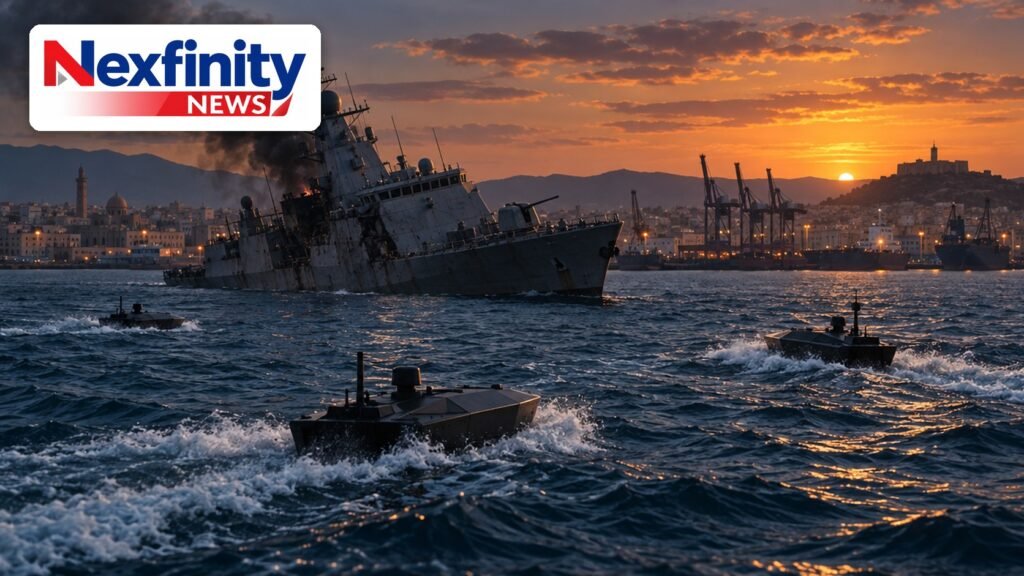
On Nov. 22, 2026, Ukrainian naval drones struck a Russian warship in the port of Benghazi, Libya. Satellite images showed the corvette Merkury capsized in the harbor, Al Jazeera reported. Ukraine claimed responsibility the next day.
Earlier suspected Ukrainian attacks in the Mediterranean hit tankers and a cargo ship. This one hit a Russian navy vessel, more than 2,000 kilometers from Ukraine’s borders.
Libyan officials say Ukraine has operated from western Libya since late 2025 under a covert deal they describe as endorsed by the West. Ukrainian long-range drones have meanwhile struck oil and gas sites in Siberia, more than 2,500 kilometers away, according to Ukrainian open-source reports.
The traffic runs both ways. Drones linked to Russia have entered NATO airspace, and European governments have tied sabotage on their soil to Moscow.
This article lays out how far the war has spread, what the reporting shows about who is backing Ukraine’s Libya operations, and whether the expansion points toward a wider conflict.
Background: A Frozen Front Pushes the Fighting Outward
The ground war has never covered all of Ukraine. Most of the fighting runs along a front line in the east and south that is more than 1,000 kilometers long. According to the Associated Press, that front has stayed largely static because swarms of drones make it hard for either side to advance.
With the ground war deadlocked, both sides have leaned on long-range strikes. Russia keeps hitting Ukrainian cities and energy infrastructure. Ukraine has built its own long-range drones and missiles to hit Russian oil revenue.
In simple terms: neither army can move the front much, so each is trying to raise the cost of the war for the other, far from the trenches.
How Far the War Now Reaches
Ukraine’s strikes now span from the central Mediterranean to western Siberia. The table below lists the farthest-reaching strikes reported so far, newest first.
| Date | Target | Location | Approx. distance | Source |
|---|---|---|---|---|
| Nov. 22, 2026 | Russian navy corvette Merkury and cargo ship MV Angara | Port of Benghazi, Libya | ~2,400 km from the front line | Al Jazeera |
| Nov. 11, 2026 | Omsk Oil Refinery, Russia’s largest by capacity | Omsk, Siberia | 2,500+ km (OSINT estimate) | United24 |
| Sept. 2026 | Novy Urengoy gas plant | Western Siberia | Ukraine’s deepest strike at the time | Al Jazeera |
| Sept. 2026 | Cargo ship Lady Mariia (suspected, unclaimed) | Mediterranean | 2,000+ km | CEPA |
| Mar. 3, 2026 | LNG carrier Arctic Metagaz | Off Libya, near Maltese waters | 2,000+ km | AP via Inquirer |
| Dec. 19, 2025 | Tanker Qendil (“shadow fleet”) | Off Libya | 2,000+ km | Marine Insight |
The Mediterranean and Libya
The Qendil strike in December 2025 was the first Ukrainian attack on a Russian tanker in the Mediterranean. Ukrainian officials said the tanker was empty and suffered critical damage. Russia calls these attacks piracy.
The March 2026 strike on the Arctic Metagaz went further. Russia’s transport ministry said the attack was launched from the Libyan coast by Ukrainian naval drones. Libya’s port authority first said the ship sank; the AP later reported that report was mistaken and the damaged vessel drifted for weeks.
In April, two Libyan officials told the AP that Ukrainian forces operate in western Libya under a covert deal endorsed by the West, and that the March strike came from a military facility in Tripoli. French broadcaster RFI reported the cooperation began with an agreement signed in October 2025. Ukraine’s military intelligence agency, HUR, has declined to comment.
In simple terms: credible reporting says Ukraine is operating from a third country on another continent. Kyiv has not confirmed it.
Benghazi: A Russian Warship Hit in Port
The Nov. 22 attack marked a shift from commercial ships to a military target. President Zelenskyy said seven Ukrainian-made naval drones sank the corvette Merkury and hit the transport ship Angara, calling it an “exemplary Ukrainian operation,” NBC News reported. The SBU, which ran the drones, called both vessels legitimate military targets. Reuters said it verified SBU videos showing fire and smoke around the vessels, according to IBTimes UK.
Accounts of the launch point conflict. The SBU said the drones were put in the water from a “mother ship,” The War Zone reported. The AP, cited by The War Zone, reported they were launched from a base run by Ukrainian forces in western Libya.
Benghazi is the seat of eastern Libya’s rival authorities, aligned with commander Khalifa Hifter. Libya’s eastern government said the corvette was in port to refuel under a military agreement with Russia, the Kyiv Post reported. Libya’s rival governments both condemned the operation and called for an investigation.
Libya analyst Jalel Harchaoui told Al Jazeera he expects Russia and the Hifter family to seek retaliation, though he said that would not be easy.
Deep Inside Russia
Ukraine’s long-range strikes became routine in 2025, when its drones began appearing over Russia’s deep rear month after month. By April 2026, President Volodymyr Zelenskyy said Ukraine could strike at distances of more than 1,500 kilometers, Bloomberg reported.
The range has kept growing. Al Jazeera reported in August that Ukrainian drones were sometimes striking more than 2,500 km inside Russia, past the Ural Mountains. The November strike on Omsk was more than 2,500 km away, based on Ukrainian open-source reports; neither Kyiv nor Moscow has commented officially. Some recent Ukrainian attacks have used more than 1,000 drones at once, according to Daily Sabah.
Kyiv’s stated aim is economic. Ukrainian officials call the campaign “long-range sanctions” meant to cut the oil revenue that funds Russia’s war.
Russia’s Side: Incursions and Sabotage on NATO Soil
The spread is not one-directional. Russian airspace violations against NATO members tripled in 2025, to 18 confirmed incidents, according to a systematic review published by Fortune. That was more than half of all incidents recorded since 2022.
The incidents have become more physical. On Aug. 4, 2026, an explosive quadcopter struck an Antonov An-124 cargo aircraft at Leipzig, Germany. Threat-intelligence firm Recorded Future assessed it as the first sabotage drone of its kind in Europe. German officials linked the plot to Moscow.
A July 2026 report by the International Institute for Strategic Studies, shared with the AP, plotted 144 suspected drone sightings across six NATO countries between 2024 and 2026. It concluded Russia likely launched some of them from “shadow fleet” ships. President Vladimir Putin said in May that Russia is not waging a sabotage campaign against Europe.
NATO’s posture has shifted in response. After Russian drones killed civilians in Romania, allied fighter jets began shooting intruders down, the Kyiv Independent reported. NATO has also launched Operation Eastern Sentry to monitor and intercept drones along its eastern flank.
Who Is Backing Ukraine’s Libya Front?
The reporting supports “Western-backed.” It does not yet show that the European Union, as a bloc, backed the Libya operations.
Two Libyan officials told the AP the deal was endorsed by the West, and the AP reported that backing included the United States. The deal itself is between Kyiv and Prime Minister Abdul-Hamid Dbeibah’s Tripoli government. The AP said the Ukrainian forces, mostly drone experts, operate mainly from an air base in Misrata. RFI reported Ukraine trains Libyan forces in drone use in exchange for basing, with options for arms sales and oil investment.
The only specific names come from analysis and proximity, not confirmation:
| Country | EU member? | What has been reported | Source |
|---|---|---|---|
| United States | No | AP reports the Western backing for the deal included the U.S.; RUSI analyst Jalel Harchaoui named it first among NATO powers whose “knowledge and blessing” is plausible | AP via Yahoo |
| United Kingdom | No | Named by Harchaoui; Russia accused British intelligence of aiding the Arctic Metagaz strike | RFI via Modern Ghana |
| Turkey | No (NATO member) | Named by Harchaoui; the Tripoli government’s main international partner | Al Jazeera |
Harchaoui was describing small groups of Ukrainian operatives in the greater Tripoli area, and he framed it as plausible, not confirmed. Some commentary has placed Italian and other foreign troops at Misrata; the AP account does not name them, and the Kyiv Post says only that international forces are present at the Misrata academy.
The EU’s documented role is enforcement, not basing. Its member states have tightened action against Russia’s “shadow fleet,” and France’s navy has intercepted a sanctioned tanker sailing from Russia in the Mediterranean, Euronews reported.
NexfinityNews asked Ukraine’s Security Service, Ukraine’s Ministry of Foreign Affairs, the U.K. Foreign, Commonwealth & Development Office and the EU’s European External Action Service whether they were aware of or endorsed Ukraine’s presence in Libya. Any responses will be added to this article.
In simple terms: the backing that reporting identifies points to Washington, with London and Ankara named by an analyst. None is an EU member, and no reporting found shows the EU or any EU government endorsing the Libya operations.
Is It a Proxy War?
The Libya reports have revived an old argument: is this a proxy war between Russia and the West? There is no agreed answer, partly because there is no agreed definition. A King’s College London analysis notes the question is both a Russian government talking point and a genuine academic debate.
The case for the label. Senior U.S. officials have used it. In March 2025, Secretary of State Marco Rubio told Fox News it was “a proxy war between nuclear powers.” Western weapons, money and intelligence have shaped the war, and Washington has said weakening Russia is a goal. A covert base in Libya, reportedly with Western backing, fits the Cold War pattern of proxy activity. Reason has argued that using the term does not mean Russia is right, only that it is honest about U.S. involvement.
The case against. Historian Lawrence Freedman has argued in the New Statesman that Kyiv, not the West, sets Ukraine’s war aims. Ukraine has often pushed further than its backers wanted, including on deep strikes. The Atlantic Council notes that arming a country at war does not by itself make it a proxy. Critics also say the label erases Ukraine’s own right to self-defense. Ukraine’s dependence has also fallen: its deepest strikes now use drones it builds itself.
What Libya changes. The Libya front sharpens both arguments. Critics say Western governments knowingly letting Ukrainian forces strike Russian ships from a third country looks like Cold War-style proxy activity. Supporters counter that Ukraine is targeting the oil revenue and naval escorts that sustain the invasion of its own territory, and that Kyiv, not its backers, chose the targets.
In simple terms: Ukraine is fighting a war of self-defense it did not start. Its Western backers also have their own strategic stakes in the outcome. Which of those facts the label emphasizes depends on who is using it.
Analysis: Does the Expansion Foreshadow a Wider War?
Analysts are split. The geographic spread is real, but most of it involves new targets rather than new combatants.
Arguments that the risk is rising:
- The trend is steady and increasingly kinetic. The Kyiv Independent cites one study recording 151 hybrid incidents in Europe between February 2022 and March 2026.
- In July 2026, Foreign Policy reported officials saying they detect signs Russia is “dusting off” plans for attacks on NATO targets.
- Restraint advocates warn the risk runs in both directions. Jennifer Kavanagh of Defense Priorities told Jacobin that without a dialogue channel, Russia could inadvertently cross a line.
- Operations in third countries, such as the reported Libya basing, are a long-flagged path by which a regional war can draw in outside powers.
Arguments for restraint:
- No new state has formally entered the war. Ukraine’s distant strikes target Russian assets and revenue, not third parties.
- A deliberate Russia-NATO war is still widely judged unlikely. A National Security Journal analysis says the likelier trigger is accidental, such as a missile or aircraft straying into NATO territory.
- Outside powers have reasons to hold Moscow back. A RUSI analysis cited by Newsweek argued a wider war would raise the odds of nuclear use and wreck the conditions China needs to pursue Taiwan.
The evidence points less to a planned march toward global war than to a war with blurring edges: covert bases abroad, sabotage on NATO soil and strikes thousands of miles from the front. The nearer-term danger is an accident that forces leaders into a response neither side planned. The clearest warning sign would be NATO civilian casualties in a Western capital, not the distance a drone can fly.
Conclusion
A war fought along a mostly frozen front in eastern Ukraine now reaches a Russian warship in Benghazi, the Siberian gas fields and the airports of Western Europe. Ukraine is reaching outward from bases in a third country, under a deal its hosts say the West endorsed. Russia is probing NATO’s defenses and resolve.
Whether that becomes a broader war depends less on how far the weapons can travel than on whether an incident kills people inside a NATO country, and how leaders respond if one does.
Key Takeaways
- Ukraine claimed a Nov. 22, 2026 drone strike that capsized a Russian navy corvette in Benghazi, its first reported hit on a Russian warship in Libya.
- RFI reports about 200 Ukrainian personnel operate from western Libya; Libyan officials told the AP the deal was “endorsed by the West.” Kyiv has not confirmed basing.
- The AP reports the Western backing included the U.S.; a RUSI analyst also named the U.K. and Turkey. None is an EU member, and no reporting shows EU endorsement.
- Ukraine has also struck a Siberian refinery more than 2,500 km away, and Russian airspace violations against NATO tripled in 2025.
- Whether this is a “proxy war” is contested; most analysts see an accidental escalation, not a planned NATO-Russia war, as the main near-term risk.
Sources
- AP: Ukrainian forces operating in Libya have attacked a Russian tanker
- AP via Inquirer: Arctic Metagaz details
- Al Jazeera: Could the Russia-Ukraine war threaten Libya’s reunification? (Nov. 24, 2026)
- Kyiv Post: SBU says naval drones destroyed Russian corvette in Benghazi
- NBC News: Ukraine sinks Russian warship Merkury off Libya
- IBTimes UK: Reuters-verified SBU video, Libyan reaction
- The War Zone: Mothership claim
- The War Zone: New phase of the naval campaign
- Euronews: RFI investigation on Ukrainian military in Libya
- RFI via Modern Ghana: Ukrainian forces in western Libya
- Kyiv Post: Reported Ukrainian bases in Libya
- CEPA: The growing African front of Russia’s war in Ukraine
- Marine Insight: Qendil strike in the Mediterranean
- United24: Omsk refinery strike
- Al Jazeera: Novy Urengoy strike
- Al Jazeera: “Long-range sanctions”
- AP via WTOP: Long-range strikes, static front
- Bloomberg via Spokesman-Review: 1,500 km range
- Daily Sabah: 1,300-drone attack
- Fortune: NATO airspace violations up 200% in 2025
- Recorded Future: Russia’s hybrid attacks across Europe
- AP via ABC: IISS drone-campaign report
- Kyiv Independent: NATO shooting down drones
- Kyiv Independent: Hybrid incident count
- Foreign Policy: NATO summit and wider-war fears
- Jacobin: Escalation risk
- National Security Journal: NATO-Russia war risk
- Newsweek: RUSI analysis
- King’s College London: Is the war a proxy conflict?
- Moscow Times: Rubio “proxy war” remarks
- New Statesman: Freedman, “Ukraine is not a proxy war”
- Atlantic Council: Proxy war and moral hazards
- Reason: “Of course Washington and Moscow are fighting a proxy war”
Hero image: AI-generated illustration, not a photograph.