
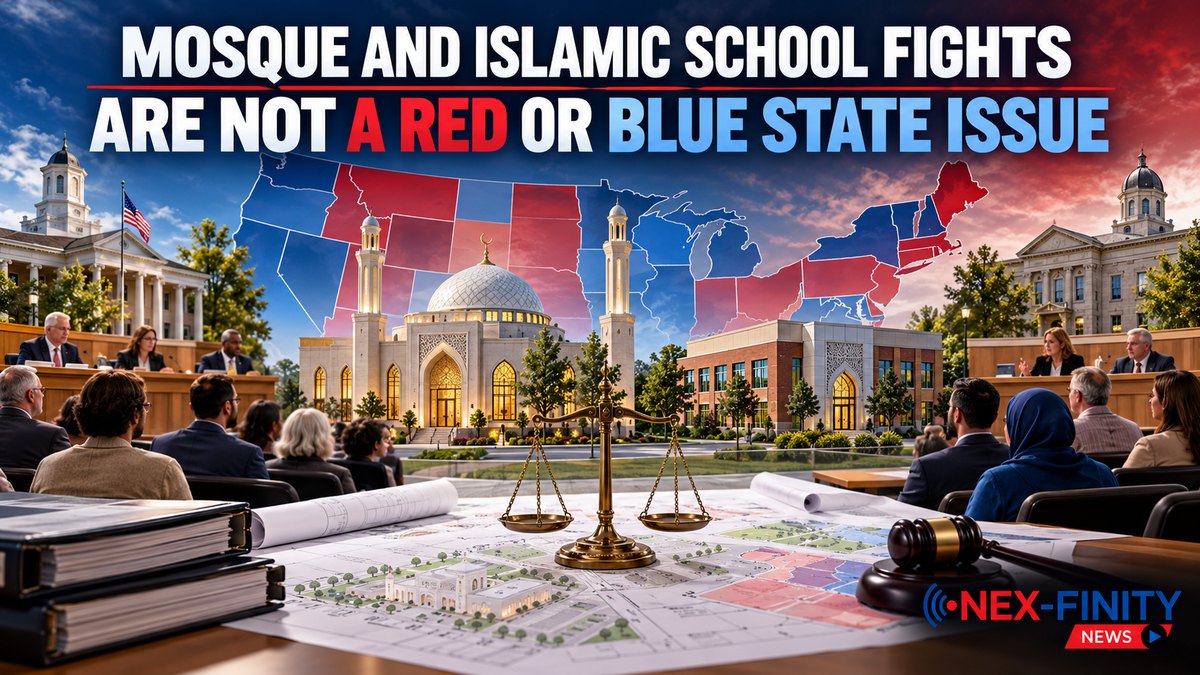
A Fight That Crosses Every Political Map
In January, the city council in Broken Arrow, Oklahoma, voted 4-1 to deny a rezoning that would have allowed the Islamic Society of Tulsa to build a mosque. Nine months later and 1,400 miles east, the Muslim Center of New Jersey filed a federal lawsuit against Marlboro Township after a five-year application ended in denial.
Oklahoma voted for Donald Trump by more than 30 points. New Jersey has not sent a Republican to the U.S. Senate since 1972. The disputes look nearly identical.
Between those two cases sit fights in suburban Texas, rural South Carolina and on Long Island’s South Shore. Each involves a proposed mosque, Islamic school or Muslim-oriented development. Each drew packed public hearings. And in each, opponents insisted their objection was about land use, not religion.
This article examines where those fights are happening, what the law allows local boards to weigh, and the harder question underneath them: whether the most uncompromising voices on each side can share the same zip code.
Background: A Small Population Moving to the Suburbs
Muslims remain a small share of the country. Pew Research Center’s most recent full estimate put the U.S. Muslim population at about 3.45 million people, or roughly 1.1% of the population. Pew projected that figure could reach 8.1 million, or 2.1%, by 2050.
The number of mosques has grown alongside the population. The US Mosque Survey 2020 counted 2,769 mosques nationwide, up from 2,106 in 2010 and 1,209 in 2000.
The more important shift is location. The same survey found the share of mosques in urban centers fell from 17% in 2010 to 6% in 2020, and that most new purpose-built mosques are in suburbs. New York led all states with 343 mosques.
In simple terms: Muslim congregations are doing what Catholic, Jewish and evangelical congregations did before them. They are following their members out of the cities and buying land where zoning boards, not landlords, decide what gets built.
That move puts congregations in front of planning commissions. The 2020 survey found 28% of mosques reported “significant resistance” when seeking zoning approval to build, move or expand.
The Law: What a Zoning Board Can and Cannot Weigh
Every one of these fights runs through the same federal statute. The Religious Land Use and Institutionalized Persons Act (RLUIPA) passed both houses of Congress unanimously and was signed in September 2000.
The law does not exempt houses of worship from zoning. It says local governments cannot impose a “substantial burden” on religious exercise without a compelling reason, cannot treat religious groups worse than secular ones, and cannot discriminate between faiths. It also gives congregations a private right to sue and lets the Justice Department enforce it.
In simple terms: A town can deny a mosque for the same traffic, parking or density reasons it would deny a church. It cannot deny a mosque because residents do not want Muslims nearby.
That is why opponents at nearly every hearing frame their case as land use. It is also why local officials, like the council chair in Lancaster County, South Carolina, open hearings by warning that religion and generalized opposition cannot be considered.
The Justice Department’s own data shows how often mosques end up in this process. Investigations involving mosques and Islamic schools rose from 14% of the Civil Rights Division’s RLUIPA land-use investigations in 2000-2010 to 38% from September 2010 to mid-2016, while Muslims make up roughly 1% of the population.
The same report found a sharp gap in outcomes. About 84% of non-Muslim RLUIPA matters resolved favorably for the religious institution at the investigation stage, compared with 20% of Muslim matters. Muslim cases were more likely to end up in litigation.
Examples: Six Fights, Red and Blue
The 2026 disputes split almost evenly between states that vote Republican and states that vote Democratic. Outcomes tracked the zoning posture of each project far more than the politics of each state.
| Location | State lean | Project | Outcome |
| Bay Shore, NY (Islip) | Blue | Islamic boys school with dormitory at former Catholic seminary | Day school allowed; 120-student boarding denied (Sept. 2026) |
| Marlboro, NJ | Blue | Muslim Center of New Jersey mosque | Denied after five years; federal suit filed (Sept. 2026) |
| McKinney, TX | Red | Islamic Association campus expansion | Approved unanimously (Aug. 2026) |
| Josephine area, TX | Red | “The Meadow,” formerly EPIC City, 402-acre development | State investigations and lawsuits; split court rulings (ongoing) |
| Indian Land, SC | Red | House converted to mosque | Conditional use denied (May 2026) |
| Broken Arrow, OK | Red | Islamic Society of Tulsa mosque and retail | Rezoning denied 4-1 (Jan. 2026) |
Bay Shore, New York
The United American Muslim Association bought the vacant 13.59-acre Montfort Seminary on South Saxon Avenue for $5 million. More than 500 people packed Islip Town Hall for a July 21 hearing. A resident group called Saxon Says No said its objection was scale, not identity.
The Zoning Board of Appeals split the difference. It ruled that town code expressly permits a parochial school on the site, but that housing 120 students overnight is not a permitted accessory use. The school may open as a day school.
One detail cuts against the claim that the fight is purely religious. The same neighbors had earlier opposed a 90-unit assisted-living plan on the property. Some online commentary about the school, however, described it in openly hostile religious terms.
Marlboro, New Jersey
The Muslim Center of New Jersey’s complaint, filed in U.S. District Court in New Jersey, alleges the zoning board bowed to anti-Muslim pressure expressed at hearings and on social media. It also alleges some council members campaigned on stopping the mosque.
Mayor Jonathan Hornik agreed with the board’s denial while condemning hate speech in a June letter.
McKinney, Texas
The McKinney Islamic Association withdrew a 2024 proposal after public opposition. It came back with a smaller plan built to fit the property’s existing 1997 planned-development zoning. A council member said publicly that if the project complied with that zoning, the city had no power to stop it.
After hours of testimony, the council approved the site plan unanimously: a 15,000-square-foot sanctuary, a classroom building and a gym. Some speakers argued the campus could become a base for training people to overthrow the country. Others cited the association’s decades in the city.
The Meadow (formerly EPIC City), Texas
The East Plano Islamic Center’s planned 402-acre community near Josephine has drawn the most sustained government response of any project. Gov. Greg Abbott and Attorney General Ken Paxton launched multiple investigations in 2025, and developers rebranded the project in January 2026.
The courts have split. A Collin County judge temporarily blocked a utility district Paxton accused of helping the project evade state oversight. A Travis County court ordered the Texas Workforce Commission to honor a fair-housing settlement with the developers. The U.S. Justice Department opened its own investigation at Sen. John Cornyn’s request.
Indian Land, South Carolina
Lancaster County Council denied a conditional use permit to convert a single-family home on 4.68 acres into a mosque. The county reported receiving 16 emails in favor and 11 against.
Broken Arrow, Oklahoma
The project would have been the first mosque in a Tulsa suburb. The planning commission recommended approval 4-1; the council reversed it 4-1, with councilors citing land use along a retail corridor.
Reporting by the Tulsa Flyer later found councilors had been flooded with anti-Muslim emails, and some privately agreed with them. A legal expert quoted by the outlet said that if the Islamic Society could prove religious animus, there was a very good chance the denial would be overturned.
Impact: Who Pays When a Board Says No
A denial rarely ends a dispute. It usually moves it to a courtroom, where taxpayers fund the town’s defense.
The pattern in the Justice Department’s data matters here. Because Muslim RLUIPA matters were far less likely than others to be resolved at the investigation stage, they were more likely to become lawsuits. In Broken Arrow, the city’s communications office has already cited the potential for “pending litigation” tied to the application.
The record created at a public hearing becomes evidence. When residents tell a board a mosque will “harbor terrorists,” as some did in Broken Arrow, a plaintiff’s lawyer can later argue that the board’s stated land-use reasons were a pretext. The Marlboro complaint is built largely on that kind of record.
In simple terms: The loudest opponents at a hearing can end up being the best witnesses for the congregation they oppose.
The costs run the other way, too. Congregations spend years and legal fees on applications. The Marlboro application took five years. McKinney’s congregation redesigned its project and waited two years to return.
State-level escalation raises the stakes further. In Texas, the dispute over The Meadow has drawn in the governor, the attorney general, at least two state agencies, two county courts and the U.S. Justice Department.
Analysis: Can the Fringes Coexist?
The honest answer is that the fringes do not have to like each other. American law has never asked them to. It asks them to follow the same rules on the same parcel of land.
Who the fringes are
On one side are opponents who treat any Muslim institution as a security threat. Their claims appear in the public record: that a mosque would “harbor terrorists”, or that a campus could become a base to train people to overthrow the nation. None of the 2026 cases reviewed here produced evidence supporting those claims.
On the other side are concerns that critics say come from the most conservative edge of the Muslim community: separatist housing, amplified calls to prayer, and religious arbitration. Texas officials cited these when Abbott said disputes must be resolved under Texas law, not Sharia. The Meadow’s developers say the project is open and settled a fair-housing complaint with the state to prove it.
In Bay Shore, residents raised the amplified call to prayer. Reporting found no evidence it was part of the formal proposal. Local noise ordinances would govern it either way, as they govern church bells.
The evidence that coexistence already works
The strongest counterpoint to the “two cultures” framing came from a deep-blue county. In Mahmoud v. Taylor, Muslim, Jewish and Christian parents in Montgomery County, Maryland, sued together for the right to opt their children out of lessons using LGBTQ-themed storybooks. The Supreme Court ruled for them 6-3 in June 2025.
That coalition shows the dividing line is not always Muslim versus non-Muslim. On questions of faith, family and schooling, religious conservatives of different traditions have found common cause against secular institutions.
The zoning record points the same way. Where a project fit existing zoning, as in McKinney and the Bay Shore day school, it moved forward despite intense opposition. Where boards had discretion, denials followed, and lawsuits followed the denials.
In simple terms: The system does not resolve whether two groups trust each other. It resolves whether a building meets the code. That has been the American answer for Catholic parishes, Orthodox Jewish yeshivas and Hindu temples before.
Where it could break down
The neutral-rules framework is under the most strain when elected officials take up the arguments of either fringe. The Marlboro complaint alleges council members campaigned on stopping the mosque. In Texas, state officials have opened multiple investigations into one congregation’s project. In both cases, judges, not voters or zoning boards, are now positioned to decide the outcome.
Conclusion
The disputes in Broken Arrow, McKinney, Marlboro and Bay Shore are not going away, and the record from 2026 gives little reason to expect they will ease. A growing, suburbanizing Muslim population will keep buying land, and the neighbors who object will keep showing up to hearings.
Zoning law settles what gets built. It does not settle how people feel about it. McKinney approved its mosque unanimously, but the hundreds of residents who spoke against it did not leave persuaded. A court victory in Marlboro or Broken Arrow would produce a building, not a welcome.
The fights are also no longer local. CAIR-Oklahoma said out-of-state actors and social media helped drive the Broken Arrow opposition, and national outlets on both sides amplified Bay Shore within days. In Texas, the governor and attorney general have made one development a statewide cause. Each case now feeds the next.
The incentives point the same direction. Opposition draws crowds, clicks and votes. Advocacy groups on both sides raise money and attention from each confrontation. Few participants have a clear reason to de-escalate.
So can the fringes coexist? Based on 2026, the realistic answer is that they will share zip codes without sharing much else. What coexistence looks like in practice is legal, not cultural: buildings approved under the code, opponents who remain opposed, and lawsuits when local boards cross the line. That is a lower bar than acceptance, and it is the one the country is currently meeting, unevenly.
Key Takeaways
- Mosque and Islamic school disputes in 2026 have occurred in Oklahoma, Texas and South Carolina as well as New York and New Jersey.
- Federal law (RLUIPA) lets towns regulate houses of worship for land use but bars religious discrimination.
- Mosques and Islamic schools rose from 14% to 38% of Justice Department RLUIPA land-use investigations between the 2000s and 2016, despite Muslims being about 1% of the population.
- Projects that fit existing zoning, such as McKinney’s campus and the Bay Shore day school, were approved despite heavy opposition.
- Hostile public testimony can become evidence in later discrimination lawsuits, as the Marlboro complaint shows.
- In Mahmoud v. Taylor, Muslim, Jewish and Christian parents sued together, a sign that religious conservatives often share more with each other than with secular institutions.
Sources
- U.S. Department of Justice, Religious Freedom in Focus, Vol. 67 (RLUIPA report findings), August 2016
- U.S. Department of Justice, 10th Anniversary RLUIPA report announcement, 2010
- U.S. Department of Justice, Letter to state and local officials on RLUIPA, March 2024
- Pew Research Center, New estimates show U.S. Muslim population continues to grow, Jan. 3, 2018
- Christianity Today, US Mosque Survey 2020 findings, June 2021
- Religion News Service, Report: Number of mosques in US grows, June 2, 2021
- Tulsa Flyer, Broken Arrow council votes 4-1 to deny rezoning, Jan. 13, 2026
- Tulsa Flyer, What Broken Arrow leaders said about a mosque proposal, July 30, 2026
- Religion News Service, Oklahoma mosque project voted down, Jan. 13, 2026
- BatesLine, The Broken Arrow mosque zoning case, Jan. 9, 2026
- Religion News Service, New Jersey Muslims sue township for mosque denial, Sept. 29, 2026
- KERA News, McKinney approves Islamic Association campus expansion, Aug. 5, 2026
- The Daily Signal, McKinney residents speak out on proposed mosque, July 23, 2026
- Dallas Observer, EPIC City to move ahead as The Meadow, Jan. 6, 2026
- Dallas Observer, Timeline of the EPIC City controversy, July 2, 2026
- The Dallas Morning News, Court temporarily blocks efforts tied to EPIC City, March 19, 2026
- KERA News, Travis County court orders TWC to honor agreement, April 29, 2026
- WRHI, Lancaster County Council denies Indian Land mosque conditional use, May 12, 2026
- Fire Island News, Bay Shore boarding school opposition, July 26, 2026
- YourNews, Bay Shore residents challenge proposed boarding school, July 25, 2026
- YourNews, Long Island zoning board allows Muslim boys school, Sept. 25, 2026
- Maryland Matters, Supreme Court says parents can pull kids from classes, June 27, 2025