
On Chicago’s West Side, Frederick Douglass Academy High School sits in a building designed for about 1,000 students. According to a June 2025 ProPublica and Chalkbeat investigation, Douglass had 27 employees for 28 students.
Douglass is the extreme case, but the gap between building space and students runs across Chicago Public Schools (CPS), the nation’s fourth-largest district. On Nov. 3, voters will choose the people who decide what to do about it. For the first time, all 21 seats on the Chicago Board of Education are on the ballot, ending mayoral control of the board that began in 1995 under Richard M. Daley.
The new board takes over a district that has lost students, added staff, and passed a budget that depends on state money not yet approved.
Background: A District Built for More Students
CPS enrollment has fallen for most of the past two decades. The district’s 21st-century peak was 438,589 students in 2002-03; by 2024-25, it enrolled 316,224.
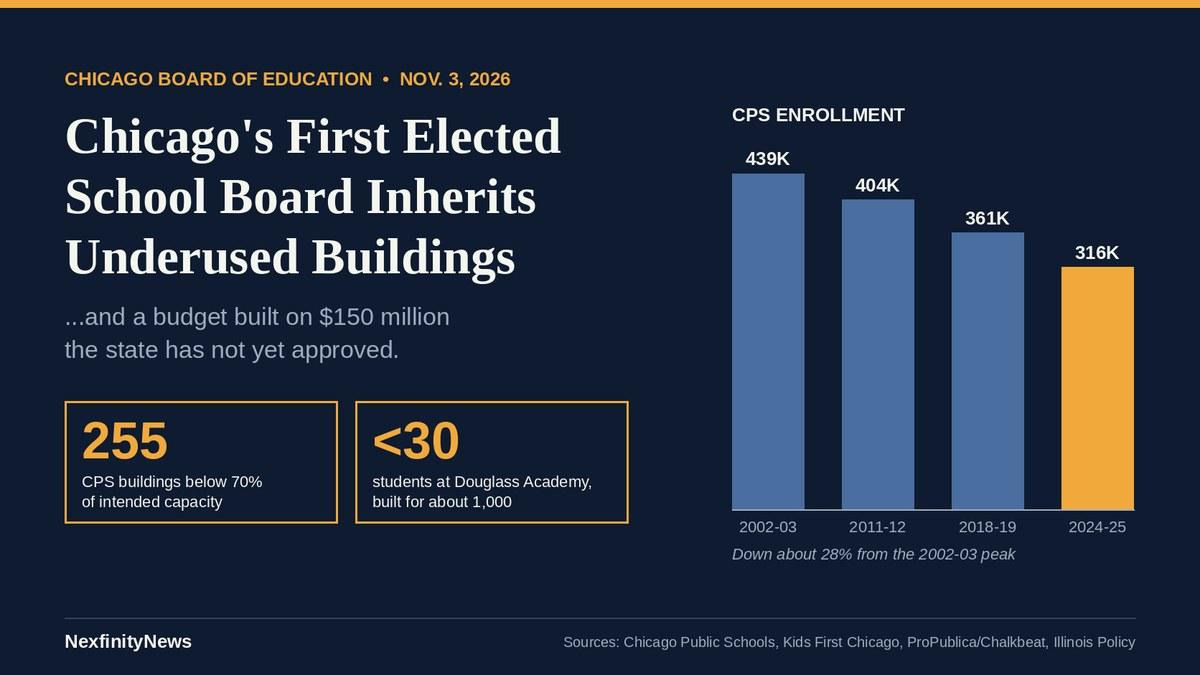
CPS enrollment, 2002-03 to 2024-25. Sources: CPS, Kids First Chicago, ProPublica/Chalkbeat, Illinois Policy. Graphic: NexfinityNews.
The decline is largely demographic. According to Kids First Chicago, Chicago has lost more than 260,000 Black residents since 2000, and CPS data show that since 2019-20, nearly 18,000 students left the city altogether, while only 727 left for non-public schools.
The buildings stayed. In the most recent school year, about 54% of CPS schools, or 255 buildings, were underutilized, and the average utilization rate across 476 single-location schools was 68%.
In simple terms: CPS calls a school “underutilized” when enrollment falls below 70% of what the building is designed to hold. The average CPS school is about one-third empty.
The problem is worst at a small group of schools. The 10 emptiest schools averaged just 11% of capacity, ranging from 3% at Douglass to 16% at Harlan Community Academy High School, and spent nearly $38,000 per student compared with a district average of nearly $20,000.
Policy: Why Staffing Didn’t Fall With Enrollment
Enrollment fell, but staffing did not follow it down. CPS says so itself. In July 2026, a district official said that from 2019 to 2026, enrollment fell by more than 45,000 students while staffing increased by nearly 10,000.
Part of that growth came from federal pandemic aid, and part came from a change in how schools are staffed. Flush with federal COVID aid, the district added more than 7,500 positions over four years, and it began guaranteeing a set number of staff, including 10 teachers, at each school regardless of enrollment.
Supporters of the guaranteed-staffing model argue that every school, however small, needs a principal, a counselor, and teachers for required courses to function. Critics argue it locks in high fixed costs at buildings with few students. Both points apply at Douglass.
The Budget the New Board Inherits
The current board passed a spending plan in July that relies on money CPS does not yet have. A divided board approved a nearly $10 billion budget that preserves jobs but relies on an additional $150 million in state funding that may not materialize.
A narrow majority of members voted to rescind hundreds of staff layoffs that CEO Macquline King’s office had made to address a deficit of more than $700 million, building in the assumption that state lawmakers would provide the extra $150 million.
CPS is also counting on $285 million in TIF funding, and it has said that if the state money does not arrive, it will likely need midyear cuts and layoffs. The district faces shortfalls that could grow to nearly $1 billion. Illinois lawmakers are not expected to vote on the funding until the fall veto session in November.
In simple terms: The new board will take office in January possibly facing a budget gap it did not create but will have to close, through cuts, new revenue, consolidating buildings, or some combination.
What the Test Scores Show
Chicago’s academic record over 20 years has three phases.
The first was real improvement. From 2003 to 2017, according to CPS, the district’s fourth- and eighth-grade math gains on the National Assessment of Educational Progress (NAEP) ranked second among urban districts nationally.
The second was a plateau. By the mid-2010s, Chicago’s average NAEP math scores had stopped rising after a decade of steady gains.
The third has been a mixed recovery at best. In 2024, CPS eighth-grade reading came within 2 points of the national public school average, the closest the district has ever been, according to CPS. But on state tests, only 22.4% of CPS 11th-graders read at grade level in 2024, and 18.6% were proficient in math.
The district’s strongest gains came before the recent staffing increase. That does not show that more staff caused worse results, because the same period included the pandemic, rising absenteeism and population loss. But the data do not show that the added staff have yet produced higher scores.
Who Is Running, and Who Is Paying
There are 43 candidates plus three write-ins, and four people are running for board president, a citywide seat with a four-year term through 2030.
The four presidential candidates:
- Hilario Dominguez, the Chicago Teachers Union’s former political director, endorsed by the CTU.
- Jessica Biggs, a current board member and former CPS principal who won her seat as an independent in 2024. SEIU is backing her, and 10 of the 15 candidates SEIU endorsed are running against CTU-backed candidates.
- Sendhil Revuluri, a board appointee from 2019 to 2022, endorsed by Chicago Democrats for Education, a PAC formed in 2024 to support what it describes as “independent” candidates.
- Victor P. Henderson, an attorney who sits on the board of the Urban Prep charter network. He had no education-group endorsements as of Sept. 18. He has loaned his campaign $500,000, and the president’s race has no donation limits.
Most of the outside money in this race comes from two camps: the teachers union and groups that support charter schools and school choice. In 2024, the CTU’s two political action committees spent $4.3 million, while super PACs tied to the Illinois Network of Charter Schools and the Urban Center spent about $3.5 million combined. This year, the charter network’s PAC has the largest war chest of any group with a stake in the election, more than $4 million, much of it from wealthy donors, some outside Chicago.
Both camps have a direct interest in the board’s decisions. The board approves labor contracts, and it also approves charter school contracts and renewals.
Money has not guaranteed results. Of the nine CTU-backed candidates in contested 2024 races, three won seats. Biggs defeated much better-funded opponents despite having one of the smallest campaign budgets.
Analysis: The Issue That Crosses the Lines
The money in this race splits mostly along union and charter lines. The decisions the winners will face do not.
School closures are the clearest example. Chicago’s 2013 closure of about 50 schools still shapes the debate, and candidates across the field have raised the issue carefully. Biggs, whose school was on the original 2013 closure list, said any move the district makes has to be “fundamentally different than what we did in 2013.”
Local officials have argued the other side. Ald. Chris Taliaferro (29th), whose ward includes Douglass, has acknowledged its low enrollment but said closing it would further remove resources from the neighborhood.
For voters, the key question for each candidate is not only who funds them. It is what they will do if the state money does not arrive: cut staff, consolidate buildings, seek new revenue, or borrow.
Conclusion
Chicago is ending three decades of mayoral control of its schools at a time when the district has more buildings than students need and a budget built on uncertain money. The new board will decide whether to close or consolidate schools, how to staff them, and what to cut if the $150 million doesn’t come.
Douglass Academy, with about as many employees as students, is where those decisions become concrete. Whoever wins on Nov. 3 will have to decide what to do with it and with the 254 other underused buildings.
Key Takeaways
- For the first time, Chicago voters will elect all 21 members of the Board of Education on Nov. 3, 2026.
- About 255 CPS buildings, roughly 54%, are below 70% of their intended capacity; Douglass Academy has fewer than 30 students.
- CPS enrollment fell by more than 45,000 from 2019 to 2026 while staffing rose by nearly 10,000, according to the district.
- The current budget depends on $150 million in state funding that has not been approved; CPS has warned of midyear cuts if it fails.
- Most outside campaign money comes from the teachers union and charter-school groups, but the budget and closure decisions facing the board cut across both camps.
Voter Information
- Election Day: Tuesday, Nov. 3, 2026
- Two votes per voter: one for your subdistrict representative, one for board president (citywide)
- Early voting: begins at the downtown Supersite, then expands to all 50 wards Oct. 19 [EDITOR: confirm start date]
- Mail ballot application deadline: Oct. 29
- Find your subdistrict: Chicago Board of Election Commissioners
Sources
- ProPublica / Chalkbeat, “Chicago Public Schools Face Low Enrollment, Soaring Costs” (June 2025)
- Illinois Policy Institute, CPS space-utilization analysis (2026); free-market advocacy organization
- Illinois Policy Institute, “Chicago Public Schools spends a lot on empty desks” (March 2026)
- Civic Federation, “Chicago Public Schools: Building Underutilization” (March 2025)
- Kids First Chicago, “Chicago’s Enrollment Crisis” series
- Chalkbeat Chicago, 2026 school board election coverage
- Chalkbeat Chicago, 2024 school board campaign spending analysis (Jan. 2025)
- WBEZ, key education endorsements for CPS school board candidates (Sept. 21, 2026)
- WBEZ / Sun-Times, school board campaign spending (July 16, 2026)
- WTTW News, school board president forum (Sept. 15, 2026)
- CBS News Chicago, 2026-27 budget coverage
- Block Club Chicago, Douglass Academy enrollment (Nov. 2023)
- NAEP Trial Urban District Assessment (TUDA)
- Illinois State Board of Education, Illinois Report Card