
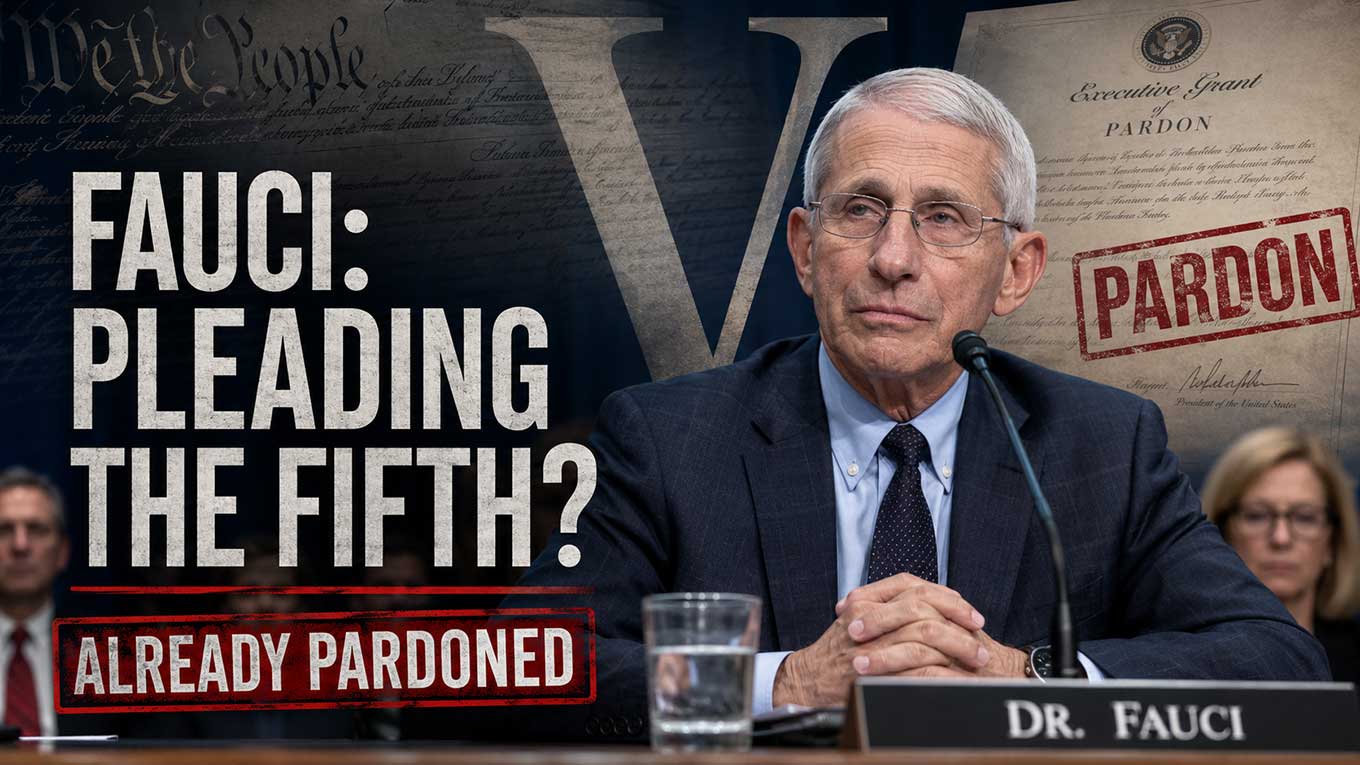
Dr. Anthony Fauci sat before the Senate Homeland Security and Governmental Affairs Committee on Wednesday, July 29, delivered an opening statement, and then said almost nothing else for more than two hours.
Under subpoena from committee chairman Sen. Rand Paul (R-Ky.), the former director of the National Institute of Allergy and Infectious Diseases invoked his Fifth Amendment right against self-incrimination more than 100 times, repeating a single sentence in response to questions about COVID-19’s origins, gain-of-function research funding, EcoHealth Alliance, and his own prior testimony to Congress.
Paul announced at the close of the hearing that the committee would vote on a resolution certifying Fauci’s contempt of Congress. That vote is now scheduled for Wednesday, though the text of the resolution has not been released.
The hearing produced no new factual findings about the pandemic. What it produced instead is a constitutional question that has never been squarely resolved: whether a person holding a presidential pardon can still refuse to testify about the conduct that pardon covers.
What happened in the room
Fauci’s decision was not telegraphed. Paul told reporters on his way into the hearing that he expected answers, and Republicans had prepared questioning built around Fauci’s 2024 testimony to the House Oversight Committee — testimony Paul’s staff has argued is contradicted by emails the committee obtained in 2025 regarding the handling of federal records.
In his opening statement, Fauci accused Paul of an “unhinged obsession” with him, saying the chairman’s purpose was to get him to say something that could be used to put him behind bars. He then declined every subsequent question, citing advice of counsel.
Sen. Josh Hawley (R-Mo.) responded with a rapid series of accusatory questions, each met with the same refusal — a sequence that circulated widely on social media afterward. At points, Republican senators tested the limits of the invocation by asking Fauci trivial questions, drawing laughter from the room. Paul at one point ordered Fauci’s attorney, David Schertler, removed from the committee room. Schertler later told Newsweek that the circumstances made continued cooperation impossible and called Paul’s accusations disgraceful.
Sen. Richard Blumenthal (D-Conn.) characterized the proceeding as a show trial and part of a campaign against science, arguing that legitimate questions about pandemic origins deserve a forum other than what he described as a vendetta against one individual.
The diary that set the table
The hearing did not begin on Wednesday. It began the previous weekend, when Paul published a tranche of Fauci’s pandemic-era journal entries in a thread on X, writing that what Fauci recorded privately and what he told the country were two different stories. The entries span December 2019 through December 2022. The document was taken down Monday evening and reposted Tuesday morning with redactions.
The volume is substantial — 1,141 pages. So is the range. Alongside notes on task force deliberations, the entries include Fauci’s running commentary on his own celebrity, his contacts with public figures, and his deteriorating view of President Trump, whose briefings he described in increasingly unflattering terms as 2020 wore on. The Washington Post led its account on the internal battle over pandemic strategy the entries expose.
The substantive core, and the reason Paul released them, concerns origins. In a January 26, 2020 entry, Fauci wrote that the Wuhan market was not the source but the amplifier, while adding that the virus jumped from animals to humans somewhere. A week later he recorded a conference call on which several senior infectious disease experts raised the possibility that the virus had not arisen naturally. Paul argues the entries show Fauci privately entertaining what he publicly dismissed.
The counter-argument is that this is what early-stage scientific uncertainty looks like in a notebook. The Associated Press noted that a number of the entries were already reflected in Fauci’s 2024 memoir and in interviews he gave at the time, including his account of the uncertainty researchers faced with a novel pathogen. The Hill’s reading of the same entries emphasized that Fauci was unsure about origins in the early months — which is a description of the same text and a very different implication.
Provenance is the other open question. Health and Human Services Secretary Robert F. Kennedy Jr. has said his department extracted the material from government computers and supplied it to the committee, describing on a broadcast interview how the writings were located through emails Fauci sent to himself. In a separate interview with USA TODAY, Kennedy characterized the entries as evidence Fauci was not forthright with the public. Kennedy’s interpretations are his own and are contested; the underlying entries and what he takes them to mean are two different things, and readers should weigh them separately.
The pardon question
On January 20, 2025, hours before leaving office, President Joe Biden issued Fauci a preemptive pardon — clemency for federal offenses he had never been charged with. Biden stated at the time that the pardons should not be read as an acknowledgment of wrongdoing, nor acceptance as an admission of guilt.
Fauci was not alone, and the mechanism was not new. The same tranche covered retired Gen. Mark Milley, the members and staff of the House Jan. 6 Select Committee, and the police officers who testified before it. Biden separately pardoned family members. The tool itself is older: Gerald Ford’s 1974 pardon of Richard Nixon covered uncharged conduct, and Jimmy Carter’s 1977 proclamation extended blanket clemency to Vietnam-era draft evaders who had never been prosecuted.
Paul’s argument is that the pardon removes Fauci’s exposure to federal prosecution for the underlying conduct, and that with no exposure there is no valid privilege to assert. Speaking to reporters after the hearing, Paul said the committee believes the Fifth Amendment may not attach when a pardon is in place, while conceding it is an open legal question rather than a settled one.
There is doctrinal support for the general proposition. The Supreme Court has long held that the privilege protects against a real and appreciable hazard of prosecution, and statutory immunity grants that eliminate that hazard can compel testimony. Whether an executive pardon operates identically to a statutory immunity grant is a narrower question with far less case law behind it.
Fauci’s position addresses a different risk. A pardon is retrospective — it reaches past conduct. It cannot reach a false statement made in the future. Any answer Fauci gave on July 29 would have been new testimony carrying fresh perjury and false-statement exposure that no 2025 pardon covers. That is the argument his counsel appears to be making, and it is the harder one for Paul to dismiss, because Paul himself warned before the hearing that the pardon would not protect Fauci if he lied.
Whether a witness may invoke the privilege specifically to guard against perjury exposure arising from the testimony itself, rather than from the underlying conduct, is contested ground. Courts have generally been skeptical of a freestanding right to refuse testimony solely to avoid the risk of lying under oath. TIME has published a useful primer on the doctrine as it applies here.
What a contempt vote would actually do
A committee vote certifying contempt is the first step, not the last. Paul has said an approved resolution would go to the Justice Department with a recommendation to prosecute. DOJ then decides independently whether to bring charges under the criminal contempt statute — and Paul has acknowledged that discretion is the open variable.
Several senators drew a comparison to Lois Lerner, the IRS official who read an opening statement to a House panel in 2013 and then refused to answer questions. The House voted to hold her in contempt; the Justice Department declined to prosecute. More recently, Congress approved contempt resolutions against Peter Navarro and Steve Bannon, both of whom were convicted and served prison time. Conviction for contempt of Congress can carry a fine and up to a year in custody.
The Lerner case is the closer analogy on posture — opening statement, then blanket refusal — and it is also the precedent that ended in no prosecution. Paul has been here before: he asked the U.S. Attorney for the District of Columbia to investigate Fauci in 2023, and no charges followed. Sen. Roger Marshall (R-Kan.) said after Wednesday’s hearing that he hopes the committee’s findings are handed to a special counsel and moved out of Washington politics.
On the coverage
A claim circulating since Wednesday holds that the press ignored the hearing. That does not survive contact with the record. CNN, NBC News, NPR, Axios, TIME, The Hill and Newsweek all carried it within hours. C-SPAN ran the full proceeding.
The sharper criticism is not volume. It is that the coverage fractured along partisan lines so completely that readers on either side received incompatible accounts of the same documents.
One document, two realities
The clearest illustration is that the press cannot agree on what to call the material. Most outlets described it as Fauci’s private diary. Kennedy publicly disputed that characterization, naming a New York Times reporter and arguing the term is inaccurate and misleading — that these were government records created by a federal employee on a government computer and therefore belong to the public.
That is not a semantic quarrel. It is the whole case. If the entries are federal records, releasing them is oversight and the privacy objection collapses. If they are a personal journal that happened to sit on a work machine, a sitting cabinet secretary extracted a private citizen’s writings and handed them to a senator conducting a years-long campaign against him. The word an outlet chose in its first paragraph determined which story its readers got, and almost no outlet showed its work on the legal question underneath — whether these entries meet the definition of a federal record under the Federal Records Act.
The downstream split followed. Conservative outlets ran the entries as proof of concealment, foregrounding Fauci’s musings on his own fame as evidence of vanity and the origins entries as evidence of dishonesty. Center and left outlets foregrounded the manner of the release, the privacy objection raised by Fauci’s defenders, and the observation that much of the material was already public in his memoir. Wire coverage from the Associated Press came closest to carrying both, noting the overlap with previously published accounts while still reporting Paul’s claims.
The takedown and re-upload with redactions is the detail that went nearly unexamined in every direction. Something in the initial release required removal within 48 hours. What it was, who flagged it, and whether third parties named in the entries were notified are reportable questions, and as of this writing no outlet appears to have answered them.
The result is that a 1,141-page primary source entered the public record and was processed almost entirely through excerpt roundups, each selected to support a conclusion the outlet had already reached. Very few readers have encountered the document itself.
Nearly every outlet covered the hearing itself as spectacle: the viral Hawley sequence, the trivial questions, the attorney ejected from the room, the tally of invocations. Outlets on the right led with the refusal and the pardon-nullifies-privilege theory. Outlets on the left and center led with the absence of new findings and Democratic characterizations of political theater. Both are accurate descriptions of the same two hours. Neither is complete.
For the direct follow-on to a pandemic that killed more than a million Americans, that is a legitimate indictment of the press: saturation coverage of the theater, competing excerpt reels from the primary source, and almost no independent reporting on the record underneath. A blackout is not the indictment — and asserting one hands critics an easy refutation that costs the underlying argument its credibility.
What to watch
- The committee vote on the contempt resolution, scheduled for Wednesday, and the text of the resolution when it is released
- Whether the diary entries are formally determined to be federal records, and by whom — the question the privacy dispute rests on
- What was redacted between the initial release and the Tuesday repost, and why
- Whether the full Senate takes up a referral, and on what timeline
- Whether the Justice Department signals any intent to act — the step that stopped the Lerner referral
- Any filing by Schertler challenging the contempt process, which would put the pardon-and-privilege question before a court for the first time
NexfinityNews will update this story as the committee vote is held. Corrections and source inquiries: editor@nexfinitynews.com