
New York City prosecutors can shape a plea deal so a noncitizen avoids deportation. In the Bronx, a 2019 training guide extended that to crimes against children, telling prosecutors to “[o]ffer something that does not have the child’s age as an element of the crime.”
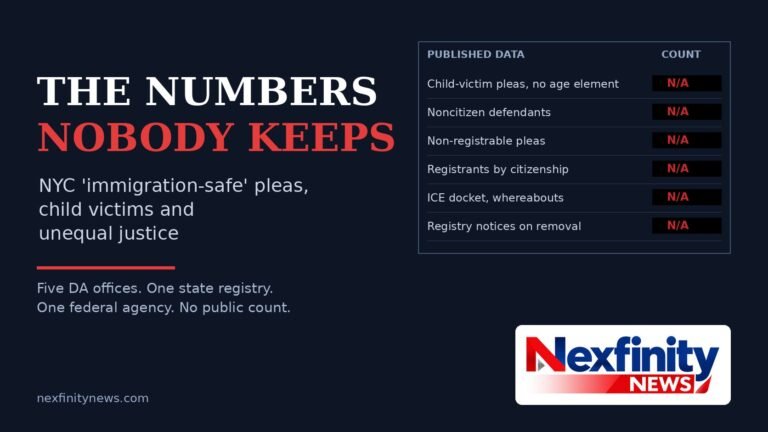
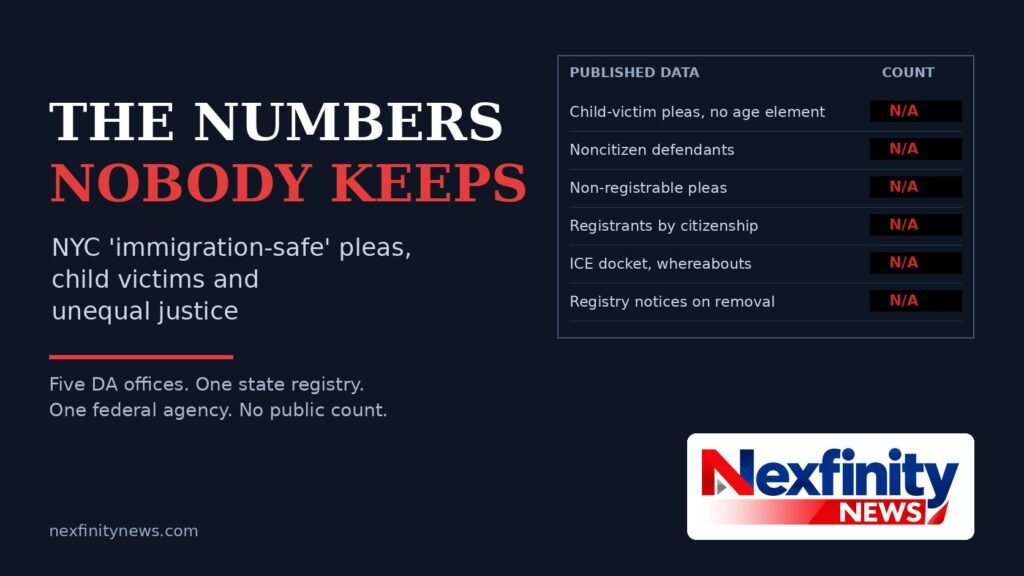
How often that happens is unknown. No district attorney’s office publishes it. The House Judiciary Committee interim staff report that surfaced the guide on Oct. 26, 2026, does not count it either. New York’s sex offender registry does not record citizenship. Federal immigration data counts convictions, not registrations, and does not track where many of those people are.
That gap is the story. Equal treatment under the law is a promise that two people who commit the same crime face the same consequences. When the plea charge, the immigration outcome and the registration outcome are never counted side by side, no one can show whether that promise is being kept.
The guide is real. But the public record stops short of a case: the committee identifies no child sex case where the instruction was applied, and the Manhattan case most often cited ended in a plea prosecutors said would lead to deportation.
This article lays out what the documents say, how “immigration-safe” pleas work, and which numbers would settle the question but are not being kept.
Background: The House Judiciary Report
The report, titled “New York City: The Dangerous Consequences of Sanctuary Policies,” was released Oct. 26, 2026, by the Republican majority of the House Judiciary Committee under Chairman Jim Jordan (R-Ohio) and immigration subcommittee Chairman Tom McClintock (R-Calif.). It is an interim staff report, not a committee finding adopted by vote.
The inquiry began May 27, 2026, when the chairmen sent letters to all five New York City district attorneys, the NYPD and the Department of Correction. New York is one of 13 jurisdictions the committee says it has examined; it has issued similar reports on Fairfax County, Va. and on Denver and Boulder prosecutors.
The report names District Attorneys Darcel Clark (Bronx), Melinda Katz (Queens), Alvin Bragg (Manhattan), Eric Gonzalez (Brooklyn) and Michael McMahon (Staten Island). Its sharpest allegations are against the Bronx and Queens offices.
How an “Immigration-Safe” Plea Works
Federal immigration law makes certain convictions grounds for deportation. “Sexual abuse of a minor” is classed as an aggravated felony under 8 U.S.C. §1101(a)(43)(A), and a “crime of child abuse” is a separate deportable offense.
Immigration courts generally do not re-try the facts of a criminal case. Under what lawyers call the categorical approach, they compare the elements of the state statute the person was convicted under against the federal definition.
In simple terms: if the crime someone pleads to does not require proof that the victim was a child, an immigration judge may not be able to treat it as a crime against a child, even if the underlying facts involved one. The Supreme Court applied this reasoning in Esquivel-Quintana v. Sessions (2017).
That is why the Bronx line matters. An offense “that does not have the child’s age as an element” is the textbook way to keep a conviction from qualifying as sexual abuse of a minor.
Prosecutors are not the only actors here. Since Padilla v. Kentucky (2010), defense lawyers have been constitutionally required to advise noncitizen clients about deportation risk, and New York’s Court of Appeals extended a similar duty to trial courts in People v. Peque (2013). Defense attorneys routinely ask for immigration-neutral pleas. The question the report raises is whether prosecutors should be offering them, and in which cases.
What the Report Alleges, Borough by Borough
The documents differ sharply by office. Only the Bronx material addresses child victims directly.
| Borough / DA | What the report cites | Child-victim language |
|---|---|---|
| Bronx — Darcel Clark | 2019 “Immigration-Conscious Plea Bargaining” guide (strategies: avoid a “conviction,” avoid an aggravated felony); 2023 “Crimmigration” training; advice to omit firearm references and the defendant’s relationship to the victim; pleas to “attempted reckless assault” | Yes: offer a charge without the child’s age as an element |
| Queens — Melinda Katz | Instruction to “exercise extreme caution” with noncitizen cases; immigration specialist who helped reduce or vacate 21 convictions in 2020; May 2026 prosecutor email calling a plea “immigration safe” | None reported |
| Brooklyn — Eric Gonzalez | Policy since 2017 seeking “immigration-neutral” outcomes, mainly for misdemeanors and low-level offenses | None reported |
| Manhattan — Alvin Bragg | January 2022 memo to avoid immigration consequences where jail was not generally expected; office now calls it “outdated” | None reported |
| Staten Island — Michael McMahon | Unit that asks ICE to delay deportations | None reported |
Sources: House Judiciary Committee interim staff report; Fox News.
The report places the Bronx line under a heading on “crimes against children,” which it says covers sex crimes, drug offenses involving a child, endangering the welfare of a child, prostitution involving a child and sexual abuse of a minor. Its source is the office’s Immigration-Conscious Plea Bargaining: A Prosecutor’s Guide, dated April 2, 2019.
Two cautions apply. First, the report shows the guidance existed; neither it nor any public reporting identifies a child-victim case where it was used. Second, the cited examples do not establish that every defendant involved was in the country unlawfully. Many noncitizen defendants are green-card holders, who can also be deported for these offenses.
The Manhattan case
The case most often attached to this debate is that of Nicol Alexandra Contreras-Suarez, a 31-year-old Colombian national charged with following a 14-year-old boy into an East Harlem bodega bathroom on Feb. 11, 2025, and raping him.
In March 2026, Contreras-Suarez pleaded guilty to second-degree rape, down from first-degree rape and stalking, in exchange for a six-month sentence already served. The Department of Homeland Security called the deal “a disgrace.” Former Manhattan prosecutor Mark Bederow called the sentence “extraordinarily low.”
Bragg’s office said the plea was reached with the victim’s family to spare the boy from testifying, and that it expected the defendant to be deported “due to the felony conviction.” ICE had lodged a detainer in February 2025.
At sentencing in early July 2026, Contreras-Suarez received the six months already served, 10 years of probation and a level-two sex offender designation. The DA’s office said the defendant was remanded without bail on a Massachusetts detainer and would be sent to Medford, Mass., to face robbery, prostitution and assault charges. It said the conviction carries immigration consequences but that detention and deportation are for federal authorities. Whether ICE has since taken custody has not been reported; NexfinityNews has asked ICE.
That makes this a case about sentence length, not immigration avoidance. The plea kept a sex-offense conviction with an age element on the record, and with it both the registry designation and the deportation ground.
Detainers and Pleas Are Two Different Fights
The plea guidance and ICE detainers are often described as one issue. They are separate mechanisms controlled by different agencies.
A detainer is ICE’s request that a jail hold someone up to 48 hours past release so agents can take custody. In New York City, that decision belongs to the NYPD and the Department of Correction, not prosecutors.
The committee reports the NYPD received 20,255 detainers from July 2018 through June 2026 and honored none; 9,645 of them came in the most recent 12 months. It says the Department of Correction declined all 2,852 it received over the same period. DHS separately said in October that New York authorities statewide had ignored 16,070 detainers.
A plea deal works on a different layer. It shapes the conviction ICE later relies on to deport someone. In simple terms: detainer policy decides whether ICE gets the person at the jailhouse door; plea bargaining decides whether ICE has a deportable conviction at all.
The two interact. Under city law, the Department of Correction may honor a detainer only when ICE presents a judicial warrant and the person has a qualifying “violent or serious crime” conviction. A reduced plea that removes that conviction removes both the detainer path and the deportation ground.
How the Offices and Their Critics Respond
Most of the named offices have said little in public. The Bronx, Queens and Brooklyn offices did not respond to Fox News Digital’s requests for comment. At an Oct. 29 press conference, Katz and Gonzalez did not answer a reporter’s question about the report, according to Hot Air, citing the New York Post.
The Staten Island office called the report “flagrantly false and patently political.” It said it asks ICE to let it prosecute and convict defendants before deportation, so victims get justice. Bragg’s office told the committee its 2022 policy was “outdated” and that prosecutors now weigh immigration status case by case. Clark has said that since 2020 her prosecutors must consider employment, immigration, family and other collateral consequences.
The case for the practice rests on proportionality. In 2017, Gonzalez argued that when two pleas both hold a defendant accountable, justice favors the one without automatic immigration penalties. Prosecutors from both parties have also argued that immigration fear keeps victims and witnesses from coming forward.
Critics answer that equal treatment cuts the other way. Council Member Joann Ariola asked when protecting a defendant’s immigration status became part of a DA’s job. Retired ICE deputy field office director Scott Mechkowski singled out the Bronx child-age line as designed to keep deportable offenders in the country.
A minority report from committee Democrats, “Acquittal by Removal” (May 2026), makes a different point: deporting defendants before trial can end prosecutions entirely, leaving victims with no conviction at all.
On Nov. 12, 2026, NexfinityNews sent written questions to all five district attorneys’ offices, to U.S. Immigration and Customs Enforcement and to the New York State Division of Criminal Justice Services, which maintains the sex offender registry, with a deadline of 5 p.m. Friday, Nov. 14. NexfinityNews also filed a Freedom of Information Law request with DCJS for aggregate registry data. None had responded by publication; ICE’s press contact sent only an out-of-office reply. DCJS acknowledged the records request on Nov. 13 (reference R000592-111326). This article will be updated with any responses received.
What Nobody Counts
Every number needed to test whether plea deals are applied equally already exists in some government file. None of it is published in a form that answers the question.
| Question | Who holds the data | Published? |
|---|---|---|
| How many child-victim cases ended in a plea without an age element? | Each DA’s case management system | No |
| Of those, how many defendants were noncitizens? | DA immigration specialists’ files | No |
| How many child-victim cases ended in pleas to non-registrable charges, by citizenship? | DA offices; NYS Division of Criminal Justice Services | No |
| How many registered sex offenders are noncitizens or undocumented? | State registries | No; registries generally do not record immigration status |
| How many noncitizens with sex convictions are on ICE’s non-detained docket, and where are they? | ICE | Partially; one-time count released to Congress in 2024, whereabouts unknown |
| How many deported sex offenders were reported to registry officials on removal? | ICE | No; GAO flagged the gap in 2013 |
The closest national figures are proxies. A 2024 NCMEC survey found more than 972,000 registered sex offenders in the United States, with no breakdown by immigration status.
In a Sept. 25, 2024 letter to Rep. Tony Gonzales, ICE reported that as of July 21, 2024, 15,811 noncitizens with sexual assault convictions and 4,250 with pending sexual assault charges were on its non-detained docket: known to the agency but not in its custody. ICE later said it did not know the exact whereabouts of everyone on the docket, and some may have left the country or be in prison. DHS officials have said many are serving sentences in state or local custody.
Those are conviction counts, not registry counts. The only registration rate on record is more than a decade old. A 2013 Government Accountability Office review found that, as of September 2012, 72% of noncitizen sex offenders under ICE supervision were registered, 22% were not required to, and 5% should have registered but had not. GAO also found ICE did not consistently notify registry officials when offenders were released or removed.
In simple terms: a parent can look up whether a registered sex offender lives on their block. No public official can say how many of the people who should be on that registry were plea-bargained off it, deported off it, or never put on it.
Equal Treatment, Other Plea Deals and the Sex Offender Registry
Is this equal treatment under the law?
Both sides claim the equal-treatment argument. Critics say that when a prosecutor weighs immigration status, two people who commit the same crime can walk away with very different outcomes. Defenders say a citizen and a noncitizen who take the same plea already face unequal punishment, because only one can be deported. On that view, an immigration-neutral plea evens out the result rather than tilting it.
The constitutional question is largely untested. Courts give prosecutors wide latitude on charging and plea offers. The Immigrant Legal Resource Center argues that citizen and noncitizen defendants are not “similarly situated” under equal-protection law, so these policies do not violate citizens’ rights.
The first federal test is under way in Virginia. On May 6, 2026, the Justice Department opened a civil rights investigation into Fairfax County Commonwealth’s Attorney Steve Descano. It is examining whether his office’s policy of weighing immigration consequences produced unequal treatment, and said it had reached no conclusions. No findings have been announced.
States also disagree. California law has required prosecutors since 2015 to weigh avoiding adverse immigration consequences in plea talks as one factor. New York has no such statute; the city offices set their own policies.
Do other plea deals work the same way?
Mechanically, yes. In New York, 94% of felony cases end in guilty pleas, and lowering the charge is routine. Prosecutors are also encouraged to weigh collateral consequences for every defendant, such as job licenses, housing and benefits. A former president of the National District Attorneys Association wrote that prosecutors must consider them to deliver a proportionate penalty.
The difference is in what gets written down. Most collateral-consequence policies apply to all defendants. The Bronx and Queens materials in the House report single out noncitizens and assign immigration specialists to their cases. Critics argue that a dedicated process for one group of defendants is the unequal treatment itself.
Child sex cases are also plea-bargained for reasons unrelated to immigration. In the Contreras-Suarez case, prosecutors said they reduced the charge to spare the victim from testifying, a common reason in cases with child witnesses.
Do they become registered sex offenders?
It depends entirely on the offense in the plea. New York’s Sex Offender Registration Act requires registration only for offenses listed in Correction Law §168-a, which include the Penal Law Article 130 sex crimes. Endangering the welfare of a child, a common plea charge in cases involving minors, is not a registrable offense.
That sets up a second gap alongside the immigration one. Dropping a child’s age from the charge does not by itself avoid registration; several Article 130 offenses without an age element are still registrable. But a plea to a non-sexual charge such as endangering the welfare of a child can avoid both deportation as sexual abuse of a minor and registration. That route is open to citizens and noncitizens alike.
The Contreras-Suarez plea, second-degree rape, is an Article 130 offense, and the defendant was designated a level-two sex offender at sentencing. Registration applies where an offender lives, works or attends school. A person deported abroad generally does not register in New York while gone. Under International Megan’s Law, a U.S. agency can alert the destination country when a registered offender travels abroad.
No NYC DA’s office publishes how many child-victim cases end in pleas to non-registrable charges, for citizens or noncitizens.
Analysis: Unequal Application Without a Record
The committee documented intent; no one has documented outcomes. A training guide shows what prosecutors were permitted to do. It does not show how often they did it, for whom, or in which cases.
The same plea tools reach different defendants differently. A charge without a child’s age can keep a noncitizen from being deported. A plea to a non-sexual charge can keep anyone off the sex offender registry. Each office decides case by case, under its own policy, with no published tally.
That is where unequal application can take root. When one class of defendants gets a dedicated specialist and written strategies for avoiding a consequence, and no one counts the results, disparities can grow without anyone being able to see them. The absence of data does not prove unequal treatment. It makes unequal treatment impossible to rule out.
The gap runs past the DAs. State registries do not track citizenship. ICE released one snapshot of sex-offense convictions on its docket and could not say where many of those people were. GAO’s warning about registry notifications on removal is 13 years old.
Closing it would not require new investigations, only reporting. Each DA could publish annual counts of child-victim cases by original charge, plea charge, registrable status and whether an immigration specialist was consulted. New York could add citizenship status to the registry record. ICE could publish its docket figures on a schedule. Victims’ families, who now have no way to see where their case fits, would be the first to benefit.
Conclusion
New York City prosecutors weigh immigration consequences in plea bargaining, and the Bronx guidance extended that to crimes against children. Whether that has produced lighter outcomes for noncitizen defendants than citizens, or in which cases, cannot be answered from any public record.
Equal treatment under the law cannot be verified without data. Today the data that would verify it is held across five DA offices, a state registry and a federal agency, and none of them publishes it.
Key Takeaways
- A 2019 Bronx DA guide told prosecutors to offer noncitizen defendants charges without “the child’s age as an element.”
- The Oct. 26, 2026 House Judiciary report identifies no specific child sex case where that guidance was applied.
- No NYC DA’s office publishes plea outcomes in child-victim cases by citizenship or registrable status.
- New York’s sex offender registry, like most state registries, does not record immigration status.
- ICE reported 15,811 people with sexual assault convictions on its non-detained docket in 2024 and could not account for all of their whereabouts.
- The only registration-rate study of noncitizen sex offenders is a 2013 GAO report.
- Without these numbers, equal application of plea bargaining can be neither proven nor disproven.
Sources
- House Judiciary Committee — “New York City: The Dangerous Consequences of Sanctuary Policies,” interim staff report (Oct. 26, 2026)
- House Judiciary Committee — Jordan/McClintock letters to NYC officials (May 27, 2026)
- House Judiciary Democrats — “Acquittal by Removal” (May 12, 2026)
- ICE letter to Rep. Tony Gonzales (Sept. 25, 2024)
- GAO-13-832 — ICE and noncitizen sex offender registration (2013)
- NYC Mayor’s Office of Immigrant Affairs — NYC detainer laws (Admin. Code §9-131)
- California Attorney General — Penal Code §1016.3 guidance
- Immigrant Defense Project — Esquivel-Quintana practice advisory
- Immigrant Legal Resource Center — equal protection and immigration-related prosecutorial considerations
- People v. Perez — endangering the welfare of a child not registrable
- Columbia Human Rights Law Review, Jailhouse Lawyer’s Manual ch. 40 — New York plea rates
- NCMEC / Global Child Exploitation Policy — registry totals
- Fox News — House report on NYC prosecutors’ plea deals
- Fox News — Contreras-Suarez plea (Mar. 25, 2026)
- New York Post via AOL — Contreras-Suarez plea (March 2026)
- New York Post via AOL — Contreras-Suarez sentencing (July 2026)
- Just the News — DHS statement on the plea
- NBC News — ICE non-detained docket and arrests
- Lawyer Monthly — DOJ investigation of Fairfax prosecutor
- BK Reader — Brooklyn DA immigration policy (2017)
- Hot Air — Oct. 29 press conference account