
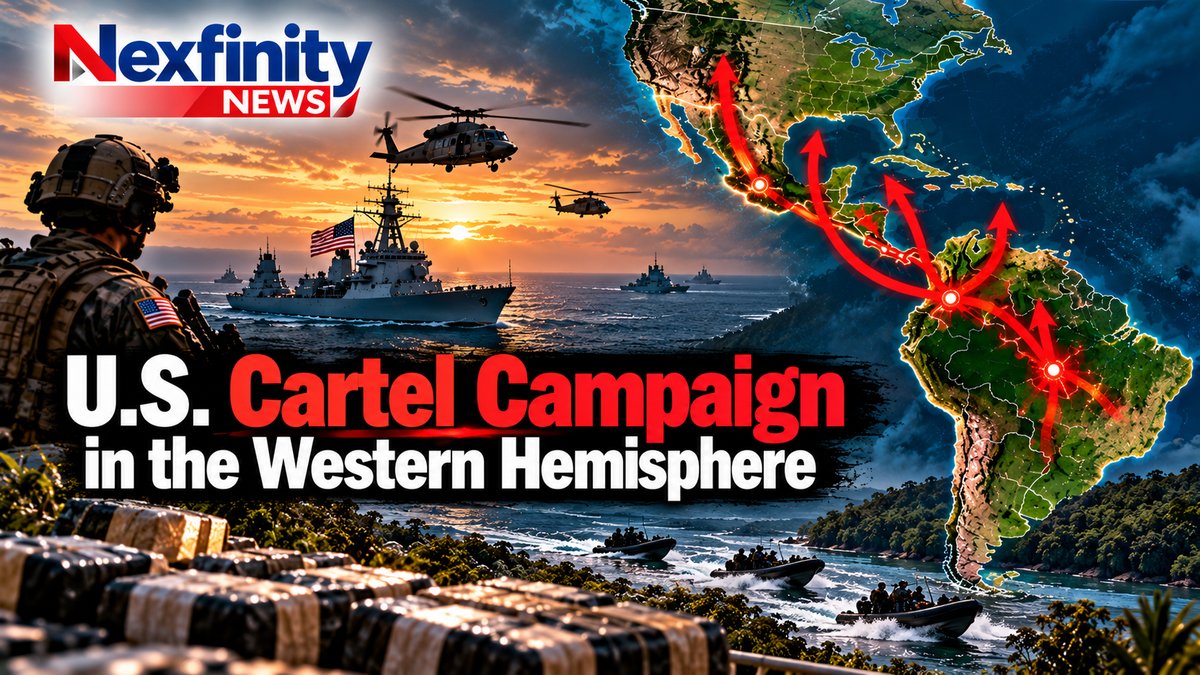
Thirteen months after the first U.S. missile hit a speedboat off Venezuela, Washington’s campaign against Latin American cartels is shifting from the sea to the shore.
In the past week alone, the Treasury Department sanctioned a business network tied to Mexico’s Cartel del Noreste, and the Army sent soldiers from the 10th Mountain Division at Fort Drum, New York, to a jungle training school in Panama. The New York Times reported a roughly 600-soldier battalion was deploying; the U.S. Embassy in Panama called that figure “categorically false” and said 120 soldiers are on a two-week course ending Oct. 25, The Rio Times reported.
At sea, the tactics are changing. U.S. forces in the Eastern Pacific have begun seizing fishing boats accused of refueling traffickers, detaining the crews and then destroying the vessels, The Washington Post reported on Oct. 16. An Ecuadorian judge has since acquitted 32 of those crew members for lack of evidence.
The U.S. Southern Command chief has said publicly that land strikes are on the table. The campaign’s maritime phase has killed at least 238 people as of Oct. 4, 2026, according to Just Security’s running timeline.
This article lays out what the United States has done, under what authority, where, and what the evidence says about results.
At a Glance
| Measure | Figure | As of | Source |
| People killed in U.S. strikes on suspected drug boats | At least 238 | Oct. 4, 2026 | Just Security |
| Strikes on vessels | 71 per Just Security; at least 79 per a tally built on NYT tracking (disputed by method) | Oct. 4, 2026 | Just Security |
| Latin American and Caribbean groups designated Foreign Terrorist Organizations | 21, including 8 Mexican | Sept. 10, 2026 | AP via PBS |
| Partner nations in the Americas Counter Cartel Coalition | 18 | Aug. 2026 | The Rio Times |
| Cartel del Noreste-linked sanctions designations | 4 people, 11 companies | Oct. 13, 2026 | OFAC |
| Ecuadorian fishing crew detained in U.S. boat seizures | About 160; 32 acquitted | Oct. 7, 2026 | Human Rights Watch |
| Estimated cost of the maritime campaign and Maduro operation | At least $4.7 billion | Aug. 2025 to Mar. 2026 | Costs of War via The Intercept |
| U.S. drug overdose deaths, 2025 (provisional) | 69,973, down 13.9% | Calendar 2025 | CDC via Becker’s |
Background: How Cartels Became “Terrorists”
The legal foundation was laid in February 2025, when the State Department designated Mexican cartels including the Sinaloa Cartel, Cartel Jalisco Nueva Generación (CJNG) and Cartel del Noreste as Foreign Terrorist Organizations (FTOs). State Department records date the CDN designation to Feb. 20, 2025.
The list has kept growing. With the Sept. 10, 2026 designation of Ecuador’s Los Tiguerones, 21 Latin American and Caribbean criminal groups now carry the FTO label, the Associated Press reported. Mexico accounts for eight of them, more than any other country.
In simple terms: the FTO label was built for groups like al-Qaida that use violence for political goals. Applying it to profit-driven drug networks lets the government treat material support for a cartel as a terrorism offense and, in the administration’s view, opens the door to military force.
The military phase began Sept. 2, 2025, when President Trump announced a strike that killed 11 people aboard a boat the administration said belonged to Tren de Aragua. Strikes spread to the Eastern Pacific in October 2025. On Jan. 3, 2026, U.S. forces captured Venezuelan leader Nicolás Maduro and his wife, Cilia Flores, and flew them to New York to face narco-terrorism and weapons charges, CBS News reported.
The campaign became multinational in March 2026. On March 7, at a “Shield of the Americas” summit at Trump’s Doral resort in Florida, the president signed a proclamation creating the Americas Counter Cartel Coalition (A3C), HSToday reported. Leaders of Argentina, El Salvador, Ecuador, Paraguay, Panama, Honduras, Guyana, Bolivia and the Dominican Republic attended. Former Homeland Security Secretary Kristi Noem was named special envoy for the effort.
The coalition now has 18 partner nations: Argentina, the Bahamas, Belize, Bolivia, Chile, Colombia, Costa Rica, the Dominican Republic, Ecuador, El Salvador, Guatemala, Guyana, Honduras, Jamaica, Panama, Paraguay, Peru, and Trinidad and Tobago, according to The Rio Times. Members commit to share intelligence, coordinate operations and plan jointly through SOUTHCOM. It is a political and military framework, not a binding defense treaty. Mexico, Brazil and Venezuela are not members.
In simple terms: the A3C is a pledge to cooperate, not a mutual-defense pact. Each joint operation on a member’s soil still depends on that government’s case-by-case consent.
Policy Explanation: The Authorities Washington Is Using
The campaign runs on four separate tools, each with its own legal basis.
| Tool | Legal basis claimed | Who runs it |
| Lethal strikes on vessels | Article II commander-in-chief power; Oct. 1, 2025 notice to Congress of a “non-international armed conflict” with cartels | Pentagon / SOUTHCOM |
| Terrorist designations | Immigration and Nationality Act §219 (FTO) and Executive Order 13224 (SDGT) | State Department |
| Asset freezes on cartel finances | Same designations, enforced through sanctions | Treasury (OFAC) |
| Indictments of officials | Federal narcotics and weapons statutes | Justice Department |
The administration formally told Congress on Oct. 1, 2025, that the U.S. was in an armed conflict with cartel “unlawful combatants,”per a compilation of reporting. The Justice Department later argued that the War Powers Resolution’s 60-day clock does not apply because the strikes use unmanned systems that do not put U.S. troops at risk.
Congress has not overruled that position. The Senate rejected a Kaine-Schiff resolution to require congressional approval 51-48 on Oct. 8, 2025, and voted down a second Venezuela-focused measure in November 2025.
In simple terms: the administration treats the cartels as a wartime enemy, which under the laws of armed conflict allows lethal force without arrest or trial. Critics say drug smuggling is a crime, not an armed attack, and that the wartime framing does not hold.
Examples: The Campaign Country by Country
At sea: the Caribbean and Eastern Pacific
As of Oct. 4, 2026, at least 238 people had been killed, including those missing and presumed dead. The public tallies agree on that death toll but not on the number of strikes. Just Security’s timeline counts 71 strikes, with 23 of the dead missing and presumed dead. A tally compiled from The New York Times’ strike tracker counts at least 79 strikes on more than 80 vessels, with 17 missing and presumed dead, largely because it counts attacks on several boats in one operation separately.
In simple terms: everyone counts the same dead; they count the attacks differently. NexfinityNews uses Just Security’s figure as its primary count and notes the alternative.
Most strikes have been in the Eastern Pacific, the main cocaine route out of Colombia and Ecuador. The Pentagon has generally not released the names of the dead or evidence of drugs aboard.
Venezuela
After Maduro’s capture, Delcy Rodríguez was sworn in as president, and her government has cooperated with Washington under pressure. On June 12, 2026, Trump said a U.S. strike coordinated with Venezuela’s government had killed Tren de Aragua leader Héctor Rusthenford Guerrero Flores, known as “Niño Guerrero,”Reuters reported. Venezuela’s information ministry said he was “neutralised” in clashes.
Mexico
Mexico has not allowed U.S. combat operations on its soil. President Claudia Sheinbaum has said unilateral action would be a grave breach of sovereignty. Instead, pressure has come through courts and money. On April 29, 2026, federal prosecutors in Manhattan indicted sitting Sinaloa Gov. Rubén Rocha Moya and nine other officials, alleging they protected the Chapitos faction of the Sinaloa Cartel. OCCRP reported it was the first indictment of a sitting Mexican governor. Rocha Moya denies the charges.
On the border, the U.S. military used a laser weapon in late August to shoot down three cartel drones in Texas’s Rio Grande Valley. A joint U.S.-Mexican counter-drone effort, Operation Águila Alta, is now in its second phase along the Tijuana-San Diego line, Small Wars Journal reported.
Colombia
Relations swung sharply after Abelardo de la Espriella took office in August 2026. Colombia joined the U.S.-led Shield of the Americas coalition, and Defense Secretary Pete Hegseth said Bogotá had authorized joint operations on Colombian soil, Colombia One reported. Colombian authorities have not publicly detailed the scope.
Ecuador
Ecuador went furthest first. On March 6, 2026, U.S. and Ecuadorian forces struck what both governments called a FARC-dissident compound near the Colombian border. A New York Times investigation later reported the target was a dairy farm, and the Pentagon referred questions to intelligence officials. On Sept. 24, 2026, about 50 SOUTHCOM troops took part in raids that led to 39 arrests of a CJNG-linked network, El Comercio reported.
Ecuador’s legal basis for hosting U.S. forces is Executive Decree 424 of June 18, 2026, which sets the terms for cooperating states to join operations under Ecuador’s declared internal armed conflict, El Comercio reported. U.S. officials have described the U.S. role as advising and supporting Ecuadorian commandos on raids rather than leading them. Ecuador does not produce cocaine but is the main export corridor for product from Colombia and Peru.
| Date | Joint action in Ecuador |
| Sept. 24, 2026 | About 50 SOUTHCOM troops and the DEA support raids in three provinces; 39 arrested in a CJNG-linked network |
| Sept. 10, 2026 | State designates Los Tiguerones as an FTO during Rubio’s visit to Quito |
| June 18, 2026 | Decree 424 formalizes foreign participation in Ecuador’s internal conflict |
| March 6, 2026 | U.S.-Ecuador strike near Colombian border; NYT later reports target was a dairy farm |
| March 3, 2026 | SOUTHCOM and Ecuadorian forces launch joint operations |
A new tactic at sea. Between Aug. 28 and Sept. 16, U.S. forces intercepted eight Ecuadorian fishing boats near the Galápagos, detained about 160 crew members and then destroyed the vessels, Human Rights Watch and JURIST reported. SOUTHCOM said the boats were floating fuel stations for speedboats tied to Los Choneros. Ecuador joined on the condition that boats not be destroyed with crews aboard, The Washington Post reported.
The cases have not held up in Ecuadorian courts. Per HRW, 32 crew were acquitted, 56 were released without charges, 58 were released with restrictions pending trial, and 14 were never brought before a judge. On Oct. 7, a judge acquitted 32 fishermen from the Conquista II and María Candelaria of unlawful association, The Rio Times reported. Defense lawyers said prosecutors never received U.S. evidence. Some detainees told HRW they were beaten or threatened. Secretary of State Marco Rubio has said the U.S. “will still blow up ships if need be.”
In simple terms: the U.S. stopped killing the crews of these supply boats, but it also destroyed the boats before handing over proof, so Ecuador’s courts had nothing to convict on.
Central America
Hegseth said in August that Guatemala and Honduras had also agreed to joint operations. Guatemala publicly denied it. The New York Times reported that 10th Mountain Division troops would train in Panama and then with forces in Colombia and Honduras, and that several hundred more would staff a new Western Hemisphere command in Miami. The U.S. Embassy in Panama disputed the size, putting the Panama contingent at 120, and said other U.S. troops would join regional drills including Southern Vanguard in Peru. SOUTHCOM has declined to comment on deployments.
Follow the Money: Inside the Cartel del Noreste Network
The Oct. 13 action is Treasury’s fourth and largest against Cartel del Noreste (CDN) under the current administration, according to Treasury’s announcement. Treasury Secretary Scott Bessent called it “Treasury’s most significant effort to date” against CDN’s financial infrastructure. It added four people and 11 companies, all in Mexico, to the Specially Designated Nationals list.
CDN is the successor to Los Zetas, the cartel founded by brothers Miguel Ángel “Z-40” and Omar “Z-42” Treviño Morales. Both were transferred from Mexico to the U.S. in February 2025 and face trafficking, racketeering and money-laundering charges in federal court in Washington, D.C.
The people
At the center is Gamaliel Garza García, a businessman from Anáhuac, Nuevo León, whom Treasury describes as a CDN associate. He races quarter horses in Mexico and at tracks in California and New Mexico, and controls most of the companies named. His son, Gamaliel Garza Elías, runs the construction firm day to day. Treasury alleges the son delivered cash to Mexican political campaigns that CDN favored.
The other two are operational. Pablo César Guajardo Álvarez, alias “El Takia,” is described as CDN’s plaza boss in Nuevo Laredo and former chief of its hitmen, involved in arms trafficking. He was arrested in 2020 in connection with a 2017 killing and later released. Francisco Javier Inzunza Partida worked as a dispatcher for a trucking company whose trailers were later seized with drugs hidden inside.
The companies
| Company | Sector | Base | Treasury’s allegation |
| Club La Molienda | Racetrack, restaurant, bar | Nuevo Laredo, Tamps. | CDN-controlled track on the city’s outskirts |
| Cuadra San Dibanh | Quarter-horse racing barn | Anáhuac, N.L. | Controlled by Garza García |
| CEGESA (Construcciones y Edificaciones Garza Elías) | Construction | Anáhuac, N.L. | Funded campaigns, won Nuevo Laredo and Tamaulipas contracts, subcontracted work to CDN-linked people |
| COPASA (Concretos y Productos Asfálticos del Norte) | Concrete and asphalt | Nuevo Laredo | Supplied materials for CEGESA’s government contracts |
| Construaceros del Fuerte | Construction | Nuevo Laredo | Controlled by Garza García |
| Inova NLD Desarrollos Inmobiliarios | Real estate development | Nuevo Laredo | Controlled by Garza García |
| Distribuidora de Gas Económico | Fuel and gas | Nuevo Laredo | Controlled by Garza García |
| Gas Energía Confiable | Fuel and gas | Nuevo Laredo | Controlled by Garza García |
| Propane Trading Group | Propane | Nuevo Laredo | Controlled by Garza García |
| Transportadora de Gas de Nuevo Laredo | Gas transport | Nuevo Laredo | Part of the fuel network |
| Tamex Logistics / Tamex Leasing | Cross-border trucking | Nuevo Laredo | Truckyard originated at least two shipments of cocaine, 52 kg total, hidden in trailer brake drums |
What the registry data shows
The OFAC entries list Mexican commercial registration dates for most of the companies, and they cluster. All four fuel and gas companies were incorporated on the same day, March 11, 2025. Two of the construction firms were registered a week apart in March 2024. CEGESA is the oldest, dating to 2016.
In simple terms: a newly formed group of companies in one sector, set up at once and controlled by one family, is a pattern compliance officers are trained to flag. Treasury has not said publicly why the fuel companies were formed together. That is a question for the agency.
Tamex is also listed with a U.S. Standard Carrier Alpha Code (SCAC) and a Mexican customs transit code (CAAT), identifiers carriers use to move freight across the border. That places a sanctioned company directly in the Laredo trucking stream, which carries close to 40% of U.S.-Mexico commercial traffic.
Why horse racing
Quarter-horse racing has a history here. Treasury says that from 2008 to 2012, front men for Los Zetas spent $16 million over 30 months buying and racing horses in New Mexico, Oklahoma, California and Texas, laundering an estimated $22 million. In June 2012, U.S. authorities seized 455 horses from an Oklahoma ranch, tracks and training farms.
The new designations suggest the method did not end with that case. Garza García races at U.S. tracks today, according to Treasury.
Who has to act
Any property of the 15 designees in U.S. jurisdiction is frozen, and Americans are barred from dealing with them. Because all but Inzunza Partida and Tamex were also designated under the counterterrorism order (E.O. 13224), foreign banks that knowingly handle their significant transactions risk U.S. secondary sanctions.
That reaches U.S. racetracks and horse-sale companies that may have taken entries or payments from Garza García’s barn, and U.S. freight brokers and shippers that booked loads with Tamex. Mexico’s financial intelligence unit, the UIF, coordinated on the action. Earlier, in April 2026, it suspended CDN-linked casino operations the same day OFAC sanctioned them.
Impact: What the Campaign Has Built, Cost and Changed
A permanent structure. On Aug. 4, 2026, SOUTHCOM activated Joint Task Force Western Hemisphere (JTF-WHEM) to replace Operation Southern Spear, Marine Corps Times reported. It is commanded by Marine Maj. Gen. Kevin Jarrard and coordinates with the 18 partner nations of the Americas Counter Cartel Coalition (A3C). SOUTHCOM commander Gen. Francis Donovan describes the goal as “total systemic friction” against the networks.
Financial pressure. Treasury has now taken four actions against CDN alone this administration. U.S. companies doing business in northern Mexico must screen partners against a growing list.
Dollar cost. The Costs of War Project estimated that the maritime campaign and the Maduro operation cost at least $4.7 billion from Aug. 1, 2025, through March 31, 2026, as reported by The Intercept. No official Pentagon figure has been published.
Drug flow. The Washington Post reported in July 2026 that Pentagon and DEA officials assessed the boat strikes had not reduced the cocaine reaching the U.S. Traffickers changed methods, and the strikes eroded the evidence that interdictions and prosecutions normally produce.
Overdose deaths. Deaths are falling, but the decline predates the campaign. Provisional CDC data show about 69,973 overdose deaths in 2025, down 13.9% from 2024 and more than 35% below the 2023 peak, Becker’s reported. The drop began in mid-2023, roughly two years before the first strike. The main driver is fentanyl, which moves mostly overland from Mexico, not cocaine by boat.
In simple terms: the government has built a lasting military and financial architecture against the cartels. Whether it is reducing drugs on American streets is not yet shown by the public data.
Analysis: Four Questions the Next Phase Will Have to Answer
1. What does “land operations” mean in practice? Donovan told The Wall Street Journal that land actions could range from strikes and safe-house raids to more cargo scanners at checkpoints. That range matters. So far, ground action has run through partner forces, with U.S. troops advising or supporting, in countries that asked for help. A unilateral strike in a country that has not consented, Mexico above all, would be a different kind of event.
2. Does consent hold? The model depends on willing governments. Ecuador, Colombia under De la Espriella, the Dominican Republic, Trinidad and Tobago and El Salvador are on board. Guatemala’s public denial of Hegseth’s August claim shows the limits. Mexico remains the hard case: eight of the 21 designated groups are Mexican, yet its government accepts intelligence-sharing and drone defense while rejecting foreign combat operations.
3. Will the legal challenges bite? In September 2026, UN Special Rapporteur Ben Saul concluded there were reasonable grounds to believe the strikes amounted to crimes against humanity of murder, The Guardian reported. The Defense Department Inspector General opened an investigation in May 2026, and the ACLU and Center for Constitutional Rights filed a federal lawsuit in January on behalf of two Trinidadian families. The administration maintains the strikes are lawful acts of self-defense against designated terrorist groups. Supporters, including Trinidad and Tobago’s prime minister, argue the cartels’ violence justifies military force.
The secret legal memo behind the strikes is also under court review. On Sept. 30, a federal judge in Manhattan ordered the government to hand over the Justice Department Office of Legal Counsel memo authorizing the boat strikes for private review, in a records lawsuit brought by the ACLU and the Center for Constitutional Rights, according to Just Security’s timeline. The court rejected two of the government’s privilege claims and has not yet ruled on a third.
4. How will success be measured? The administration points to destroyed vessels and dismantled leadership, including the deaths of CJNG leader “El Mencho” in a Mexican operation in February and Niño Guerrero in June. Critics point to the DEA assessment on cocaine flow. Neither side has published the metric that would settle it: price and purity of cocaine and fentanyl at the U.S. street level over time.
For a related look at how cheap drones are reshaping conflict, see our earlier drone warfare analysis.
Frequently Asked Questions
What is Operation Southern Spear?
Operation Southern Spear was the name the Pentagon gave in November 2025 to its military campaign against Latin American drug-trafficking networks, including lethal strikes on suspected drug boats in the Caribbean and Eastern Pacific. In August 2026, U.S. Southern Command replaced it with Joint Task Force Western Hemisphere (JTF-WHEM), a standing headquarters that coordinates with 18 partner nations.
How many people have U.S. strikes on suspected drug boats killed?
At least 238 people had been killed as of Oct. 4, 2026, since strikes began in September 2025. The number of strikes is disputed by method: Just Security’s timeline counts 71, while a tally built on The New York Times’ strike tracker counts at least 79, because it counts attacks on several boats separately. The Pentagon has generally not identified the dead or released evidence of drugs aboard.
What is the Americas Counter Cartel Coalition?
The Americas Counter Cartel Coalition (A3C) is a U.S.-led framework created by a presidential proclamation signed March 7, 2026, at a “Shield of the Americas” summit in Doral, Florida. It has 18 partner nations that commit to share intelligence and coordinate operations through U.S. Southern Command. It is not a binding defense treaty, and Mexico, Brazil and Venezuela are not members.
Which cartels has the U.S. designated as terrorist organizations?
As of Sept. 10, 2026, the State Department had designated 21 Latin American and Caribbean criminal groups as Foreign Terrorist Organizations. Eight are Mexican, including the Sinaloa Cartel, Cartel Jalisco Nueva Generación and Cartel del Noreste. Others include Venezuela’s Tren de Aragua, Colombia’s Clan del Golfo and Ecuador’s Los Choneros and Los Tiguerones.
Has the U.S. military carried out operations on land?
Yes, with partner governments. U.S. forces joined a strike in Ecuador in March 2026 and supported Ecuadorian raids in September 2026, and Trump said a U.S. strike coordinated with Venezuela killed Tren de Aragua leader “Niño Guerrero” in June 2026. Colombia’s new government has authorized joint operations. Mexico has not allowed U.S. combat operations on its soil.
Are the boat strikes legal?
The legality is contested. The administration says the U.S. is in a “non-international armed conflict” with cartels and that the strikes are lawful self-defense. A UN special rapporteur concluded in September 2026 that the strikes may amount to crimes against humanity, and on Sept. 30, 2026, a federal judge in Manhattan ordered the government to submit the Justice Department’s legal memo on the strikes for private court review.
Have the strikes reduced the drugs reaching the United States?
Public evidence does not show that they have. The Washington Post reported in July 2026 that Pentagon and DEA officials assessed the strikes had not reduced cocaine entering the U.S. U.S. overdose deaths fell about 14% in 2025, but that decline began in mid-2023, before the military campaign.
What did the Treasury Department sanction on Oct. 13, 2026?
Treasury’s Office of Foreign Assets Control sanctioned four people and 11 companies tied to Mexico’s Cartel del Noreste, including a racetrack, a quarter-horse racing barn, construction and fuel companies, and a cross-border trucking firm in Nuevo Laredo. Treasury called it its most significant action to date against the cartel’s finances.
Conclusion
The U.S. campaign against cartels is no longer a series of boat strikes. It is a standing hemispheric command, an 18-nation coalition, a list of 21 terrorist designations, a sanctions program and a set of indictments reaching into Mexican state government.
The next phase points toward land, through partner forces where governments agree. The open questions are where consent ends, how courts and international bodies respond, and whether anyone can show the effort is reducing the drugs that reach American communities.
Key Takeaways
- At least 238 people had been killed in U.S. strikes on suspected drug vessels as of Oct. 4, 2026; the strike count is disputed (71 per Just Security, at least 79 per a tally built on NYT tracking).
- 21 Latin American and Caribbean groups are designated Foreign Terrorist Organizations; eight are Mexican.
- Joint Task Force Western Hemisphere replaced Operation Southern Spear in August 2026 and works with the 18 nations of the Americas Counter Cartel Coalition.
- U.S. forces have operated on the ground with partners in Ecuador and Venezuela; Colombia has authorized joint operations; Mexico has not.
- At sea, U.S. forces have shifted to seizing crews and destroying suspected fuel-supply boats; Ecuadorian courts have acquitted 32 of the detained crew for lack of evidence.
- Treasury sanctioned a Cartel del Noreste network of 4 people and 11 companies on Oct. 13, 2026, including horse-racing, fuel and trucking firms.
- U.S. overdose deaths fell about 14% in 2025, but the decline began in 2023, before the military campaign.
- Pentagon and DEA officials assessed the boat strikes did not reduce cocaine entering the U.S., according to The Washington Post.
How We Reported This
This article is based on U.S. government records, including Treasury and OFAC designation notices, State Department releases and SOUTHCOM statements as published; court and rights-group records, including Human Rights Watch and Just Security’s timeline of strikes and litigation; and wire, regional and specialist reporting, each linked where it is cited. NexfinityNews did not independently verify casualty figures, which come from public tallies of U.S. announcements.
Where sources disagree, we say so. Strike counts differ by method: Just Security counts 71 and a tally built on The New York Times’ tracker counts at least 79, though both put the death toll at 238. The size of the 10th Mountain Division contingent in Panama is disputed between The New York Times and the U.S. Embassy. The claim that no U.S. evidence reached Ecuadorian courts comes from defense lawyers and Human Rights Watch, not a published ruling.
This article will be updated as figures change. Errors can be reported under our corrections policy.
Sources
- U.S. Department of the Treasury, OFAC, Counter Narcotics and Counter Terrorism Designations, Oct. 13, 2026
- U.S. Department of the Treasury (via EIN Presswire), Treasury Targets Cartel del Noreste’s Horse Racing Enterprise, Oct. 13, 2026
- U.S. Department of State, Disrupting Cartel del Noreste’s Financial Network, Oct. 13, 2026
- Just Security, Timeline of Boat Strikes and Related Actions, updated Oct. 2026
- Human Rights Watch, US: Rights Concerns for Maritime Operations Near Ecuador, Oct. 2, 2026
- The Washington Post via The Spokesman-Review, Seize crew, then blow up boat, Oct. 16, 2026
- JURIST, US forces destroy Ecuadorian fishing boats, detain over 140 crew, Oct. 2026
- The Rio Times, Ecuador Judge Acquits 32 Fishermen, Oct. 2026
- The Rio Times, US denies sending 600 troops to Panama, Oct. 2026
- The Rio Times, 18 Nations Join US-Led Anti-Cartel Coalition, Aug. 5, 2026
- HSToday, Trump Launches 17-Nation Counter Cartel Coalition, March 2026
- Fox News, Pentagon sends hundreds of Army troops to Latin America, Oct. 15, 2026
- Marine Corps Times, SOUTHCOM replaces Southern Spear with Western Hemisphere task force, Aug. 6, 2026
- AP via PBS, Trump list of FTOs in Latin America grows to 21, Sept. 11, 2026
- CBS News, Maduro arrives in New York, Jan. 3, 2026
- Reuters via TimesLive, Trump says US military strike killed leader of Venezuela’s Tren de Aragua gang, June 13, 2026
- OCCRP, US Indicts Governor of Sinaloa and Nine Other Mexican Officials, Apr. 30, 2026
- The Hill, Laser used to shoot down cartel drones near Mexico border, Aug. 28, 2026
- Small Wars Journal, Operation High Eagle, Oct. 13, 2026
- Colombia One, Colombia and Ecuador Forge US-Backed Alliance, Oct. 3, 2026
- El Comercio (Ecuador), Aporte de los 50 militares de EE.UU., Sept. 2026
- The Intercept, Trump Has Already Spent at Least $4.7 Billion, Apr. 23, 2026
- Becker’s Hospital Review, Drug overdose deaths fall in 42 states, 2026
- The Guardian, UN expert: boat strikes may be crimes against humanity, Sept. 21, 2026
- Wikipedia, compiling The New York Times’ strike tracker (secondary), United States strikes on alleged drug traffickers during Operation Southern Spear