
Introduction
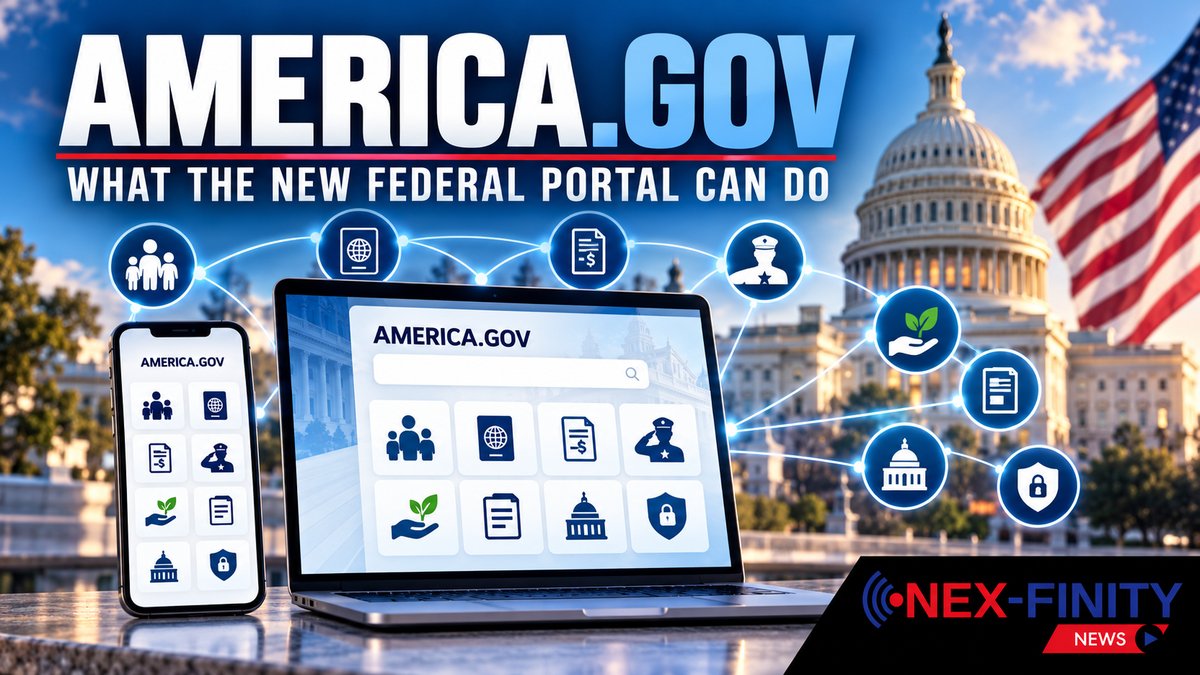
The federal government opened a new front door on Sept. 29, 2026. America.gov is an AI-assisted portal meant to replace the hunt across agency websites with a single place to ask a question and, eventually, finish the task.
Two of the most common reasons Americans deal with Washington are getting a passport and updating their name after a marriage, divorce or court order. Both were featured prominently at the launch.
This article explains what America.gov can do for those tasks today, what the administration says is coming, and the other services the site covers. The short answer: the guidance is live now, while the ability to actually file is still months to more than a year away.
Background
President Donald Trump unveiled America.gov at the Andrew W. Mellon Auditorium in Washington and signed an executive order the same day, according to the White House photo gallery of the event.
The site is operated by the General Services Administration (GSA) and was built by the National Design Studio, a White House design and technology team led by U.S. Chief Design Officer Joe Gebbia, a co-founder of Airbnb, Axios reported. The studio was created by executive order in August 2025.
According to the site, America.gov draws on content from more than 29,000 federal websites. Gebbia said the AI features are powered by Google’s Gemini and xAI’s Grok, per Axios, citing The Wall Street Journal and CNBC.
In simple terms: America.gov is a chatbot that has read the government’s public websites and answers questions in plain English, with links back to the official pages.
What the Executive Order Requires
The order, titled “Streamlining Access to Government Services Through America.gov,” designates the site as the single point of entry for federal services online, according to the text of the order and the White House fact sheet.
Its main provisions:
- Covered services. Public-facing federal services that serve more than 100,000 users in a 12-month period and can be accessed or applied for online must integrate with America.gov (Section 3). IRS tax filing and services provided by the Department of War and the intelligence community are excluded. OMB may add or exclude services by memorandum.
- Login.gov. GSA’s existing sign-in and identity-verification service becomes the authentication system for America.gov (Section 4).
- OMB guidance. The Office of Management and Budget has 90 days, until about Dec. 28, 2026, to issue implementation guidance. Agencies must then identify their covered services, connect them and report usage data (Section 5).
- Agencies keep their authority. Agencies retain custody of their records, their systems and their authority to decide cases. The order states that unifying access must not create a centralized federal system of records on Americans (Section 2(c)). America.gov is a front end, not a new agency.
The order also preserves existing phone, mail, in-person and agency-website channels, so that America.gov is a better option but not the only option (Section 2(f)).
In simple terms: the order tells agencies to plug their biggest online services into one site. It does not change who decides your application.
Passports: What Works Now and What’s Coming
Today, America.gov answers passport questions and points users to the State Department. It does not yet accept applications. You do not need an account to ask a question, Axios reported.
What’s promised. At the launch, Secretary of State Marco Rubio demonstrated a passport application inside America.gov. Users would sign in through Login.gov, upload a photo, pay online and receive status updates (WPDE).
The timeline depends on who is speaking:
| Source | Stated timeline |
| White House fact sheet | Passport renewal “later this year” (2026) |
| Secretary Rubio, per Government Executive | Goal: “vast majority” of Americans can apply by end of 2027 |
| America.gov’s own feature tiles, per The Register | Passport application listed as coming in 2027 |
The statements may describe a phased rollout, with renewals starting first and broad availability later. The White House has not published a schedule that reconciles them.
What to do in the meantime. The State Department already offers online renewal at its own site for adults 25 and older who are not changing personal information, are not traveling for at least six weeks and are in a U.S. state or territory. The department warns that its own portal is the only authorized place to renew online and that other sites may be fraudulent.
That warning matters now. A new, heavily publicized government portal is a predictable target for look-alike sites charging “processing fees.” The real address ends in .gov.
Name Changes: The Feature With the Most to Gain
Changing a legal name is one of the clearest cases for a single portal. A newlywed or recently divorced person typically has to notify several separate agencies, each with its own form and proof requirements.
USA.gov’s name-change guide lists the agencies to notify with certified copies of the change: the Social Security Administration, the State Department for a passport, USCIS for naturalized citizens’ certificates, and the state motor vehicle office.
Today, America.gov can walk a user through that checklist in plain language. “Updating your legal name across multiple agencies” appears on the site as a planned feature, but The Register found that clicking it, along with the other transaction tiles, shows only that it is coming in 2027.
At the launch, Trump described the goal directly: a user would ask America.gov, and it would fill out the forms, track the progress and mail out a new Social Security card, passport and insurance card (Yahoo News).
The passport rules have not changed. Under current State Department rules, the path depends on timing:
| Your situation | What to file |
| Passport issued less than 1 year ago and name changed within that year | Form DS-5504; no fee in most cases; certified marriage certificate, divorce decree or court order |
| Passport older than 1 year, or name changed more than 1 year after issuance | Renewal by mail on Form DS-82 with the certified name-change document |
| Name changed by usage, with no court order or certificate | Apply in person on DS-11 with Form DS-60 and 3 public records showing 5+ years of use |
One point trips people up: the State Department’s online renewal system is not available if you are changing your name. Name changes still go by mail or in person.
In simple terms: America.gov can tell you which form you need today. It cannot yet file it for you, and it cannot replace the certified documents agencies require.
Other Benefits of the Site
Beyond passports and names, America.gov covers a wide range of everyday federal tasks. These work today as guidance; filing comes later as agencies connect.
- One search box for 29,000 sites. Users ask in plain language instead of guessing which agency owns a problem. The site says every answer comes from official government websites, with links to the original source (Axios).
- No account needed to ask. Questions can be asked anonymously. Login.gov is required only for future transactions.
- Voice and attachments. Users can speak a question or attach a document, and the site says more specific details produce better answers.
- Medicare. The site helps compare Medicare plans. CMS Administrator Mehmet Oz demonstrated a guided enrollment flow, and the White House lists Medicare enrollment alongside passport renewal as the first transactions (Government Executive).
- Everyday tasks. Replacing a Social Security card, changing an address with USPS, registering to vote, buying a national park pass and registering a business are among the covered topics.
- Jobs and recreation. Officials cited federal job searches and campsite reservations at national parks.
- Veterans and Social Security. Oz’s presentation showed Login.gov verification flowing to CMS, the Social Security Administration and the Department of Veterans Affairs, a planned link for veterans seeking benefits.
In simple terms: for now, America.gov is a better map of the government. The promise is that it becomes the place where the trip is completed.
Impact and Analysis
The time-savings claim. Officials framed America.gov as a way to give Americans back roughly 10 billion hours spent on government paperwork (Spectrum News). That figure tracks the government’s own estimate of the total federal paperwork burden, about 10.5 billion hours a year (American Action Forum).
The caveat: the Treasury Department, largely through tax forms, has historically accounted for most of that burden. IRS tax filing is excluded from the executive order. The hours America.gov can realistically recover are a smaller share than the headline number suggests.
Accuracy. America.gov’s answers are AI-generated, and users may need to verify important information against the sources it cites. Axios reported that at launch the site said Joe Biden won the 2020 election, contradicting the president, before it began declining some political questions. The site also declines to give financial, tax or legal advice.
For passports and name changes, a wrong answer has real costs: a rejected application, a lost fee or a missed trip. Checking the linked State Department page before filing remains the safe practice.
Privacy. The site’s privacy policy says its AI partners operate under zero-data-retention agreements, meaning prompts are not stored, sold or used for training, The Register reported. The White House told The Register that no user messages reach Gemini or Grok. The same policy says providers may receive approximate location data, which The Register noted appears to conflict with that statement.
Once transactions go live, Login.gov becomes the gatekeeper. According to GSA’s March 2026 Login.gov Privacy Impact Assessment, Login.gov checks identity against driver’s license data through AAMVA, passport data through the State Department, and two private vendors, LexisNexis and Socure. The assessment says the vendors may retain verification data for up to one year for fraud investigations, and that third-party scripts collect device information and behavioral signals, such as keyboard and mouse patterns, during verification. Readers who follow this publication’s surveillance coverage will recognize the question: one front door also means one concentrated record of how citizens interact with their government.
Enforceability. Section 6 of the order states that it creates no enforceable rights and is subject to the availability of appropriations. Its privacy commitments, including the bar on a centralized system of records, are policy statements rather than rights a user can enforce in court. Integration deadlines depend on OMB guidance not yet issued and on agency budgets.
Conclusion
America.gov’s launch delivered a working guide and an ambitious promise. For passports and name changes, the guide is useful now: it can tell a reader which form applies, what documents to gather and where to file.
The promise, a portal that files the forms, tracks them and updates every agency at once, depends on OMB guidance due within 90 days, agency integration work and funding. Official timelines range from late 2026 to the end of 2027.
Until then, the State Department’s own site remains the place to renew or change a passport. Americans who use America.gov should treat it as a starting point and confirm details against the official page it links.
Key Takeaways
- America.gov launched Sept. 29, 2026, as an AI-assisted front door to more than 29,000 federal websites, run by GSA and built by the National Design Studio.
- Today it answers questions and links to agencies. It does not yet accept passport applications or process name changes.
- Passport transactions are promised “later this year” by the White House; the State Department’s goal is broad availability by the end of 2027.
- Multi-agency name updates are listed as a 2027 feature. Current passport name-change rules, including the mail or in-person requirement, still apply.
- Answers are AI-generated. Verify against the linked official source, and use only .gov addresses.
- Transactions will require Login.gov identity verification, which relies on driver’s license, passport and private-vendor data.
Related coverage: The Right to Privacy Was Never Written Into the Constitution
Sources
- White House fact sheet: America.gov
- Executive order: Streamlining Access to Government Services Through America.gov
- White House gallery: America.gov launch event
- State Department: Change or Correct a Passport
- State Department: Renew Your Passport Online
- USA.gov: How to change your name
- Axios: Everything to know about America.gov
- The Register: Trump launches America.gov with AI chatbots at its core
- Government Executive: White House launches America.gov
- GSA: Login.gov Privacy Impact Assessment (March 2026)
- Yahoo News: Trump unveils America.gov
- WPDE: America.gov launches
- Spectrum News: Trump administration launches America.gov
- American Action Forum: Paperwork burden